Key Mezzo Level Social Work Interventions, Examples, and Roles
Picture a camera with a zoom lens. Zoom all the way in and you see one person: their history, their strengths, their next step. Zoom all the way out and you see the whole landscape: laws, funding streams, and the policies that shape thousands of lives at once.
Now stop somewhere in the middle. Suddenly you can see the whole room. The family around the kitchen table. The support group that meets on Tuesday nights. The care team trying to coordinate five agencies. The neighborhood association, the school, the workplace.
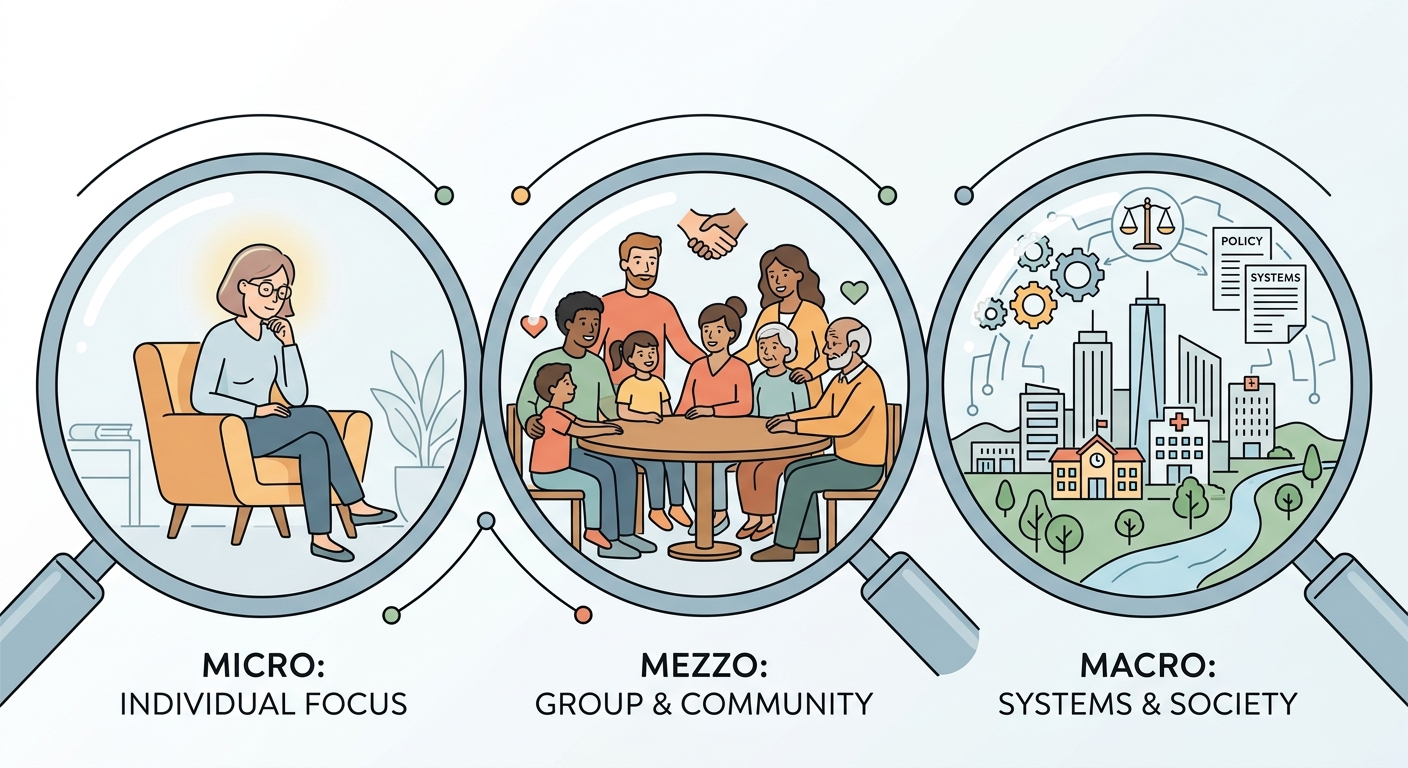
That middle setting is mezzo level social work, and it’s where a surprising amount of real change happens.
If you’re a social worker curious about making the move, or you’ve just landed in a mezzo role and want your footing, this guide covers what mezzo practice is, how it differs from micro and macro work, what the day-to-day looks like, and how to get started.
Let’s get started
Watch this video:
or
read the guide below.
One Problem, Three Lenses
The easiest way to understand the three levels of social work practice is to watch them tackle the same problem. Take housing instability in a single community.
- Micro: You work one-on-one with a client who is facing eviction. You assess their situation, connect them with emergency rental assistance, and build a plan with them.
- Mezzo: You notice that a dozen families in the same apartment complex are in the same position. You start a tenant support group, coordinate with the property manager and local legal aid, and help residents organize around shared concerns.
- Macro: You work to change the conditions behind the pattern: advocating for tenant protection policies, shaping local housing funding, or running a community-wide research effort on eviction rates.
Same issue, three vantage points. They work best when they feed each other, and mezzo is often the link that makes that happen.
💡All-in-one Case Management Software.
Everything in one place: clients, notes, forms, appointments, reports, and outcomes.
👉 Try it Free - No credit card needed
What Is Mezzo Level Social Work?
Mezzo social work focuses on small to mid-sized groups and the systems immediately around individuals. Where micro practice centers on the individual and macro practice targets large-scale systems, mezzo practice works with:
- Families and households, including family systems work and family group conferencing
- Therapeutic and support groups, such as grief groups, recovery groups, and parenting groups
- Organizations and teams, including schools, agencies, hospitals, and workplaces
- Neighborhoods and local communities, including resident groups, community programs, and local coalitions
The core idea is that people don’t live in isolation. They live inside groups and institutions that shape their options, their relationships, and their wellbeing. Mezzo practice works on those in-between structures.
👉 Try it Free - Free Case Management System
Micro vs. Mezzo vs. Macro at a Glance
| Settings | Activities | |
| Micro social work Individual / small family | Clinics, hospitals, private practice, child welfare, school counseling | Assessment, counseling, case management, crisis intervention, referrals |
| Mezzo social work Group, family, org, local community | Schools, community centers, nonprofits, treatment programs, healthcare teams, neighborhood initiatives | Group facilitation, program coordination, family mediation, team and agency collaboration, community engagement |
| Macro social work Large system, populations, policy | Government agencies, advocacy organizations, research institutions, large nonprofits | Policy analysis, legislative advocacy, program evaluation, community organizing at scale, grant strategy |
In practice the lines blur. A school social worker might counsel a student (micro), run a peer support group (mezzo), and sit on a district committee about attendance policy (macro) in the same week.
All-in-One Case Management Software
Sign Up Today, Free
No credit card needed!
Do You Have a Team? | ||
Our best all-in-one client and top case management software simplifies everything from client intake and assessments to programs, projects, goals tracking, planning, scheduling, documentation, reporting dashboard, and progress tracking.
What Mezzo Practice Looks Like Day to Day
Mezzo roles vary a lot by setting, but here are some common examples.
- Running groups. A mental health center social worker leads a weekly anxiety skills group. A hospital social worker facilitates a caregiver support circle. A school social worker runs a lunchtime group for students navigating a transition. In each case you’re managing group dynamics as much as content.
- Working with families. You help a family renegotiate roles after a major change, mediate a conflict, or join a family team meeting to align everyone around a care plan. The family is your client, not just one person in it.
- Coordinating teams and organizations. You facilitate case conferences, bridge gaps between agencies, or help a team improve how it communicates. This is often invisible work, and it’s the reason clients don’t fall through cracks between services.
- Building and running programs. You design a community workshop series, launch a peer mentoring program, or organize a resource fair. You’re thinking about participants, partners, logistics, and outcomes all at once.
- Engaging communities. You attend neighborhood meetings, build relationships with local leaders, and help residents identify what they want to change and how.

The Skills That Matter Most
If you already have micro experience, you have a foundation. Here’s what tends to separate comfortable mezzo practitioners from those still finding their rhythm.
- Group facilitation. Setting the tone, managing airtime, redirecting gently, and holding space for disagreement without losing the room.
- Systems thinking. Seeing how a family, team, or organization functions as a whole, including its unwritten rules, power dynamics, and communication patterns.
- Mediation and conflict navigation. Helping people with competing needs reach workable agreements.
- Program planning and evaluation. Defining goals, measuring whether a group or initiative is working, and adjusting.
- Collaboration and communication. Working across agencies, disciplines, and sometimes very different professional cultures.
- Cultural humility. Groups hold a lot of different identities and lived experiences at once. Staying curious and open is what keeps a group safe and useful for everyone in it.
Making the Move: Getting Into Mezzo Work
There isn’t a single entry point, but these steps help.

Start where you are
Look for mezzo opportunities inside your current role. Offer to co-facilitate a group, join a care team, or help organize a community event. This builds experience and shows you what you enjoy.
Learn the formal tools
Group work models, family systems theory, and community assessment methods are all worth studying. Continuing education on group facilitation or family therapy can strengthen your résumé and your confidence.
Look for the right titles
Mezzo work often appears under titles like program coordinator, group facilitator, family services worker, community outreach specialist, school social worker, or care coordinator. Read job descriptions for the activities, not just the title.
Find a mentor
Someone who has run groups or led community programs can save you from many first-year mistakes.
👉 Try this Case Management Software free today
No credit card needed
Your First 90 Days in a Mezzo Role
If you’ve just stepped into a mezzo position, here’s a practical roadmap.
- Days 1 to 30: Listen and map. Learn the landscape before you try to change it. Who are the stakeholders? What groups already exist? What do families, colleagues, and partner organizations say is working and what isn’t? Sit in on existing groups and meetings before you lead anything.
- Days 31 to 60: Build relationships and small wins. Trust is the currency of mezzo work. Connect with partner agencies, community members, and colleagues. Pick one manageable project, such as co-leading a group session or tightening up a referral handoff, and do it well.
- Days 61 to 90: Start shaping. With context and credibility in hand, you can propose improvements: a new group format, a better coordination process, or a simple way to track outcomes. Come with observations from your first two months and invite input.
Throughout, take notes on what you learn about each group’s culture. It will pay off later.
💡All-in-one Case Management Software.
Everything in one place: clients, notes, forms, appointments, reports, and outcomes.
👉 Try it Free - No credit card needed
Why the Middle Matters
Micro practice changes lives one at a time. Macro practice changes the rules everyone plays by. Mezzo practice sits between them and does something neither can do alone: it builds the relationships, groups, and local structures that make both individual change and systemic change possible.
If you’re drawn to bringing people together, strengthening the networks around them, and seeing change happen at a human scale, mezzo social work may be the setting where you do your best work.
Key Takeaways
- Mezzo social work focuses on groups, families, organizations, and local communities.
- It sits between micro (individuals) and macro (large systems and policy), and the three levels reinforce each other.
- Core skills include group facilitation, systems thinking, mediation, program planning, and cultural humility.
- You can build mezzo experience from your current role before making a full transition.
- The first 90 days in a mezzo role are about listening, relationship-building, and small wins.
- Strong, secure documentation practices matter just as much in group and family work as they do in one-on-one practice.
👉 Try it Free today - No credit card needed
Mezzo Social Work Frequently Asked Questions
What is mezzo level social work?
Mezzo level social work focuses on small to mid-sized groups and the systems around individuals, including families, support groups, organizations, and local communities. It sits between micro practice (individuals) and macro practice (large systems and policy).
What is the difference between micro, mezzo, and macro social work?
Micro social work helps individuals, mezzo social work works with groups, families, and organizations, and macro social work targets large-scale systems and policy. A quick way to remember it: micro helps a person, mezzo helps the people around them, and macro helps the system they all live in.
What are some examples of mezzo social work?
Common examples include leading a support or skills group, facilitating a family team meeting, coordinating a case conference across agencies, running a peer mentoring program, and organizing community workshops or neighborhood initiatives.
What skills do mezzo social workers need?
The most important skills are group facilitation, systems thinking, mediation and conflict navigation, program planning and evaluation, cross-agency collaboration, and cultural humility. If you have micro experience, you already have a strong foundation to build on.
How do I transition from micro to mezzo social work?
Start by finding mezzo opportunities in your current role, such as co-facilitating a group or joining a care team. Then study group work and family systems models, look for roles like program coordinator or family services worker, and find a mentor who has led groups or community programs.
How can case management software help with mezzo social work?
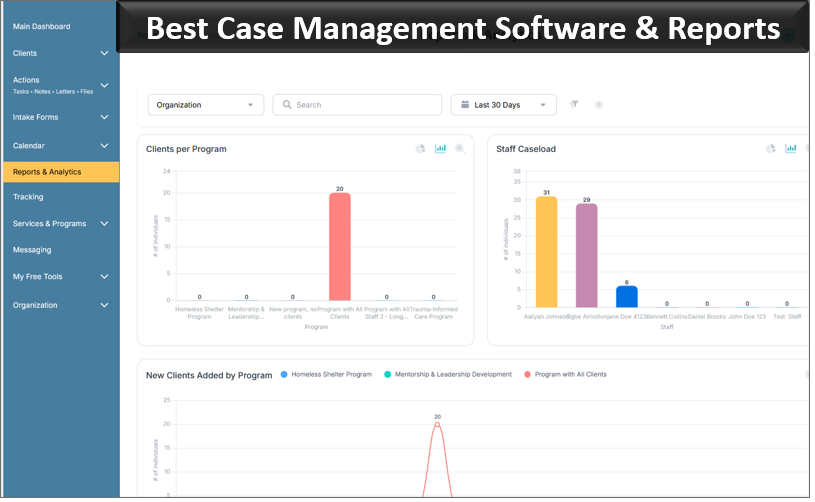
Group and family work doesn’t fit neatly into one-person-one-note formats. Case Management Hub software with flexible documentation, role-based access, shared care plans, and outcome tracking helps you record group-level work, protect confidentiality, and coordinate with partners.
👉 Try it free today - No credit card needed
Note: Content on this website (socialworkportal.com) is copyrighted and protected under applicable copyright laws. Unauthorized reproduction, distribution, or use of any content from the website, without explicit written permission, is strictly prohibited. Read: Terms of Use.
Social Work Portal Disclaimer: Social Work Portal is not a social work agency and we do not refer social workers. This web site is provided for educational and informational purposes only and does not constitute providing medical advice or professional social and healthcare services. The information provided should not be used for diagnosing or treating a health problem or disease, and those seeking personal medical advice should consult with ... Read our full disclaimer here: Social Work Portal Disclaimer.