A Simple Guide for Working with GAD Assessments, Scores and Next Steps
Anxiety is something everyone experiences from time to time. But when worry becomes constant, hard to control, and starts interfering with daily life, it may point to generalized anxiety disorder, or GAD. For social workers, clinicians, and mental health professionals, understanding what GAD actually is comes first. Knowing which assessment tools to use to screen for it and track it over time comes next.
This article walks through both halves of that picture: what generalized anxiety disorder is and how it’s diagnosed, then a tour of the assessment tools used to screen for and measure it, including the GAD-7, GAD-2, and a few others worth knowing.
What you’ll learn:
- What generalized anxiety disorder is and how it differs from everyday worry
- The clinical criteria used to diagnose GAD
- How the GAD-7 questionnaire works and how GAD-7 scoring is calculated
- The difference between GAD-2 and GAD-7
- Other assessment tools clinicians use alongside or instead of the GAD-7
- How digital intake tools support this workflow in practice
Let’s get started
Watch this video:
or
read the guide below.
What Is Generalized Anxiety Disorder?
Generalized anxiety disorder is a mental health condition marked by persistent, excessive worry about a wide range of everyday concerns, work, health, finances, relationships, that’s difficult to control and lasts most days for six months or longer. It’s one of the most common anxiety disorders, and it often coexists with depression, panic disorder, or other anxiety-related conditions, which is part of what makes it tricky to identify without a structured approach.
The distinction that matters most in practice is between normal worry and clinical GAD. Nearly everyone worries about a deadline or a doctor’s appointment. GAD is different in scale and persistence. The worry is disproportionate to the actual likelihood or impact of the thing being worried about, it’s hard to shut off once it starts, and it typically comes paired with physical symptoms like muscle tension, fatigue, irritability, sleep disturbance, or trouble concentrating.
💡All-in-one Case Management Software.
Everything in one place: clients, notes, forms, appointments, reports, and outcomes.
👉 Try it Free - No credit card needed
What Are the Diagnostic Criteria for Generalized Anxiety Disorder?
Clinicians use the criteria outlined in the DSM-5 to diagnose GAD. Broadly, this requires:
- Excessive anxiety and worry occurring more days than not for at least six months, about multiple events or activities
- Difficulty controlling the worry
- At least three of the following symptoms in adults: restlessness, fatigue, difficulty concentrating, irritability, muscle tension, or sleep disturbance
- Symptoms that cause significant distress or impairment in daily functioning
- Symptoms not better explained by another condition or substance
No blood test or scan confirms GAD. Diagnosis relies on clinical interviews combined with standardized questionnaires, which is exactly where GAD assessment tools like the GAD-7 come in. They don’t replace clinical judgment, but they give it structure and a way to track change over time.
👉 Try it Free - Free Case Management System
What Is the GAD-7 Questionnaire?
The GAD-7 is the most widely used tool for screening and measuring the severity of generalized anxiety disorder. It’s a seven-item, self-report questionnaire where clients rate how often they’ve experienced core anxiety symptoms, feeling on edge, uncontrollable worry, restlessness, irritability, over the past two weeks.
Each item maps closely to the DSM criteria for GAD, which is part of why it’s held up so well since publication. It takes most people two to three minutes to complete, needs no special training to administer, and produces a score that’s easy to track across sessions, making it a practical fit for busy caseloads and intake workflows alike.
All-in-One Case Management Software
Sign Up Today, Free
No credit card needed!
Do You Have a Team? | ||
Our best all-in-one client and top case management software simplifies everything from client intake and assessments to programs, projects, goals tracking, planning, scheduling, documentation, reporting dashboard, and progress tracking.
How Does GAD-7 Scoring Work?
GAD-7 scoring is simple by design. Each of the seven items is rated from 0 to 3:
| Frequency | Points |
| Not at all | 0 |
| Several days | 1 |
| More than half the days | 2 |
| Nearly every day | 3 |
Total scores range from 0 to 21 and fall into four severity bands:
- 0 to 4: Minimal anxiety
- 5 to 9: Mild anxiety
- 10 to 14: Moderate anxiety
- 15 to 21: Severe anxiety
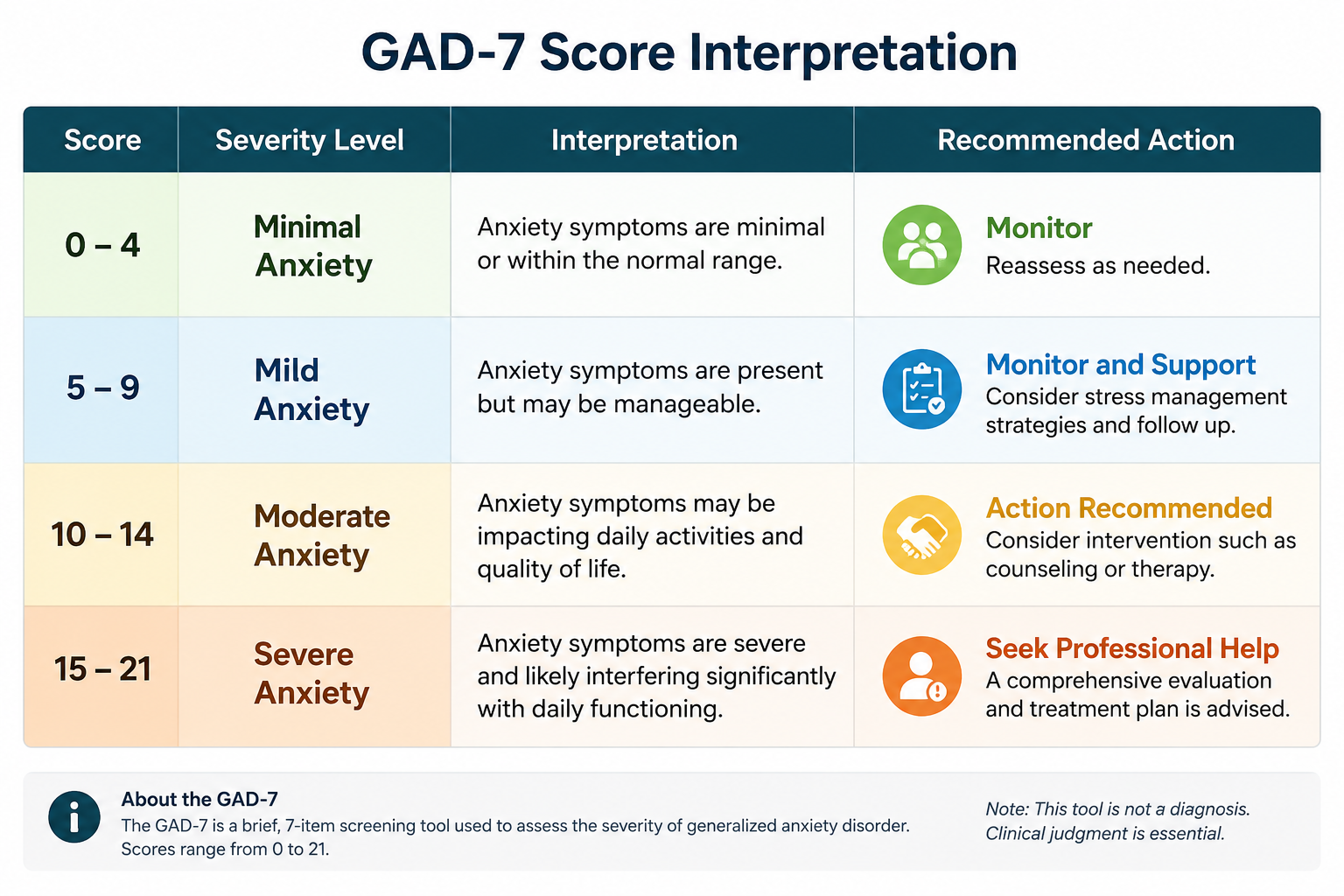
A score of 10 or higher is the standard threshold for flagging further evaluation. That cutoff isn’t arbitrary. In the original GAD-7 validation study, a score of 10 correctly identified 89% of patients who had generalized anxiety disorder and correctly ruled it out in 82% of those who didn’t (Spitzer et al., 2006). Some clinicians use a lower cutoff of 8 when sensitivity matters more than specificity, particularly in settings where missing a case carries a higher cost than a false positive.

What Other GAD Assessment Tools Do Clinicians Use?
The GAD-7 is the most common tool, but it isn’t the only one. A few others show up regularly in clinical practice, sometimes as alternatives and sometimes alongside the GAD-7 for a fuller picture.
GAD-2. A two-item version using only the first two GAD-7 questions, scored 0 to 6. It’s used as a rapid initial screen. A score of 3 or higher on the GAD-2 typically prompts a full GAD-7. (Learn more about the GAD-2)
GAD-Q-IV. The Generalized Anxiety Disorder Questionnaire-IV is a self-report diagnostic measure built directly around DSM-IV criteria, using a mix of yes/no and scaled questions. It’s more diagnostic in structure than the GAD-7, though its flexible response format can make severity ratings less precise. (Learn more about the GAD-Q-IV)
Hamilton Anxiety Rating Scale (HAM-A). Developed by Max Hamilton in 1959, this is a 14-item, clinician-administered scale that evaluates both psychological and physical symptoms of anxiety. Unlike the GAD-7, it isn’t specific to GAD, it measures anxiety broadly, which makes it useful when a clinician wants a more comprehensive symptom picture rather than a GAD-specific score. (Learn more about the HAM-A)
Penn State Worry Questionnaire (PSWQ). A 16-item self-report tool focused specifically on the frequency, excessiveness, and uncontrollability of worry, the core cognitive feature of GAD. It’s often used in research settings or alongside the GAD-7 to capture the worry component in more depth. (Learn more about the PSWQ)
Here’s how the main tools compare at a glance:
| Tool | Items | Format | Best used for |
| GAD-7 | 7 | Self-report | Standard screening and severity tracking |
| GAD-2 | 2 | Self-report | Quick initial triage |
| GAD-Q-IV | Varies | Self-report | DSM-based diagnostic screening |
| HAM-A | 14 | Clinician-administered | Broad anxiety symptom severity |
| PSWQ | 16 | Self-report | Measuring pathological worry specifically |
🔥Still using spreadsheets for case management?
Switch to an all-in-one case management platform.
👉 Try it Free - No credit card needed
Which GAD Assessment Should You Use and When?
The right tool depends on the setting and the goal.
For fast triage during intake, the GAD-2 is efficient and low-burden, with the GAD-7 as the natural follow-up for anyone who screens positive.
For ongoing severity tracking across treatment, the GAD-7 remains the standard, largely because of its brevity, strong validation, and ease of repeated use without fatiguing the client.
For a more formal diagnostic lean, the GAD-Q-IV maps more directly onto DSM criteria, though it typically needs to be paired with clinical interview rather than used alone.
For a broader anxiety symptom picture, especially when anxiety may overlap with other conditions, the HAM-A gives clinicians more granularity, at the cost of requiring clinician administration rather than self-report.
For research or deeper work on worry specifically, the PSWQ adds detail the GAD-7 doesn’t capture on its own.
A few things worth keeping in mind regardless of which tool you choose: scores are a screening signal, not a diagnosis on their own; population fit matters, since not every tool is validated for adolescents or non-English-speaking clients; and consistency across staff and programs makes aggregated data far more useful for supervision, treatment planning, and funder reporting.
👉 Try this Case Management Software free today
No credit card needed
How Do Social Workers and Agencies Put GAD Assessments Into Practice?
For an individual clinician, a GAD assessment supports one treatment plan. For an agency or nonprofit managing a full caseload, the value compounds. Aggregated scores across clients can show whether an intervention is working at a program level, support outcome reporting for funders, and flag when a client’s trajectory needs a second look.
That’s often where the administrative load gets heavy. Paper forms get misplaced, spreadsheets don’t connect to case notes, and a score entered in one session doesn’t automatically link back to the goals set months earlier.
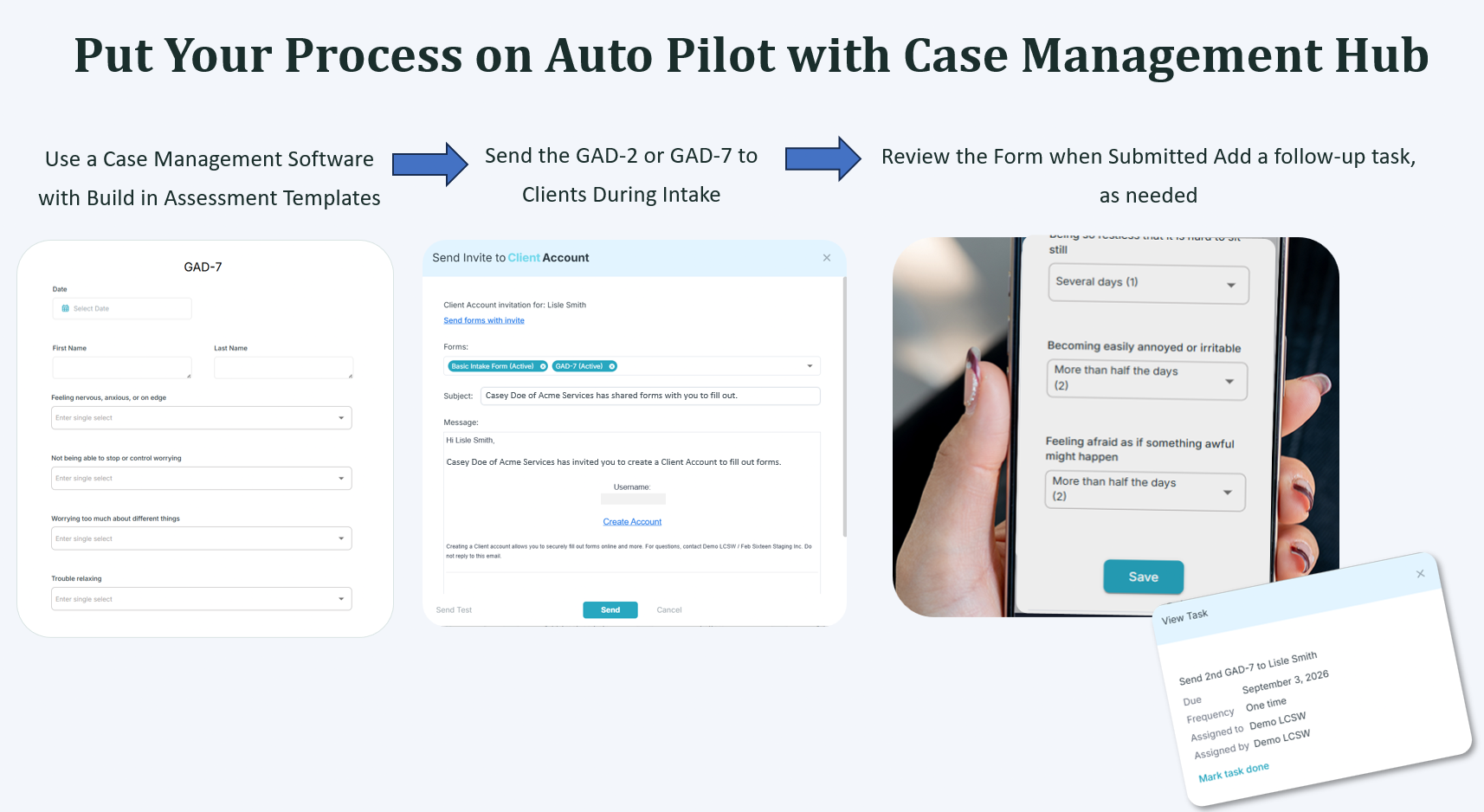
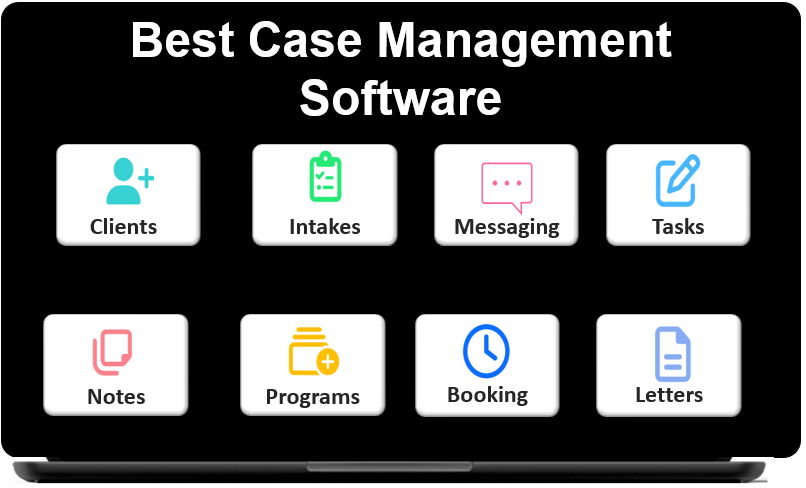
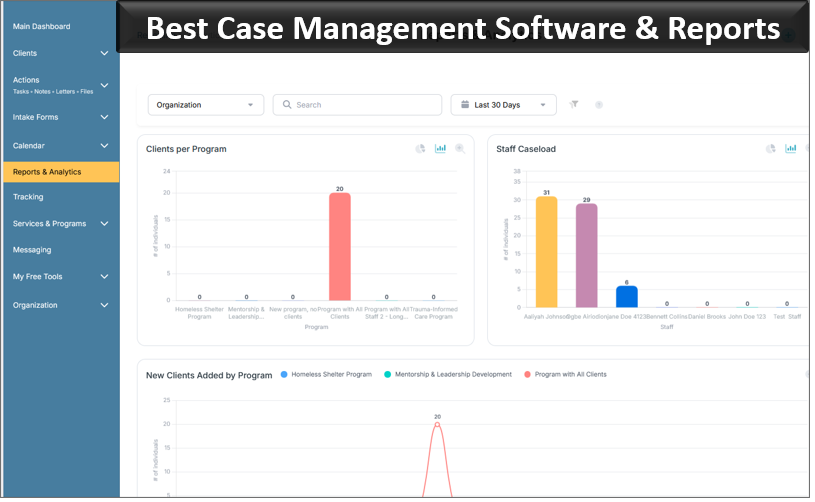
This is the kind of workflow gap a dedicated social work case management software is built to close. Platforms like Case Management Hub let teams build GAD-7 and other standardized assessments as digital intake forms, track scores alongside client goals and progress notes, and pull reporting across a whole caseload without re-entering data by hand. For agencies balancing intake, scheduling, documentation, and funder reporting alongside clinical work, having assessments live inside the same system as everything else tends to save real time.
💡All-in-one Case Management Software.
Everything in one place: clients, notes, forms, appointments, reports, and outcomes.
👉 Try it Free - No credit card needed
Anxiety Assessment Tool Frequently Asked Questions
What is generalized anxiety disorder (GAD)?
GAD is a mental health condition characterized by persistent, excessive worry about multiple areas of life that's difficult to control and lasts most days for six months or longer, often accompanied by physical symptoms like fatigue, muscle tension, or sleep trouble.
What does a GAD-7 score of 15 mean?
A score of 15 falls in the severe anxiety range (15–21) and suggests significant symptom burden warranting prompt clinical evaluation, though the score alone shouldn't be used to diagnose without a fuller clinical interview.
How is generalized anxiety disorder diagnosed?
Diagnosis relies on clinical interviews assessing DSM-5 criteria, often supported by standardized questionnaires like the GAD-7, GAD-Q-IV, or HAM-A, rather than any single lab test or scan.
What's the difference between GAD-2 and GAD-7?
The GAD-2 uses two items as a rapid initial screen, while the full GAD-7 uses seven items for a more complete severity assessment. A GAD-2 score of 3 or higher typically prompts a follow-up GAD-7.
Is the GAD-7 the only tool used to assess generalized anxiety disorder?
No. While the GAD-7 is the most widely used, other tools like the GAD-Q-IV, Hamilton Anxiety Rating Scale, and Penn State Worry Questionnaire are also used, depending on whether the goal is quick screening, diagnostic alignment, or a deeper look at specific symptoms like worry.
Can a low GAD-7 score rule out generalized anxiety disorder?
Not definitively. Self-report tools can miss cases where a client underreports symptoms due to stigma or limited insight, so clinical judgment should always accompany the score.
👉 Try it free today - No credit card needed
Note: Content on this website (socialworkportal.com) is copyrighted and protected under applicable copyright laws. Unauthorized reproduction, distribution, or use of any content from the website, without explicit written permission, is strictly prohibited. Read: Terms of Use.
Social Work Portal Disclaimer: Social Work Portal is not a social work agency and we do not refer social workers. This web site is provided for educational and informational purposes only and does not constitute providing medical advice or professional social and healthcare services. The information provided should not be used for diagnosing or treating a health problem or disease, and those seeking personal medical advice should consult with ... Read our full disclaimer here: Social Work Portal Disclaimer.