Proven Strategies for Social Workers to Cope with Burnout and Compassion Fatigue
Most social workers can remember the moment they knew something had shifted in how they feel about their work. Maybe it was dreading a call from a client you usually enjoy. Maybe it was sitting in the parking lot for ten minutes before heading in or noticing that a case that once kept you awake at night barely registered.
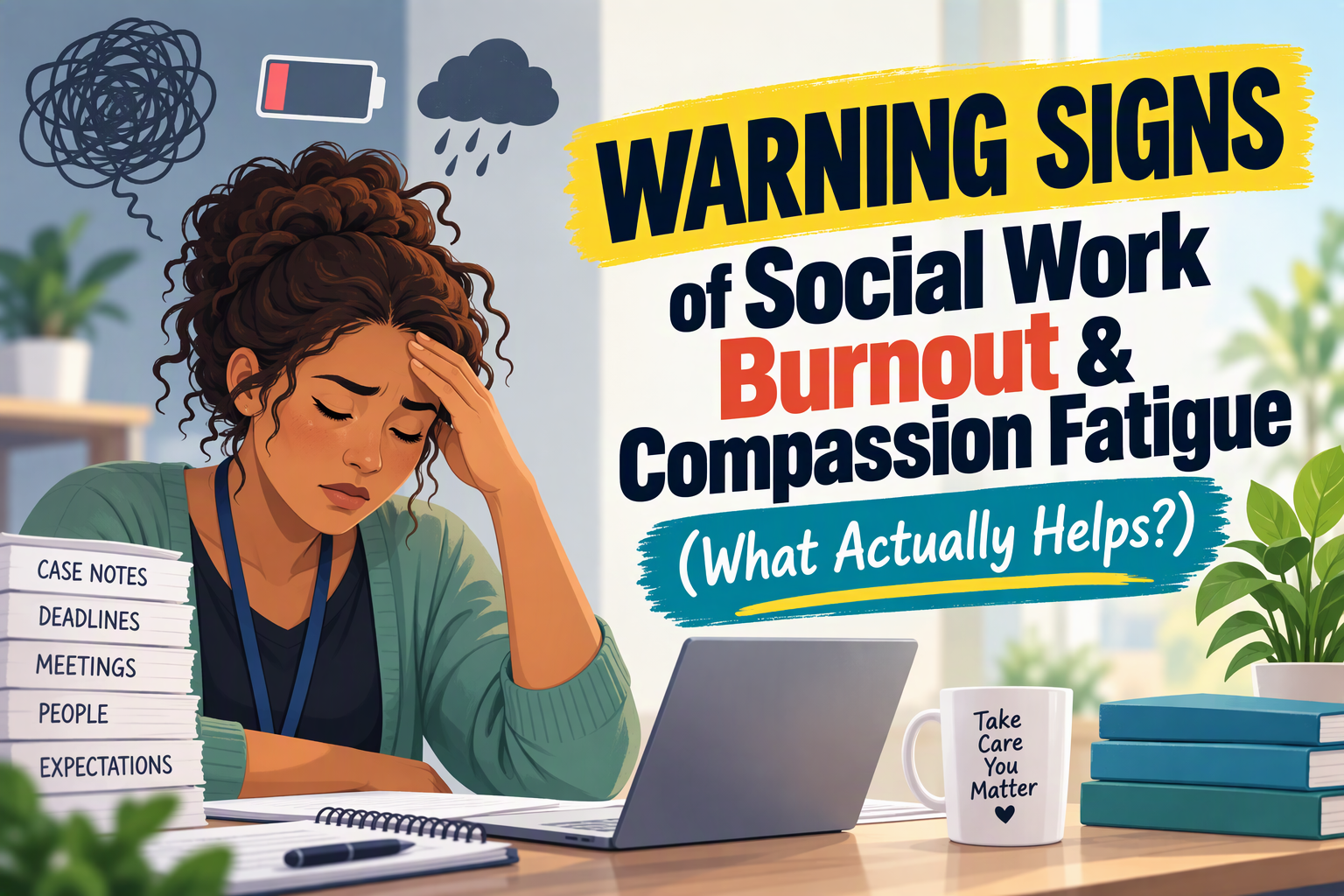
Social work burnout and compassion fatigue are common in helping professions, and neither one means you chose the wrong career. They are predictable responses to sustained emotional demand and heavy workloads.
This guide covers how to recognize the warning signs of compassion fatigue and social work burnout, how the two conditions differ, and what to do that actually helps. By the end, you should have several helpful tools to get you back in the right frame of mind.
Let’s get started
Watch this video:
or
read the guide below.
What Is Social Work Burnout?
Burnout is a reaction to chronic workplace stress that has not been successfully managed. The World Health Organization classifies it as an occupational phenomenon, not a medical condition. Christina Maslach, whose research shaped how burnout is measured, describes three parts:
- Emotional exhaustion
- Cynicism or detachment toward the work and the people in it
- A shrinking sense of accomplishment
In social work, burnout usually builds from the conditions of the job. Large caseloads, heavy documentation, limited community resources, and little control over outcomes wear people down over months or years. Because the roots are largely organizational, burnout is rarely fixed by willpower alone.
💡All-in-one Case Management Software.
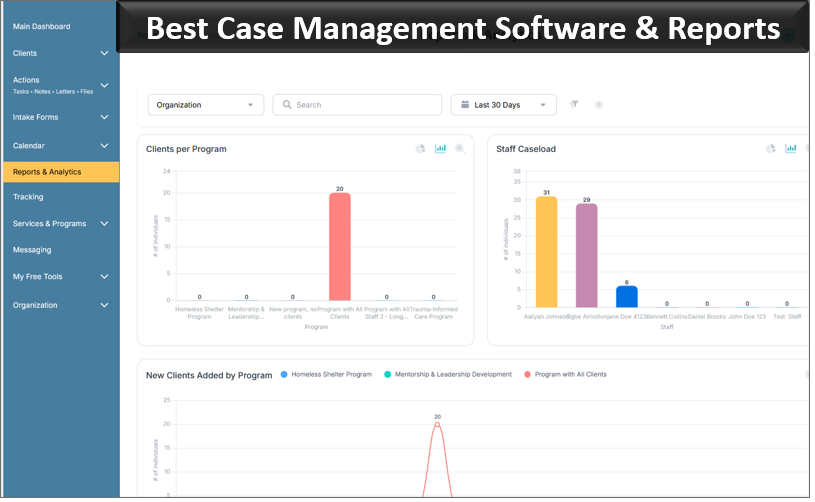
Everything in one place: clients, notes, forms, appointments, reports, and outcomes.
👉 Try it Free - No credit card needed
What Is Compassion Fatigue in Social Work?
Compassion fatigue is the emotional and physical toll of caring for people who are suffering. Charles Figley, a pioneer in the study of traumatic stress, called it the cost of caring. It tends to affect the most empathic, engaged people in the field, which is why it often catches them off guard.
Compassion fatigue includes secondary traumatic stress, a set of symptoms that resemble post-traumatic stress disorder (PTSD) and develop after repeated exposure to clients’ trauma. These can include intrusive thoughts about a client’s story, hypervigilance, avoidance, and trouble sleeping. Unlike burnout, compassion fatigue can show up quickly after a particularly hard case.

👉 Try it Free - Free Case Management System
How Are Burnout, Compassion Fatigue, and Vicarious Trauma Different?
The terms are often used interchangeably, but they point to different causes.
- Burnout comes from workplace conditions and builds gradually.
- Compassion fatigue comes from ongoing exposure to other people’s suffering and can arrive suddenly.
- Vicarious trauma is a lasting change in how you see the world, such as your sense of safety, trust, or control, after absorbing clients’ traumatic experiences.
They often overlap. A social worker with a crushing caseload can have burnout and compassion fatigue at the same time, and telling them apart matters because the remedies differ. Burnout calls for changes to workload and support. Compassion fatigue and vicarious trauma call for processing, supervision, and recovery.
All-in-One Case Management Software
Sign Up Today, Free
No credit card needed!
Do You Have a Team? | ||
Our best all-in-one client and top case management software simplifies everything from client intake and assessments to programs, projects, goals tracking, planning, scheduling, documentation, reporting dashboard, and progress tracking.
What Are the Warning Signs of Burnout and Compassion Fatigue?
Signs tend to cluster in a few areas. Two or three that persist for several weeks are worth taking seriously.
Emotional signs
- Feeling numb, irritable, or hopeless about work
- Cynicism toward clients, colleagues, or the system
- Dread before shifts or sessions
- Intrusive thoughts or images from client cases
Physical signs
- Constant tiredness that rest does not fix
- Headaches, stomach trouble, or frequent illness
- Trouble sleeping or nightmares

Behavioral and professional signs
- Withdrawing from coworkers or avoiding certain clients
- Missing deadlines or falling behind on documentation
- More sick days or thoughts of leaving the field
- Feeling that nothing you do makes a difference
Personal signs
- Less interest in hobbies and relationships
- Difficulty leaving work at work
- Relying more on alcohol, food, or screens to decompress



Why Are Social Workers Especially at Risk?
Several features of the work combine. Social workers carry heavy caseloads while holding stories of abuse, neglect, poverty, illness, and loss. Resources are often scarce, so they cannot always give clients what they need, which creates moral distress. Documentation, social work processes, and compliance tasks eat into time that could go to direct care or recovery. And the people drawn to the profession tend to be highly empathic, a strength that also increases exposure.
What Actually Helps Social Workers Recover?
Recovery works best when it happens on several levels at once.
Protect your boundaries and recovery time.
Build an end-of-day ritual, use your leave, and keep time for sleep, movement, and people outside work. Small, consistent habits beat occasional big gestures.
Use supervision and peer support.
Regular reflective supervision and trusted peer consultation give you a place to process hard cases before they pile up. Talking with colleagues who understand the work reduces the feeling of carrying everything alone.
Reconnect with meaning.
Researchers call the satisfaction that comes from doing the work well compassion satisfaction, and it acts as a buffer. Notice client progress, keep a folder of thank-you notes, or return to the reason you entered the field.
Measure where you are.
The Professional Quality of Life Scale (ProQOL) is a free, widely used self-assessment covering compassion satisfaction, burnout, and secondary traumatic stress. It gives you a baseline and a way to track change.
Get professional support when symptoms persist.
If symptoms last, interfere with daily life, or include thoughts of harming yourself, talk with a licensed mental health professional. Many counties and municipalities have helplines that people can call to get immediate support.
Self-care matters, but it cannot make up for an unsustainable workload. If the job itself is the main driver, raising that with your supervisor is part of the solution.
🔥Still using spreadsheets for case management?
Switch to an all-in-one case management platform.
👉 Try it Free - No credit card needed
How Can Supervisors and Organizations Help?
Individual effort only goes so far when the system keeps producing the problem. Agencies can make a real difference by:
- Keeping caseloads manageable and being honest when they are not
- Offering trauma-informed, reflective supervision on a regular schedule
- Protecting time for documentation and breaks
- Normalizing conversations about stress so asking for help is not seen as weakness
- Providing training on secondary traumatic stress and vicarious trauma
- Reducing avoidable administrative work

👉 Try this Case Management Software free today
No credit card needed
Can Software Ease the Administrative Side of Burnout?
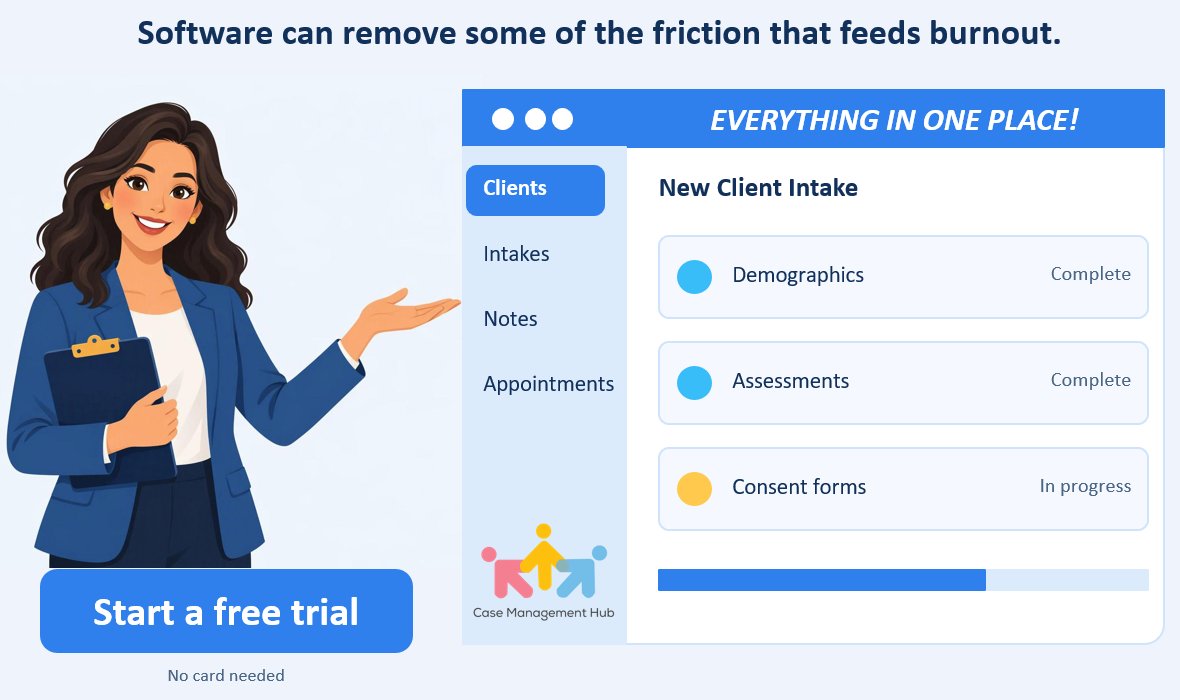
Software cannot cure burnout, but it can remove some of the friction that feeds it. Paperwork, scattered notes, repeated data entry, and chasing down records take hours that social workers would rather spend with clients or on their own recovery. A HIPAA-compliant case management platform like Case Management Hub brings intakes, progress notes, assessments, documentation, and billing into one place, so less of the day goes to administrative upkeep.
If you are looking for ways to lighten the load for yourself or your team, you can start a free trial and see how it fits your workflow.
What Questions Do Social Workers Ask About Burnout and Compassion Fatigue?
Is compassion fatigue the same as burnout?
No. Burnout grows out of chronic workplace stress, while compassion fatigue grows out of repeated exposure to other people's suffering. They often occur together, but they have different causes and call for different responses.
Can compassion fatigue go away?
Yes. With rest, support, and changes to workload or boundaries, most people recover. Symptoms that linger deserve attention from a licensed mental health professional.
How long does recovery take?
There is no fixed timeline. Mild symptoms may ease within weeks of consistent changes, while long-standing burnout can take months. Recovery tends to go faster when workplace conditions change too.
Should I quit social work because of burnout?
Not necessarily. Many people recover by changing their caseload, setting, population served, or support system rather than leaving the field. If you are weighing it, talk with a supervisor, mentor, or counselor first.
What is the Professional Quality of Life Scale?
The ProQOL is a free self-assessment that measures compassion satisfaction, burnout, and secondary traumatic stress in people who work in helping roles. You can find it here: https://proqol.org/proqol-measure
👉 Try it free today - No credit card needed
Note: Content on this website (socialworkportal.com) is copyrighted and protected under applicable copyright laws. Unauthorized reproduction, distribution, or use of any content from the website, without explicit written permission, is strictly prohibited. Read: Terms of Use.
Social Work Portal Disclaimer: Social Work Portal is not a social work agency and we do not refer social workers. This web site is provided for educational and informational purposes only and does not constitute providing medical advice or professional social and healthcare services. The information provided should not be used for diagnosing or treating a health problem or disease, and those seeking personal medical advice should consult with ... Read our full disclaimer here: Social Work Portal Disclaimer.