Discover the Best Processes for Social Work and How to Use Them
Social work runs on process. Behind every client interaction is a structured workflow that keeps services consistent, defensible, and genuinely useful to the people being served. Whether you’re a student social worker still learning the ropes or a seasoned clinician refining your approach, understanding the core social work processes, from intake through crisis response to documentation, makes the difference between scattered casework and a practice that holds up under scrutiny.
Learn the most important social work processes used across clinical, nonprofit, and human services settings, with real examples and the considerations you need to choose the right approach for your work.
What you’ll learn:
- The core stages of the social work case management process
- How the client intake process and assessment process work together
- What treatment planning and crisis intervention look like in practice
- How SOAP notes fit into broader documentation practices, with an example
- Key decision-making factors for choosing the right process for your setting
- How the right tools can simplify your workflow
Let’s get started
Watch this video:
or
read the guide below.
What Is the Social Work Case Management Process?
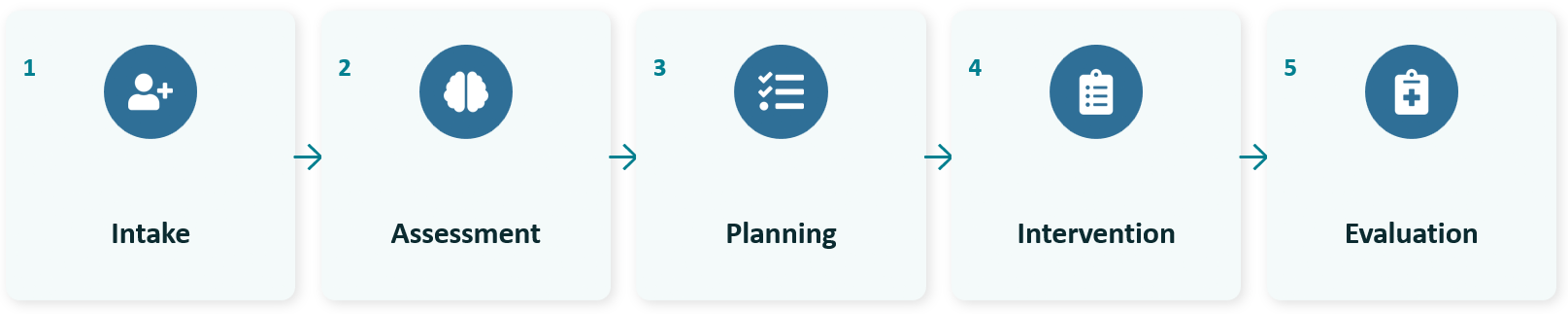
At its foundation, the social work case management process is a cycle, not a straight line. Most practitioners recognize five recurring stages: intake, assessment, planning, intervention, and evaluation. Each stage feeds into the next, and cases often loop back through earlier stages as client circumstances shift.
This case management process gives practitioners a shared framework, regardless of setting. A school social worker, a hospital discharge planner, and a nonprofit case manager are all moving through some version of this same cycle, even though their day-to-day work looks completely different.
💡All-in-one Case Management Software.
Everything in one place: clients, notes, forms, appointments, reports, and outcomes.
👉 Try it Free - No credit card needed
How Does the Client Intake Process Work in Social Work?
The client intake process in social work sets the tone for everything that follows. A thorough intake captures demographic information, presenting concerns, safety considerations, and consent, ideally through a digital intake form that reduces transcription errors and speeds up onboarding.
Good intake processes ask the right questions without overwhelming a client who may already be in distress. That means using structured forms with clear branching logic, only asking for sensitive details once, and making sure intake data flows directly into the client’s ongoing record rather than living in a separate system that staff have to re-enter later.
What Does the Social Work Assessment Process Involve?
Once intake is complete, the social work assessment process digs deeper, often incorporating tools like the biopsychosocial assessment or the biopsychosocial spiritual model to understand a client’s full context: physical health, mental health, relationships, environment, and spiritual or cultural factors.
Assessment is where practitioners move from “what is the client asking for” to “what is actually going on.” A strong assessment process is structured enough to be consistent across staff, but flexible enough to capture the nuance of an individual client’s situation. Standardized screening tools, such as the PHQ-9 for depression, often get layered into this stage to support clinical judgment with measurable data.
👉 Try it Free - Free Case Management System
How Does Treatment Planning Turn Assessment into Action?
Treatment planning translates assessment findings into concrete, measurable goals. A good treatment plan identifies specific, time-bound objectives, names the interventions that will be used, and assigns responsibility, whether that’s the client, the practitioner, or a referral partner.
Treatment plans work best when they’re revisited regularly rather than written once and filed away. Many agencies build in scheduled review points, often tied to the evaluation stage of the broader case management cycle, so goals get adjusted as circumstances change rather than staying static for months.
All-in-One Case Management Software
Sign Up Today, Free
No credit card needed!
Do You Have a Team? | ||
Our best all-in-one client and top case management software simplifies everything from client intake and assessments to programs, projects, goals tracking, planning, scheduling, documentation, reporting dashboard, and progress tracking.
What Is the Crisis Intervention Process in Social Work?
Not every case follows a calm, linear path. The crisis intervention process is a distinct social work process designed for moments of acute risk: suicidal ideation, domestic violence disclosures, child safety concerns, or sudden housing loss. This process typically moves through rapid assessment of immediate danger, stabilization, safety planning, and connection to emergency resources.
Crisis intervention differs from standard case management in pace and priority. Documentation still matters, but the immediate goal is safety, with full assessment and planning often picked up once the acute risk has passed. Agencies that train staff on a clear, repeatable crisis protocol tend to see more consistent outcomes and less hesitation in high-pressure moments.
How Does the Referral Process Support Client Care?
Few social workers can meet every client need directly, which makes the referral process one of the most consistently used social work processes across settings. A solid referral process documents what was referred, why, the outcome, and any follow-up needed, rather than treating a referral as a one-time handoff.
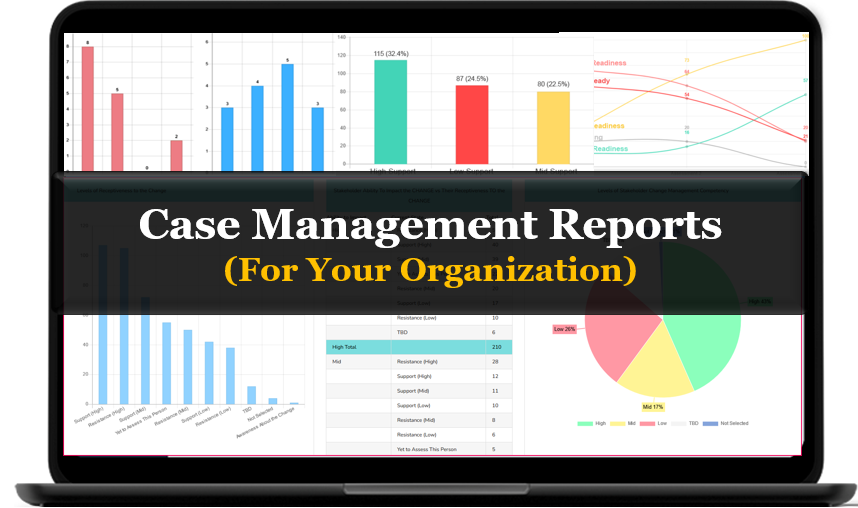
Example of a Referral Report in the Case Management Hub Software
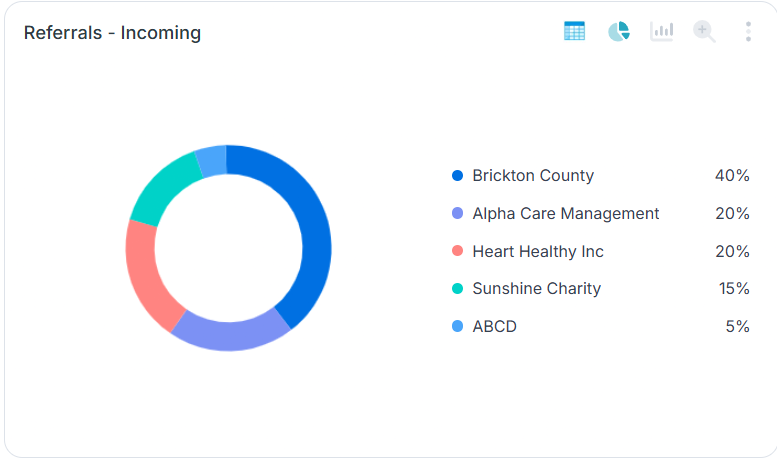
Tracking referral outcomes matters more than it gets credit for. Without a system to follow up, it’s easy to lose visibility into whether a client actually connected with the housing program, the psychiatrist, or the benefits office they were referred to, which undermines the whole point of the referral in the first place.

How Do SOAP Notes Fit Into Social Work Documentation?
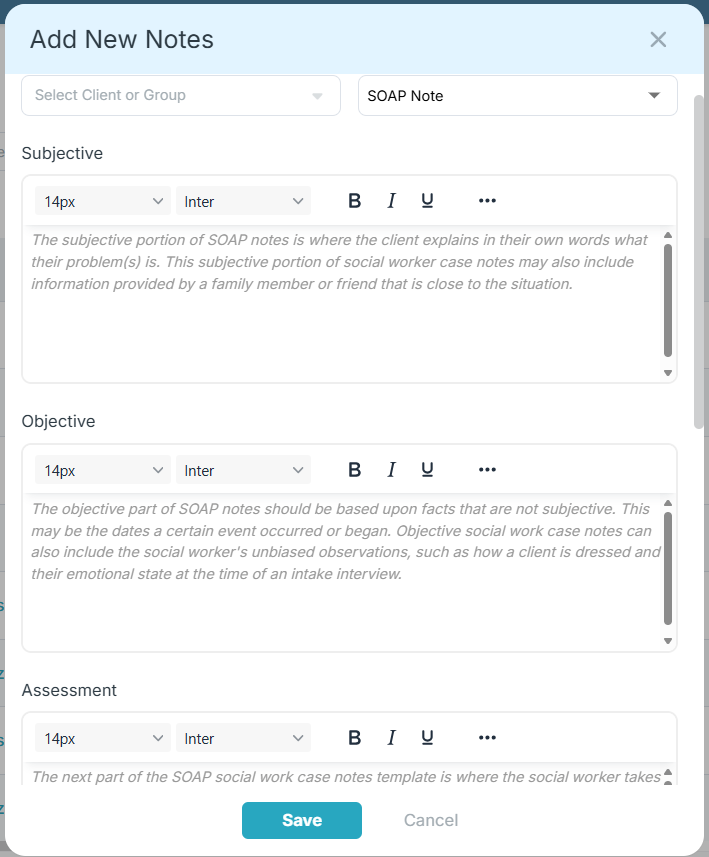
SOAP notes are one of the most widely used formats for case notes in social work, borrowed originally from medical and clinical documentation but adapted widely across mental health and human services. SOAP stands for Subjective, Objective, Assessment, and Plan, four sections that organize a client encounter into a clean, repeatable structure.
The SOAP note format works well because it separates what the client reports (Subjective) from what the practitioner directly observes (Objective), then moves into clinical interpretation (Assessment) and next steps (Plan). Here’s a simplified SOAP note example for social workers:
Subjective: Client reports increased anxiety since losing housing two weeks ago. States, “I haven’t been sleeping well and I’m worried about my kids.”
Objective: Client appeared fatigued, made consistent eye contact, spoke coherently. No signs of acute distress observed during session.
Assessment: Client presents with situational anxiety related to housing instability. No indication of risk to self or others. Coping skills appear intact but strained.
Plan: Refer to emergency housing assistance program. Schedule follow-up in one week. Provide client with stress management resources.
If you’re looking to standardize this format across your team, Case Management Hub includes a free SOAP note template you can access through a free trial, already built into the documentation workflow so notes stay organized alongside the rest of the case file.
🔥Still using spreadsheets for case management?
Switch to an all-in-one case management platform.
👉 Try it Free - No credit card needed
How Should Social Workers Choose Between Different Documentation Formats?
SOAP isn’t the only documentation option, and the right format depends on setting, pace, and reporting needs.
| Format | Structure | Best For |
| SOAP | Subjective, Objective, Assessment, Plan | Clinical and medical-adjacent settings |
| DAP | Data, Assessment, Plan | Brief, fast-paced documentation needs |
| BIRP | Behavior, Intervention, Response, Plan | Behavioral health and therapy notes |
| Narrative | Free-form storytelling | Complex cases needing nuance |
DAP notes condense the subjective and objective sections into one “Data” category, which some clinicians find faster for high-volume caseloads. BIRP notes are popular in behavioral health because they explicitly track the intervention used and the client’s response, useful for measuring treatment effectiveness over time. Narrative notes offer flexibility but can be harder to scan quickly or standardize across a team.
👉 Try this Case Management Software free today
No credit card needed
Why Does Documentation Take Up So Much of a Social Worker’s Time?
If it feels like documentation eats into the time you’d rather spend with clients, you’re not imagining it. A British Association of Social Workers report found that care workers spend about 65% of their week on paperwork. (source: Dropbox).
That imbalance is a major driver of burnout across the field, and it’s part of why so many organizations are rethinking how they structure their social work processes. Standardized templates, digital forms, and centralized case management software all play a role in shrinking time spent on administrative tasks without sacrificing the quality or defensibility of the record.
💡All-in-one Case Management Software.
Everything in one place: clients, notes, forms, appointments, reports, and outcomes.
👉 Try it Free - No credit card needed
What Should Social Workers Consider When Choosing a Process or Format?
A few factors should guide these decisions:
Regulatory and funder requirements
Some programs mandate specific documentation formats tied to billing or compliance.
Caseload volume
High-volume settings often benefit from shorter formats like DAP, while complex cases may need narrative flexibility.
Team collaboration needs
If multiple staff touch a single case, structured formats like SOAP or BIRP make handoffs smoother.
Risk level
Crisis-prone caseloads need a documented, rehearsed intervention process, not just a note-writing format.
Technology access
Paper-based systems slow down retrieval and reporting compared to digital, searchable records.
Weighing these factors honestly, rather than defaulting to whatever process a previous supervisor used, leads to practices that actually serve clients and the organization.
👉 Try it Free today - No credit card needed
Where Software Fits Into the Social Work Process
Strong processes matter, but they’re hard to sustain when intake forms, assessments, case notes, referrals, and scheduling all live in different places. That’s the gap a centralized case management software for social workers is built to close. Case Management Hub brings client intake, SOAP and other note formats, secure messaging, appointment scheduling, goal and progress tracking, and reporting into one platform, so the administrative side of the job takes up less of the week and more time is left for actual client care. Plus, we hear from our customers that they love our outstanding customer support!
👉 Try it Free - Free Case Management System
FAQ: Social Work Processes and Documentation
What are the main stages of the social work case management process?
Intake, assessment, planning, intervention, and evaluation form the core cycle, though cases often move back and forth between stages as circumstances change.
What does SOAP stand for in social work documentation?
SOAP stands for Subjective, Objective, Assessment, and Plan. It's a structured note format that separates client-reported information from clinical observation and next steps.
Is DAP or SOAP better for social work?
Neither is universally better. SOAP offers more separation between subjective and objective data, which suits clinical settings, while DAP is faster to write and often preferred in high-volume case management environments.
How is crisis intervention different from standard case management?
Crisis intervention prioritizes immediate safety and stabilization over full assessment and planning, which typically resume once acute risk has passed.
Why does the referral process matter so much in social work?
Because referrals without follow-up tracking often fail to connect clients to the resources they need. A documented referral process tracks outcomes, not just the initial handoff.
How can software improve social work processes overall?
Case management software can standardize templates, reduce duplicate data entry, speed up intake, and centralize records across every stage of the process, which cuts down on administrative burden and supports more consistent, audit-ready documentation.