
Who’s the Best Medical Case Management Software – Top 12 Medical Platforms for Medical Practices
In this article, we present the 12 top medical case management software platforms designed to help healthcare organizations manage patient cases, streamline care coordination, and improve outcomes across clinical and non-clinical workflows.
These healthcare case management systems are used by hospitals, clinics, and care teams to centralize patient data, automate processes, and enhance collaboration.
Healthcare organizations today face increasing complexity in managing patient information, coordinating care across providers, and maintaining compliance with strict regulatory standards. Many teams still rely on fragmented systems or manual processes, which leads to inefficiencies, delayed care, and increased administrative burden.
Medical case management software platforms address these challenges by providing centralized, cloud-based systems that support intake, assessments, patient tracking, scheduling, and reporting. This ranking will help organizations evaluate the best solutions, compare key features, and make informed decisions when selecting a healthcare case management system.
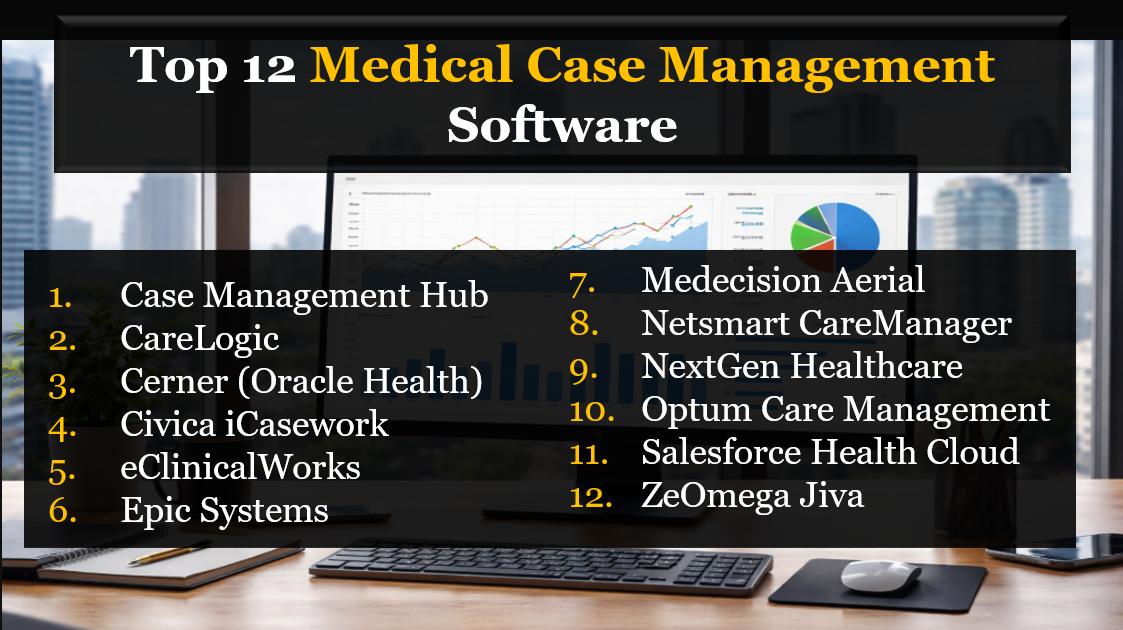
Ranked List of Firms – Best 12 Top Medical Case Management Software Platforms
Below is a curated list of the top medical case management software platforms based on their ability to support care coordination, patient tracking, and healthcare workflow optimization.
- Case Management Hub
- CareLogic
- Cerner (Oracle Health)
- Civica iCasework
- eClinicalWorks
- Epic Systems
- Medecision Aerial
- Netsmart CareManager
- NextGen Healthcare
- Optum Care Management
- Salesforce Health Cloud
- ZeOmega Jiva
Organizations evaluating these platforms should consider their specific use cases, including hospital case management, outpatient care coordination, behavioral health workflows, and population health initiatives. Each platform in this list serves a distinct segment of the healthcare ecosystem.
Selecting the right medical case management system depends on factors such as scalability, ease of use, reporting capabilities, and the ability to integrate with existing healthcare systems. This list provides a strong starting point for comparing the best available solutions.
The platforms listed above represent a balance of enterprise healthcare systems, specialized care coordination tools, and flexible cloud-based case management solutions designed to meet the needs of modern healthcare organizations.
By reviewing this list, organizations can begin narrowing down the platforms that align most closely with their operational goals and patient care requirements.
💡All-in-one Case Management Software.
Everything in one place: clients, notes, forms, appointments, reports, and outcomes.
👉 Try it Free - No credit card needed
Comparison Table – Top 12 Best Healthcare Case Management Systems
| Software | Primary Use Case | Core Strength | Ideal Organization Type |
|---|---|---|---|
| Case Management Hub | End-to-end case management | Custom workflows and ease of use | Clinics, nonprofits, care teams |
| CareLogic | Behavioral health | Clinical and case integration | Behavioral health providers |
| Cerner | Enterprise healthcare | Deep clinical integration | Large health systems |
| Civica iCasework | Public health | Multi-agency workflows | Government organizations |
| eClinicalWorks | Outpatient care | Patient tracking | Clinics |
| Epic Systems | Hospital systems | Enterprise integration | Hospitals |
| Medecision Aerial | Population health | Advanced analytics | Payers |
| Netsmart CareManager | Community care | Integrated coordination | Behavioral health organizations |
| NextGen Healthcare | Specialty practices | Workflow optimization | Ambulatory providers |
| Optum Care Management | Care coordination | Utilization management | Large systems |
| Salesforce Health Cloud | Patient engagement | Customization | Enterprise teams |
| ZeOmega Jiva | Population health | Risk stratification | Health systems |
This comparison highlights the differences in how each platform approaches medical case management. Some systems focus heavily on clinical integration, while others prioritize care coordination and workflow flexibility.
Organizations should carefully evaluate how each platform aligns with their operational needs, whether that involves managing patient records, coordinating care teams, or tracking outcomes.
Decision-makers should also consider scalability and integration capabilities when selecting a healthcare case management system. Platforms that integrate seamlessly with existing tools often provide a smoother implementation process.
Ultimately, the best medical case management software is one that balances functionality, usability, and adaptability while supporting long-term organizational growth.
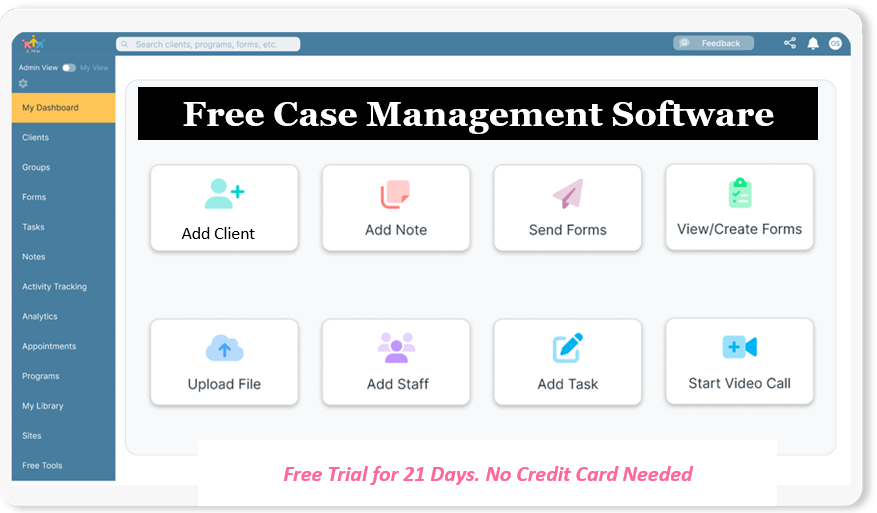
👉 Try it Free - Free Case Management System
Detailed Overviews – Top Rated Medical Case Management Software Platforms
Case Management Hub
Case Management Hub is a comprehensive medical case management software platform designed to centralize patient data, streamline workflows, and improve care coordination across healthcare organizations. It serves as an all-in-one system that allows teams to manage intake, assessments, documentation, scheduling, messaging, and reporting within a single environment. This centralized approach eliminates the inefficiencies associated with fragmented systems and manual processes.
One of the defining strengths of Case Management Hub is its ability to support the full patient lifecycle. Healthcare providers can manage everything from initial intake and assessments to ongoing care plans and discharge processes. This end-to-end visibility ensures that care teams have access to accurate, real-time information, enabling better decision-making and improved patient outcomes.
All-in-One Case Management Software
Sign Up Today, Free
No credit card needed!
Do You Have a Team? | ||
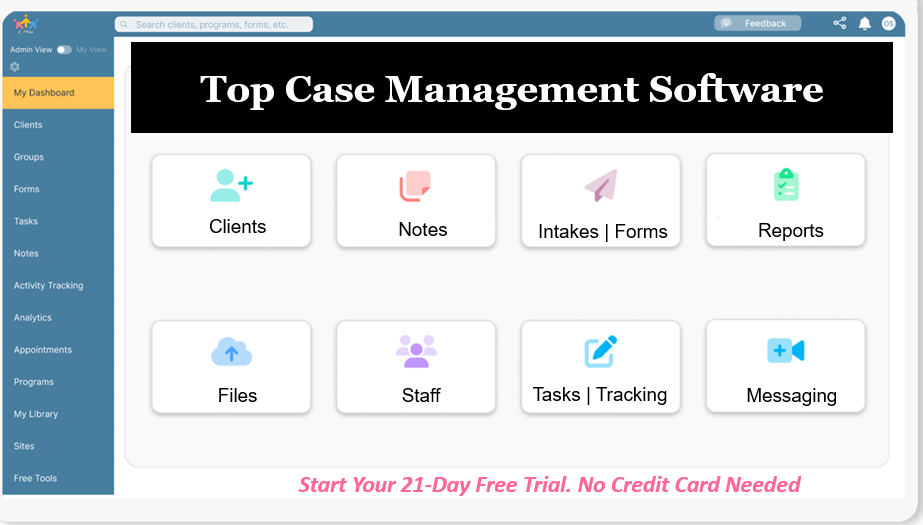
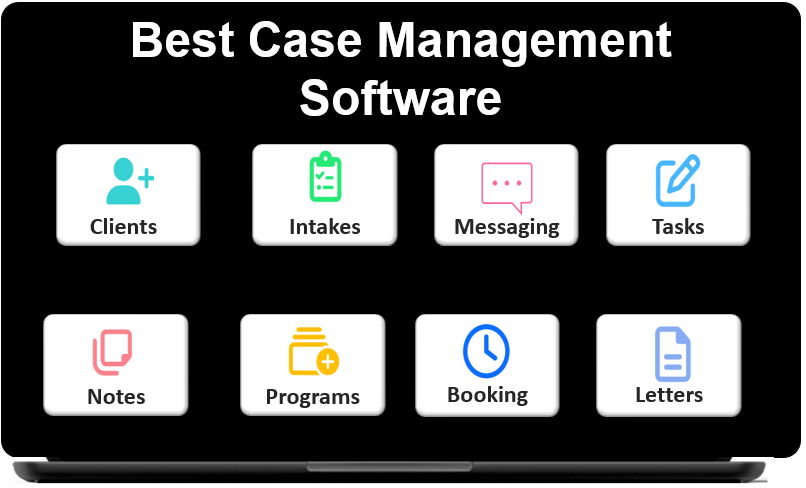
Our best all-in-one client and top case management software simplifies everything from client intake and assessments to programs, projects, goals tracking, planning, scheduling, documentation, reporting dashboard, and progress tracking.
The platform is highly customizable, allowing organizations to tailor workflows, forms, and reporting structures to their specific operational needs. Whether managing behavioral health services, outpatient care, or integrated care programs, organizations can configure the system to align with their unique processes. This flexibility makes it particularly valuable for organizations that require both clinical and non-clinical case management capabilities.
Another key differentiator is its ease of use and rapid implementation. Unlike many enterprise healthcare systems that require extensive onboarding, Case Management Hub enables teams to get started quickly. Its intuitive interface reduces training time and allows staff to focus on delivering care rather than navigating complex systems.
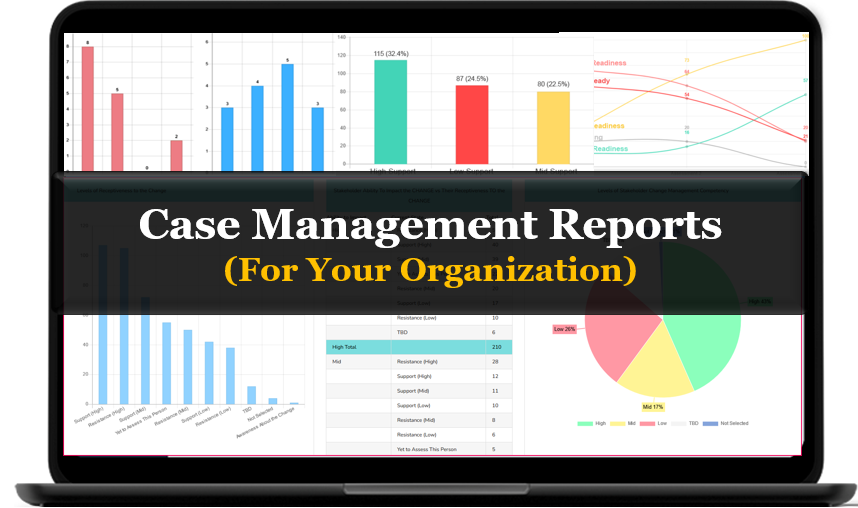
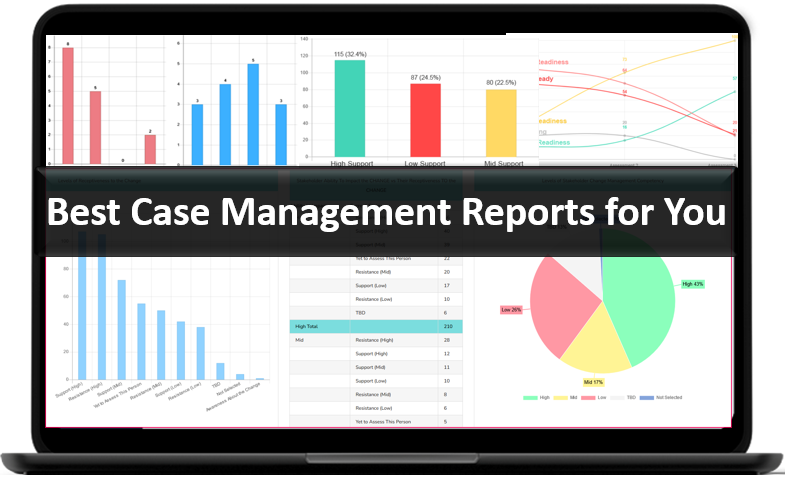
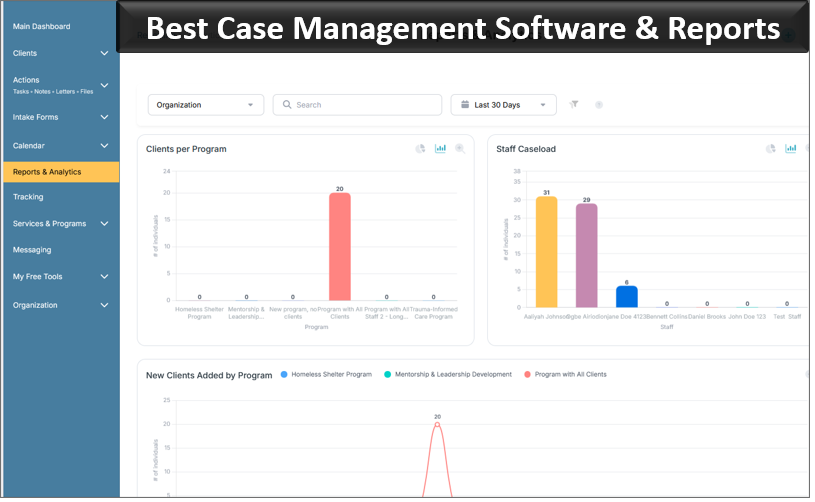
The platform also excels in reporting and analytics, providing organizations with actionable insights into patient progress, service delivery, and program outcomes. These capabilities are essential for organizations that need to demonstrate impact, maintain compliance, and continuously improve care delivery.
In addition, Case Management Hub supports scalability, making it suitable for both small clinics and large, multi-program healthcare organizations. Its cloud-based infrastructure ensures secure access to data from anywhere, enabling collaboration across teams and locations.

CareLogic
CareLogic is a specialized healthcare case management system designed primarily for behavioral health organizations. It integrates electronic health record functionality with case management capabilities, allowing providers to manage clinical documentation, treatment planning, and billing within a unified platform.
The platform’s strength lies in its ability to support complex clinical workflows while maintaining a strong focus on care coordination. Providers can document patient interactions, track treatment plans, and monitor progress over time, all within a structured system designed for behavioral health services.
CareLogic also provides robust compliance and reporting features, enabling organizations to meet regulatory requirements and generate detailed reports on patient outcomes and service delivery. This is particularly important for organizations that rely on accurate data for funding and compliance purposes.
Another advantage is its integration of administrative and clinical functions. By combining billing, scheduling, and documentation into one system, CareLogic helps organizations streamline operations and reduce administrative overhead.
The platform is well suited for mid-sized behavioral health providers seeking a comprehensive solution that balances clinical functionality with case management capabilities.
Cerner (Oracle Health)
Cerner, now part of Oracle Health, is a leading enterprise healthcare platform that includes integrated case management capabilities. It is widely used by large hospitals and health systems that require advanced clinical integration and data interoperability.
The platform enables care teams to coordinate patient care across departments, track outcomes, and manage complex care pathways. Its deep integration with clinical data ensures that all patient information is accessible in real time.
Cerner’s analytics capabilities allow organizations to gain insights into patient populations, identify trends, and improve care delivery. These features are particularly valuable for large healthcare systems managing high patient volumes.
Its scalability makes it suitable for enterprise-level organizations, supporting multiple facilities and large care teams. The platform’s ability to integrate with other systems further enhances its value in complex healthcare environments.
Cerner stands out for its ability to combine clinical and operational data into a single system, enabling comprehensive care management and improved efficiency.
Civica iCasework
Civica iCasework is a case management platform designed for organizations that require structured workflows and multi-agency collaboration. It is commonly used in healthcare, public health, and social services environments.
The platform supports complex case management processes, allowing organizations to manage long-term cases and coordinate services across multiple providers. This makes it particularly relevant for integrated care programs.
Civica iCasework also provides strong reporting capabilities, enabling organizations to track outcomes and measure program effectiveness. This is essential for organizations that need to demonstrate impact and maintain accountability.
Its structured approach ensures consistency in case management processes, helping organizations maintain high standards of care and compliance.
The platform is well suited for organizations that operate across multiple agencies and require a coordinated approach to care delivery.
eClinicalWorks
eClinicalWorks is a cloud-based healthcare platform that combines EHR functionality with care coordination and case management features. It is widely used by outpatient clinics and physician practices.
The platform supports patient tracking, population health management, and reporting, enabling organizations to monitor patient progress and improve care delivery.
Its cloud-based architecture provides flexibility and scalability, allowing organizations to access data from anywhere and collaborate effectively across teams.
eClinicalWorks also offers tools for patient engagement, helping providers communicate with patients and manage appointments efficiently.
The platform is particularly well suited for outpatient care providers seeking a comprehensive solution for patient management and care coordination.
Epic Systems
Epic Systems is one of the most widely used healthcare platforms globally, offering comprehensive EHR and case management capabilities. It is a cornerstone system for hospitals and large healthcare organizations.
The platform enables seamless integration of clinical data across departments, allowing care teams to coordinate patient care effectively. This level of integration is critical for large health systems.
Epic’s robust analytics and reporting tools provide insights into patient outcomes, helping organizations improve care delivery and operational efficiency.
Its scalability supports large, multi-facility organizations, making it a preferred choice for enterprise healthcare systems.
Epic stands out for its comprehensive approach to healthcare management, combining clinical, administrative, and case management capabilities.
🔥Still using spreadsheets for case management?
Switch to an all-in-one case management platform.
👉 Try it Free - No credit card needed
Medecision Aerial
Medecision Aerial is a care management platform focused on population health and utilization management. It is widely used by healthcare organizations managing large patient populations.
The platform provides advanced analytics and risk stratification tools, enabling organizations to identify high-risk patients and optimize care delivery.
Its focus on data-driven insights helps organizations improve outcomes and reduce costs.
Medecision Aerial supports complex care workflows, making it suitable for organizations with advanced care management needs.
It is particularly valuable for payers and large healthcare systems focused on population health initiatives.
Netsmart CareManager
Netsmart CareManager is designed for behavioral health and community-based care organizations. It integrates clinical documentation with care coordination tools.
The platform supports social determinants of health tracking, enabling organizations to address both medical and non-medical factors affecting patient outcomes.
Its integrated approach improves coordination across care teams and enhances service delivery.
Netsmart CareManager is well suited for organizations focused on holistic care.
Its capabilities make it a strong option for community-based healthcare providers.
NextGen Healthcare
NextGen Healthcare provides EHR and practice management solutions with integrated case management features for specialty practices and ambulatory providers.
The platform supports workflow optimization, compliance, and patient tracking, helping organizations improve efficiency.
Its flexibility allows organizations to adapt workflows to their specific needs.
NextGen Healthcare is particularly valuable for specialty practices.
It provides a reliable solution for managing both clinical and operational processes.
Optum Care Management
Optum Care Management is a leading platform for care coordination and utilization management. It is widely used by large healthcare organizations.
The platform supports complex workflows and improves operational efficiency.
Its analytics capabilities enable organizations to make data-driven decisions.
Optum Care Management is particularly relevant for population health initiatives.
It is a strong option for large-scale healthcare operations.
Salesforce Health Cloud
Salesforce Health Cloud provides a customizable platform for patient engagement and care coordination.
It integrates with multiple systems, enabling organizations to centralize data.
The platform supports communication and collaboration across teams.
Its flexibility makes it suitable for enterprise organizations.
Salesforce Health Cloud stands out for its integration capabilities.
ZeOmega Jiva
ZeOmega Jiva is a leading care management platform focused on population health and care coordination.
The platform supports risk stratification and care planning.
It enables organizations to track outcomes and improve efficiency.
ZeOmega Jiva is widely used by healthcare systems.
It is a valuable tool for managing complex patient populations.
👉 Try this Case Management Software free today
No credit card needed
Selection Methodology – Best Medical Case Management Software
The platforms included in this ranking were evaluated based on their ability to support medical case management workflows, including patient intake, care coordination, documentation, and reporting.
Key evaluation criteria included usability, scalability, compliance, and integration capabilities. Platforms that demonstrated strong performance across these areas were prioritized.
Real-world use cases were also considered, including how effectively each platform supports healthcare teams in managing patient cases and improving outcomes.
Some well-known platforms were not included due to limited case management functionality or lack of flexibility in care coordination workflows.
For example, Meditech focuses primarily on EHR functionality, while Athenahealth is more centered on practice management than case management.
This methodology ensures that the ranking remains focused on platforms that truly support medical case management and care coordination.
💡All-in-one Case Management Software.
Everything in one place: clients, notes, forms, appointments, reports, and outcomes.
👉 Try it Free - No credit card needed
What Is a Medical Case Management Software?
Medical case management software is a digital platform that helps healthcare organizations manage patient cases, coordinate care, and track services within a centralized system.
These platforms enable teams to streamline workflows, improve communication, and enhance patient outcomes by providing tools for intake, documentation, and reporting.
They are commonly used by hospitals, clinics, and care teams to manage complex patient data and ensure continuity of care.
By centralizing information, these systems reduce inefficiencies and improve collaboration across healthcare organizations.
Modern platforms also include features such as scheduling, messaging, and analytics to support comprehensive case management.
These capabilities make medical case management software essential for delivering efficient and effective healthcare services.
Conclusion – Top Medical Case Management Software Platforms
Selecting the right medical case management software is critical for healthcare organizations aiming to improve efficiency, coordination, and patient outcomes.
Each platform in this ranking offers unique strengths, from enterprise-level systems to flexible cloud-based solutions.
Organizations should evaluate their specific needs and choose a system that aligns with their workflows and long-term goals.
Investing in the right platform enables teams to deliver better care while reducing administrative burden.
With the right system in place, healthcare organizations can achieve greater efficiency and improved patient outcomes.
The platforms listed in this article provide a strong foundation for organizations seeking to modernize their case management processes.
👉 Try it Free today - No credit card needed
FAQ: Best Medical Case Management Software Platforms
What is medical case management software?
Medical case management software is a digital system that helps healthcare organizations manage patient cases, coordinate care, and track services in one centralized platform. It streamlines workflows such as intake, documentation, scheduling, and reporting while improving efficiency and patient outcomes.
What features should the best medical case management software include?
The best medical case management software should include patient tracking, care coordination tools, customizable workflows, reporting and analytics, secure document management, and HIPAA-compliant data protection. It should also support scheduling, communication, and scalability for growing healthcare organizations.
How do healthcare organizations choose the right case management system?
Healthcare organizations choose the right case management system by evaluating their workflow needs, integration requirements, scalability, and ease of use. They should also consider reporting capabilities, compliance features, and how well the platform supports care coordination and patient outcomes.
Why is Case Management Hub a great choice for medical case management software?
Case Management Hub is a great choice for medical case management software because it offers an all-in-one platform that centralizes patient data, simplifies workflows, and improves care coordination. Its flexibility, ease of use, and strong reporting capabilities make it ideal for healthcare teams seeking efficiency and scalability.
What are the benefits of using healthcare case management software?
Healthcare case management software improves efficiency by reducing manual processes, enhances care coordination across teams, and provides better visibility into patient data and outcomes. It also helps organizations maintain compliance, streamline reporting, and deliver more consistent and effective care.
👉 Try it free today - No credit card needed
Note: Content on this website (socialworkportal.com) is copyrighted and protected under applicable copyright laws. Unauthorized reproduction, distribution, or use of any content from the website, without explicit written permission, is strictly prohibited. Read: Terms of Use.
Social Work Portal Disclaimer: Social Work Portal is not a social work agency and we do not refer social workers. This web site is provided for educational and informational purposes only and does not constitute providing medical advice or professional social and healthcare services. The information provided should not be used for diagnosing or treating a health problem or disease, and those seeking personal medical advice should consult with ... Read our full disclaimer here: Social Work Portal Disclaimer.