How Social Work Theories and Models Work Together to Support Clients
If you have ever sat in a supervision meeting and heard someone say “what’s your theoretical orientation here?” right after asking “so what’s your plan for this case?”, you have already bumped into the confusion this article is meant to clear up.
A social work theory and practice model are two different tools, and social workers use both, but they answer different questions.
A theory explains why a client’s situation looks the way it does. A practice model tells you what to do about it. Mixing the two up is common, especially for students and newer practitioners, because the terms get used almost interchangeably in casual conversation. Getting the distinction straight makes it easier to build a defensible, well-documented care plan and to explain your reasoning to a supervisor, a court, or an insurance reviewer.
We’ll go through the main differences and how to use social work models and theories together to support your clients.
Let’s get started
Watch this video:
or
read the guide below.
What Is Social Work Theory, Exactly?
A social work theory is an explanatory framework. It gives you a lens for understanding why a person, family, or community is experiencing a particular problem. Theories come out of research in psychology, sociology, and related fields, and they help you make sense of the forces at play in a client’s life before you decide how to intervene.
Think of theory as the diagnostic layer. It does not tell you what steps to take with a client. It tells you what you are looking at.
- Explains causes and contributing factors
- Comes from research and clinical study
- Used mainly during assessment and understanding
- Does not include a set sequence of steps
- Examples: Ecological Systems Theory, Psychosocial Development Theory, Empowerment Theory
💡All-in-one Case Management Software.
Everything in one place: clients, notes, forms, appointments, reports, and outcomes.
👉 Try it Free - No credit card needed
What Is a Social Work Practice Model?
A practice model, sometimes called a practice framework or method of practice, is the action layer. It lays out a structured sequence of steps for how you will actually work with a client from first contact to case closure.
Where theory helps you understand a problem, a practice model gives you a repeatable process for addressing it. Most practice models follow some version of engagement, assessment, planning, intervention, and evaluation, though the specific steps and emphasis vary by model.
Examples include the Crisis Intervention Model, the Task-Centered Practice Model, and the Planned-Change Model. Each one is built around a defined workflow rather than an explanation of client behavior.

👉 Try it Free - Free Case Management System
Social Work Theory vs. Practice Model: Side-by-Side Comparison
| Social Work Theory | Practice Model | |
| Answers the question | Why is this happening? | What do I do next? |
| Function | Explains client behavior and circumstances | Structures the helping process |
| Origin | Research in psychology, sociology, human development | Developed practice frameworks and methods |
| Used during | Assessment, case conceptualization | Engagement through termination |
| Flexibility | Can apply across many models | Can incorporate multiple theories |
| Example | Ecological Systems Theory | Crisis Intervention Model |
All-in-One Case Management Software
Sign Up Today, Free
No credit card needed!
Do You Have a Team? | ||
Our best all-in-one client and top case management software simplifies everything from client intake and assessments to programs, projects, goals tracking, planning, scheduling, documentation, reporting dashboard, and progress tracking.
How Do Theory and Practice Model Work Together in a Real Case?
Neither one works well on its own. A theory without a practice model gives you insight but no direction. A practice model without a theory gives you a checklist but no understanding of why it should work for this particular client.
Here is what that pairing might look like in practice.
A social worker is assigned a new client, a teenager who has been skipping school and showing signs of withdrawal at home. Using Ecological Systems Theory, the social worker looks beyond the teenager’s behavior to the surrounding systems: family conflict, a recent school transfer, a peer group that has shifted, and a parent working two jobs with little time for check-ins. That theory shapes how the social worker interprets the intake information.
The social worker then applies the Crisis Intervention Model to structure the actual engagement: establishing rapport quickly, identifying the most pressing stressor, helping the teenager and family generate coping alternatives, and building a short-term action plan with scheduled follow-up.
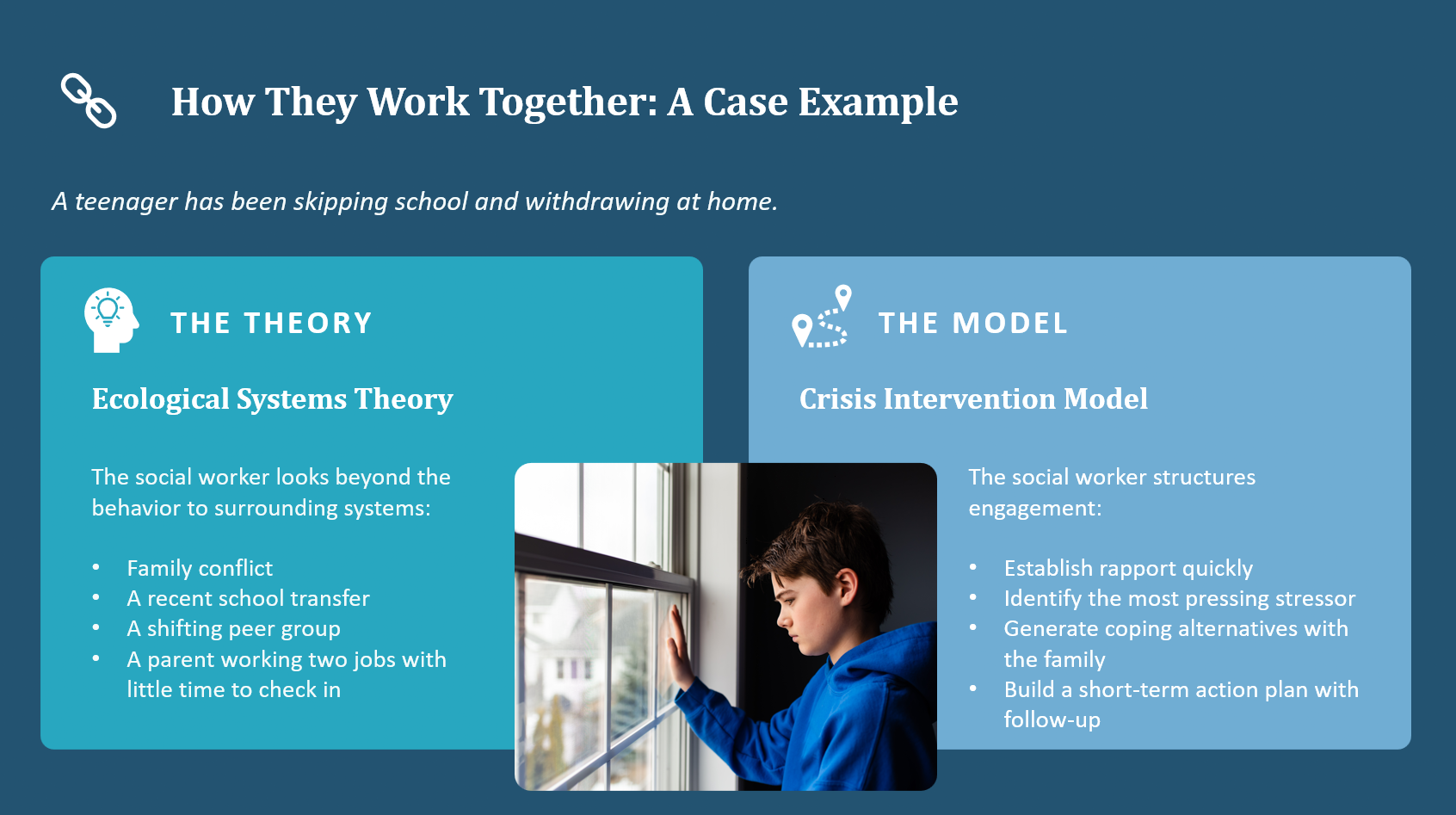
The theory explained the “why.” The model organized the “how.” In the case file, both should show up, usually with the theoretical rationale noted in the assessment section and the model’s steps reflected in the intervention and progress notes.



Why Does This Distinction Matter for Documentation?
Beyond the classroom, this distinction has a practical payoff. Case notes, treatment plans, and utilization reviews often ask a social worker to justify their clinical reasoning. A note that only describes actions taken, without any theoretical grounding, can look arbitrary. A note that only references theory, without a clear intervention structure, can look vague about what actually happened in the session.
Strong documentation typically references both. Something like “using an ecological systems lens, the client’s school avoidance was assessed in the context of family and peer stressors; a crisis intervention approach was used to stabilize the immediate situation” tells a reviewer both why you approached the case the way you did and what you actually did about it.
This is also where having a system that lets you track theoretical orientation alongside your intervention steps in one client record becomes genuinely useful, rather than trying to reconstruct that reasoning from memory during an audit. Case Management Hub lets you document assessment notes, care plans, and progress notes in one connected client file, so the reasoning behind a case and the actions taken on it stay linked together instead of scattered across separate systems. You can try it free with no credit card needed.
🔥Still using spreadsheets for case management?
Switch to an all-in-one case management platform.
👉 Try it Free - No credit card needed
Do Social Workers Have to Pick Just One Theory or Model?
No, and in practice most do not. Many social workers describe their orientation as eclectic, meaning they draw on more than one theory depending on the client and situation, and they may adapt elements from more than one practice model within a single case. A family case might draw on Family Life Cycle Theory for one aspect of the assessment and Systems Theory for another, while the actual engagement follows a Planned-Change Model structure.
This flexibility is part of why understanding the theory-versus-model distinction matters. If you treat every idea as interchangeable, it becomes hard to explain your reasoning cleanly. If you know which piece is doing which job, you can combine them deliberately instead of by accident.
It is also worth noting that even with strong theoretical grounding available, translating it into consistent day-to-day practice is not automatic. One survey of 341 social workers found that while respondents reported slightly positive attitudes toward evidence-based practice, their actual engagement with the evidence-based practice process was relatively low. That gap is part of why deliberately pairing a theory with a defined practice model, and documenting that pairing, matters as much as knowing the definitions.

👉 Try this Case Management Software free today
No credit card needed
Social Work Theory and Practice Model Conclusion
Theory and practice model are not competing frameworks. They are two halves of clinical reasoning. Theory helps a social worker understand what is happening and why. A practice model provides the structured process for doing something about it. Knowing which is which, and being able to name both in your documentation, strengthens your case conceptualization and makes your reasoning easier to defend, whether to a supervisor, a court, or your own future self reviewing the file six months later.

👉 Try it Free today - No credit card needed
Social Work Theory vs. Practice Model – FAQs
What is the main difference between a social work theory and a practice model?
A theory explains why a client's situation exists, drawing on research into human behavior and social systems. A practice model provides the structured steps a social worker follows to engage with, assess, and intervene with a client. Theory answers 'why,' a model answers 'what to do.'
Can a social work theory be used with more than one practice model?
Yes. Theories are not tied to a single practice model. Ecological Systems Theory, for example, could inform a case that uses the Crisis Intervention Model or one that uses the Task-Centered Practice Model. The theory shapes understanding, while the model shapes the workflow.
Do social workers need to choose only one theory to work from?
No. Many social workers use an eclectic approach, applying different theories depending on the client and the specific issue being assessed. This is common in generalist social work practice, where client situations vary widely.
How do I know which practice model to use with a client?
Practice model selection usually depends on the nature of the situation. Acute, immediate-danger situations often call for the Crisis Intervention Model, while longer-term, goal-focused work might use the Task-Centered Practice Model or Planned-Change Model. The theory used during assessment can also point toward which model fits best.
Should case notes reference both theory and practice model?
It helps. Referencing the theoretical framework used during assessment, alongside the practice model steps followed during intervention, gives a more complete and defensible picture of clinical reasoning in the case record.
Is a practice model the same as an intervention?
Not quite. A practice model is the broader structured framework guiding the full engagement, from intake to termination. An intervention is typically one component within that model, such as a specific technique or activity used during the implementation phase.

👉 Try it free today - No credit card needed
Note: Content on this website (socialworkportal.com) is copyrighted and protected under applicable copyright laws. Unauthorized reproduction, distribution, or use of any content from the website, without explicit written permission, is strictly prohibited. Read: Terms of Use.
Social Work Portal Disclaimer: Social Work Portal is not a social work agency and we do not refer social workers. This web site is provided for educational and informational purposes only and does not constitute providing medical advice or professional social and healthcare services. The information provided should not be used for diagnosing or treating a health problem or disease, and those seeking personal medical advice should consult with ... Read our full disclaimer here: Social Work Portal Disclaimer.