What Is Happening with Artificial Intelligence in Social Work? (Ethics, Security, and Case Management)
Artificial intelligence has moved from a curiosity to a daily conversation in social work. Some practitioners are already drafting emails and summarizing documents with chatbots, while others are waiting to see what their agencies and licensing bodies will allow. Both responses make sense.
The social work profession handles some of the most sensitive information that exists, and AI tools are changing faster than the rules around them.
The profession handles some of the most sensitive information that exists, and AI tools are changing faster than the rules around them. This article looks at what recent research shows, where professional guidance stands, and what social workers, case managers, and nonprofit teams should weigh before bringing AI into client work.
Let’s get started
Watch this video:
or
read the guide below.
How Are Social Workers Using Artificial Intelligence Right Now?
Use varies widely. Research from Social Work England found that AI use differs significantly across practicing social workers, students, and academics. Some people use it every day, and others have not touched it.
Where it is being used, the focus tends to be administrative. A practitioner guide shared through the National Association of Social Workers (NASW) job board describes documentation, drafting, and administrative work as the areas where AI helps most, and it places clinical decision-making outside what AI should do. The guide puts it simply: AI drafts, and the social worker decides.
Documentation is the obvious draw. Case notes, intake summaries, and progress reports take hours that could go to clients. Research presented at a social work symposium in Singapore in March 2026 looked at the effectiveness of AI-assisted documentation, and the presenters were clear that the human connection at the center of the profession has to be preserved.
💡All-in-one Case Management Software.
Everything in one place: clients, notes, forms, appointments, reports, and outcomes.
👉 Try it Free - No credit card needed
What Do the Latest Reports Say About AI in Social Work?
Two recent studies give the clearest picture so far.
Social Work England recently published two 2025 research reports on the emerging use of AI in social work education and practice. The regulator commissioned Research in Practice to gather the views, hopes, and concerns of social workers, employers, educators, and AI experts. The reports cover how AI is being used, the risks and ethical challenges, and how to prepare social workers to use it lawfully, ethically, and responsibly.
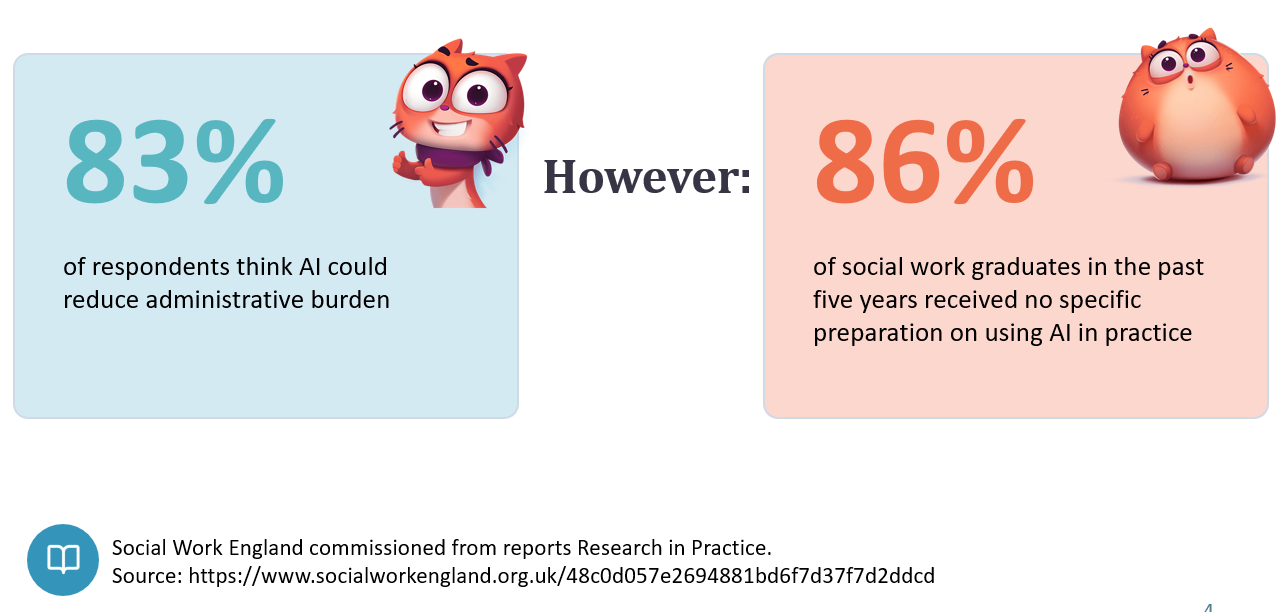
Two findings stand out. First, 83 percent of respondents think AI could reduce administrative burden, however 86 percent of social workers who graduated in the past five years received no specific preparation on using AI in practice. The reports also call on government departments, regulators, and professional bodies to work together on shaping how social workers use AI.
In the United States, researchers at the University at Buffalo School of Social Work surveyed 103 social workers with advanced degrees about the risks and opportunities AI presents in practice and education. Their paper, released in August 2026, found that guidance from professional bodies such as NASW and the Council on Social Work Education has been slower to respond than the technology itself.
Across these sources, the pattern is the same. Interest is high, preparation is low, and formal guidance is behind.
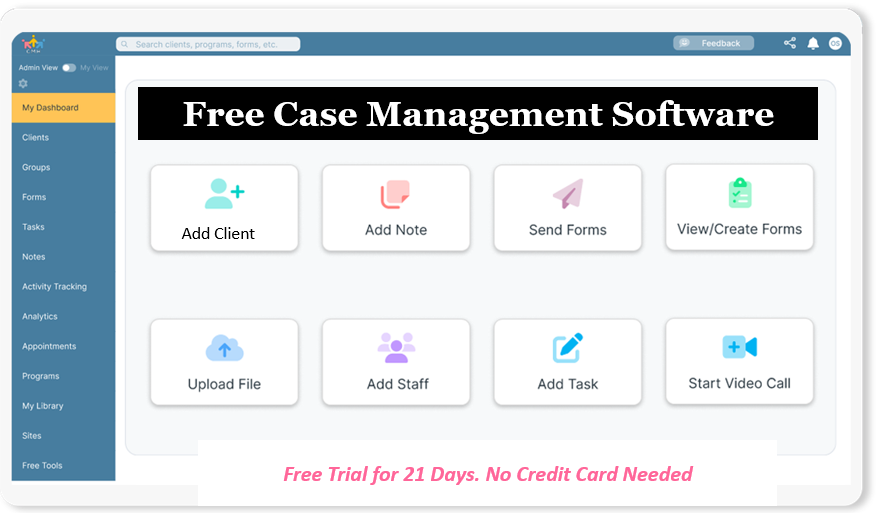
👉 Try it Free - Free Case Management System
Why Is Professional Guidance Still Catching Up?
The main framework most practitioners point to is the 2017 Standards for Technology in Social Work Practice, developed by NASW, the Association of Social Work Boards, the Council on Social Work Education, and the Clinical Social Work Association. It was written before generative AI became common, yet its principles of competence, confidentiality, and informed consent still apply to any new tool.
The gap shows up in daily work. The same practitioner guide notes that the supervision section of those standards is where many agencies are weakest. Until formal AI guidance arrives, agency policy fills the space, and agencies that have not written one leave their staff guessing.
All-in-One Case Management Software
Sign Up Today, Free
No credit card needed!
Do You Have a Team? | ||
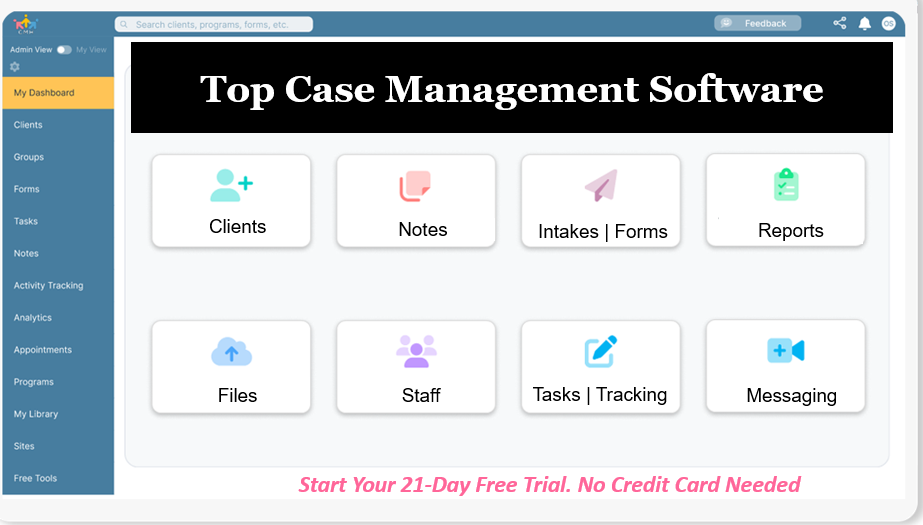
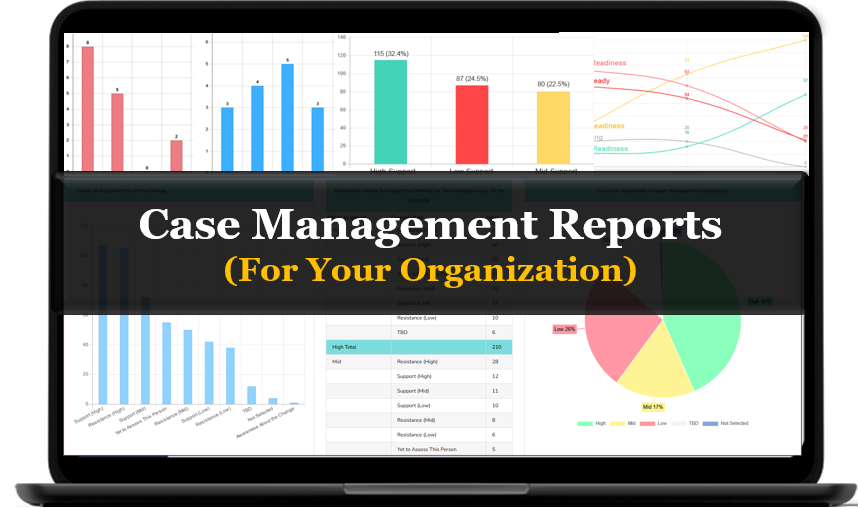
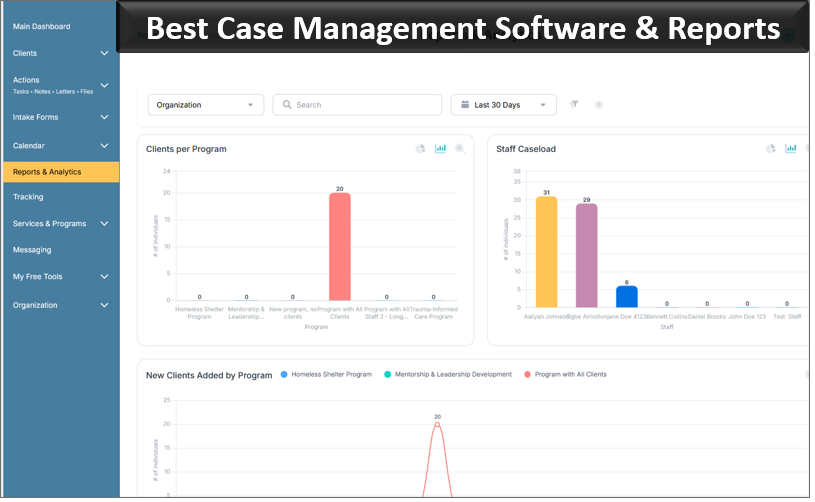
Our best all-in-one client and top case management software simplifies everything from client intake and assessments to programs, projects, goals tracking, planning, scheduling, documentation, reporting dashboard, and progress tracking.
Where Does AI Help, and Where Should It Stop?
AI is a reasonable fit for tasks that save time without touching professional judgment: drafting routine correspondence, summarizing long documents, tidying notes, and rewording information in plain language for clients.
It should stop well before decisions that affect people’s lives. Risk assessment, eligibility, safety planning, and removal decisions belong to trained professionals who know the family and the context. Predictive tools in child welfare have already drawn criticism for bias, which is a good reason to keep a person in charge of every consequential call.
Privacy is the other boundary. Free consumer chatbots typically do not come with a business associate agreement, which the Health Insurance Portability and Accountability Act (HIPAA) requires when a vendor handles protected health information. Pasting identifiable client details into one of those tools can create a compliance problem before anyone notices.

What Should Nonprofits and Case Management Teams Ask Before Adopting AI?
Nonprofits often feel pressure to adopt AI quickly because staff are stretched and funders are asking about efficiency. A short set of questions can slow things down in a useful way:
- Where does client data go when someone uses the AI feature?
- Is that data used to train models, and can that be ruled out in writing?
- Is a business associate agreement in place?
- Who can see the logs and the stored prompts?
- Can the feature be turned off for the whole organization?
- Does a person review every AI output before it enters a client record?
- What happens to the data if we leave the vendor?
A vendor that answers these clearly and in writing is showing the right instincts. A vendor that answers with marketing language is telling you something too.
🔥Still using spreadsheets for case management?
Switch to an all-in-one case management platform.
👉 Try it Free - No credit card needed
What Does Careful AI Adoption Look Like in Case Management Software?
Case management systems hold mental health histories, family circumstances, substance use records, housing situations, and more. That is the kind of information HIPAA, federal rules such as 42 CFR Part 2 for substance use treatment records, and state privacy laws exist to protect. Adding AI to a system like that is a different job from adding a button to a consumer app.
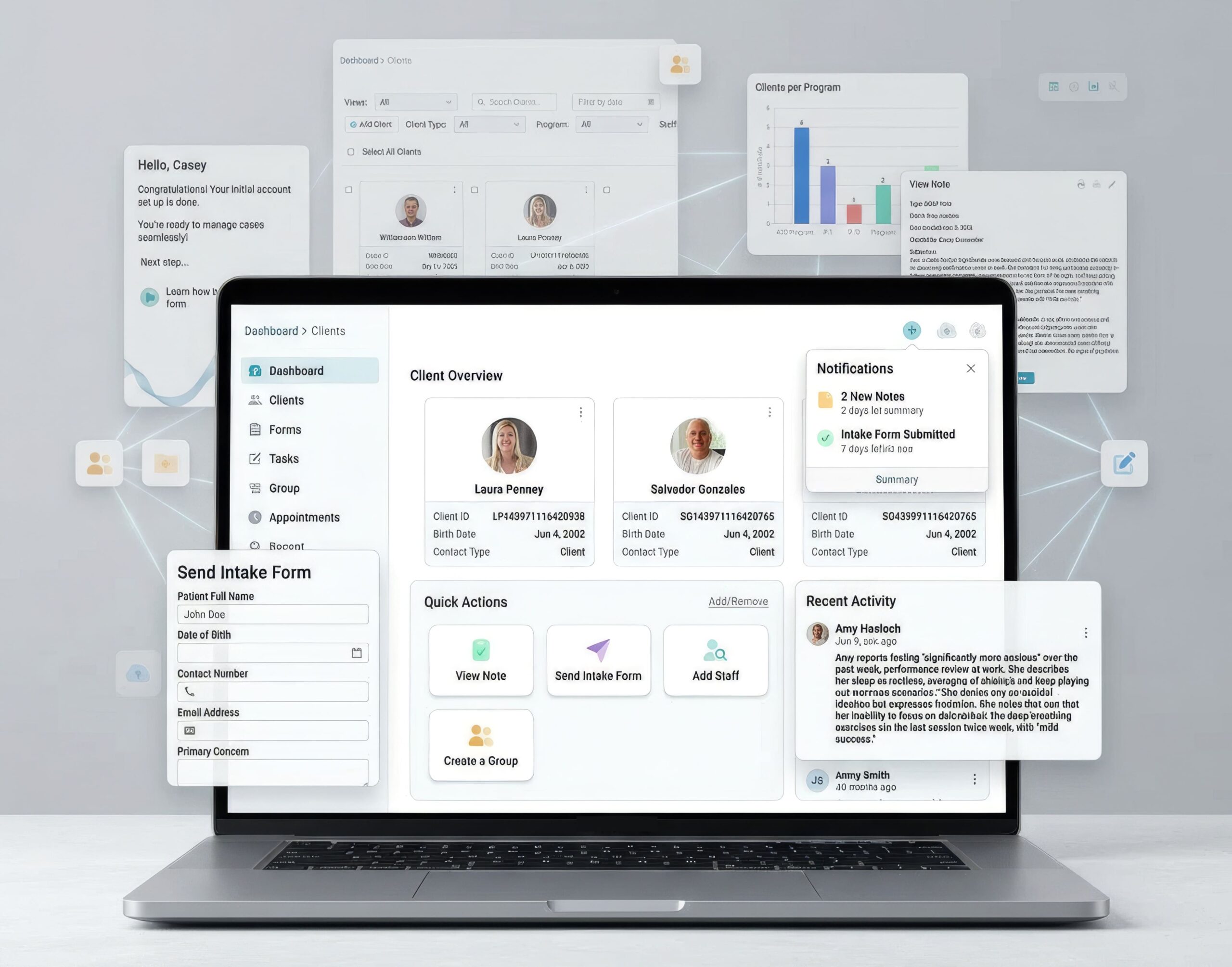
Responsible software developers, like Case Management Hub, are treating it that way. Before any AI feature reaches users, they research where data travels, whether it stays contained, whether it is retained or used for training, and how access is logged and controlled. That work takes time, and shipping first and fixing later is not an option when the data involves vulnerable people. A feature that arrives quickly and weakens client trust is not progress.
This is the approach we are taking at Case Management Hub. Our HIPAA-compliant case management software has not incorporated AI yet, and that is a deliberate choice. We are weighing the security side first, studying the options and how data would be contained, so that anything we add is something your team can trust with sensitive case data.
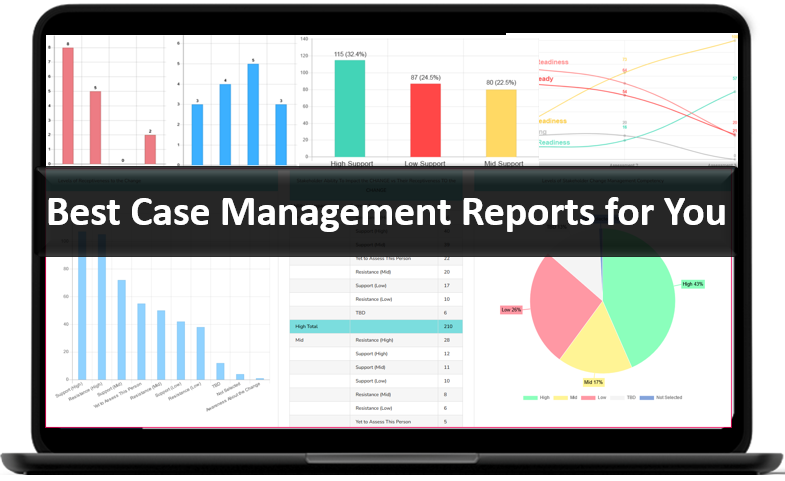
If you want to see how the platform handles documentation, intakes, and assessments today, you can start a free trial.
👉 Try it Free today - No credit card needed
What Are Common Questions About AI in Social Work?
Is AI safe to use in social work?
It can be, for low-risk administrative tasks, with a person reviewing the output and no identifiable client information going into tools that are not built to protect it. Safety depends on the tool, the task, and the agency's policy.
Can social workers use ChatGPT with client information?
General consumer chatbots are generally a poor place for identifiable client information. Follow your agency's policy, and use only tools covered by the safeguards and agreements that privacy rules require.
Will AI replace social workers?
The research reviewed here points the other way. Practitioners, educators, and regulators keep returning to the relationship, the judgment, and the human contact that software cannot supply.
What does the NASW say about AI?
NASW and its partners issued technology standards in 2017, and the NASW Code of Ethics continues to apply. Researchers note that more specific AI guidance has been slow to arrive.
Is AI HIPAA compliant?
No tool is compliant just because it says so. Compliance depends on how the tool is configured, what agreements are in place, and how data is stored, accessed, and protected.
👉 Try it free today - No credit card needed
Note: Content on this website (socialworkportal.com) is copyrighted and protected under applicable copyright laws. Unauthorized reproduction, distribution, or use of any content from the website, without explicit written permission, is strictly prohibited. Read: Terms of Use.
Social Work Portal Disclaimer: Social Work Portal is not a social work agency and we do not refer social workers. This web site is provided for educational and informational purposes only and does not constitute providing medical advice or professional social and healthcare services. The information provided should not be used for diagnosing or treating a health problem or disease, and those seeking personal medical advice should consult with ... Read our full disclaimer here: Social Work Portal Disclaimer.