Turning Genograms into Audit-Proof Clinical Notes
You complete an intensive intake session with a rich three-generation genogram on your desk: relational lines tracing anxious attachments, chronic conflict, triangulation, and decades of substance dependency. In the therapy room, the map offers immediate clarity.
Then you sit down to chart.
Staring at a blank narrative field in your EHR, it is tempting either to write a vague summary (“completed genogram; discussed family history”) or spend forty-five unbilled minutes hand-typing genealogical biographies. Both fail. Vague charting invites audit clawbacks; sprawling biographies drain clinical energy and risk privacy violations.
Turning a visual family map into a defensible progress note requires a repeatable translation framework.
Let’s get started
Watch this video:
or
read the guide below.
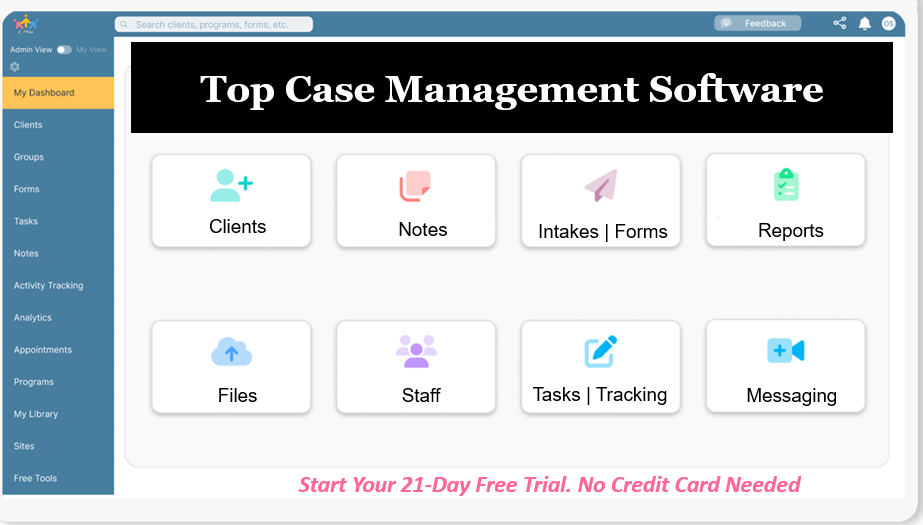
💡All-in-one Case Management Software.
Everything in one place: clients, notes, forms, appointments, reports, and outcomes.
👉 Try it Free - No credit card needed
What You’ll Learn in This Guide
- How commercial insurance auditors evaluate family mapping and why incomplete genogram documentation triggers billing denials.
- A strict clinical translation matrix to convert standard McGoldrick-Gerson relational symbols into objective behavioral language.
- Complete, audit-tested SOAP and DAP progress note templates built from a complex intergenerational case study.
- Objective phrasing banks for documenting boundary violations, emotional cutoffs, and family trauma without assigning informal diagnoses to non-clients.
- How modern digital tools eliminate duplicate paperwork, disconnected PDF attachments, and manual transcription.
- Practical strategies to resolve collateral privacy restrictions under HIPAA standards and state confidentiality statutes.
Why Is Genogram Documentation in Family Therapy Under Intense Audit Scrutiny?
Behavioral healthcare providers are subjected to intensive documentation audits. According to peer-reviewed data published in the Annals of Family Medicine, ambulatory care clinicians spend an average of 35.8% of their working day interacting with EHR documentation rather than delivering direct patient care. When billing complex relational encounters, that documentation burden increases significantly.
Commercial payers (including Optum, Aetna, and Cigna) routinely scrutinize family psychotherapy billing codes (CPT 90847 for family psychotherapy with patient present, and CPT 90846 for family psychotherapy without patient present). When auditors review charts linked to these codes, their primary question is straightforward:
Did this family intervention directly treat the identified patient’s covered DSM-5-TR psychiatric diagnosis, or did it merely provide unbillable relationship coaching, general genealogical review, or family mediation?
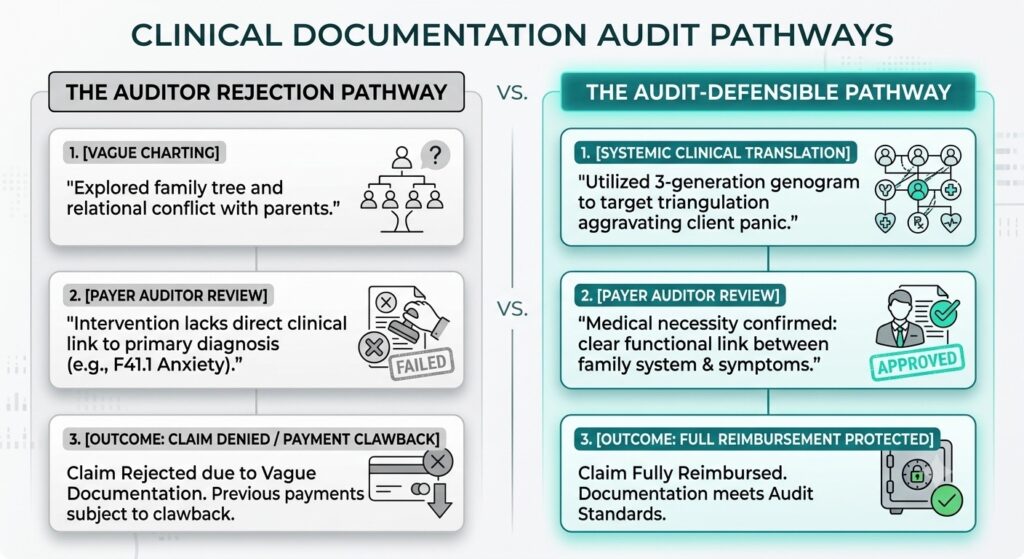
A visual diagram stored as an unindexed image file or loose sheet in a physical binder offers zero audit protection. Family mapping data must function as the clinical spine of an intake, feeding directly into a comprehensive biopsychosocial assessment to establish medical necessity. Auditors review the written progress note for four specific compliance anchors:
- Clear Link to the Primary Diagnosis: The documentation must show how intergenerational patterns directly aggravate the index client’s acute functional impairment.
- Clinical Rationale for Relational Collaterals: The note must explain why gathering generational collateral information is essential to resolving the client’s symptoms.
- Active Interventions Over Passive History: The note must capture what clinical interventions occurred (such as externalizing systemic roles, detriangulating, or charting emotional cutoffs) rather than merely recording passive conversational topics.
- Differentiation from Psychoeducation: The record must reflect specialized systemic therapy targeting entrenched behavioral cycles, distinguishing the service from informal family support.
👉 Try it Free - Free Case Management System
How Do You Translate Visual Genogram Symbols into Objective Clinical Language?
The core challenge in documenting family systems work lies in translating graphic notation into neutral, defensible observations. Before transcribing complex relational lines, verify your charting foundation with our guide on how to create a clinical genogram step-by-step. Graphic maps rely on shorthand; legal medical records require objective, non-pejorative documentation that avoids making diagnostic assertions about unconsenting family members.
Use this clinical translation rubric to convert standard genogram notations into audit-ready narrative text:
| Genogram Visual Pattern | Common Layman Phrase (Audit Risk) | Defensible Clinical Phrasing (Audit-Proof) |
| Triple Solid Line | “Client and mother are codependent and toxic.” | “Systemic mapping reveals high enmeshment and diffuse interpersonal boundaries between client and maternal caregiver, characterized by frequent emotional parentification.” |
| Broken / Dashed Line | “Client does not talk to their deadbeat father.” | “Identified an active emotional cutoff between client and paternal figure lasting 48 months; client endorses acute avoidance behaviors upon contact attempts.” |
| Jagged / Zig-Zag Line | “Client has explosive, toxic arguments with sister.” | “Persistent relational volatility marked by recurring symmetrical escalation and dysregulated verbal conflict over family resource allocation.” |
| Two Solid Lines to a Child | “Mother and father use the child to fight each other.” | “Structural assessment indicates systemic triangulation: marital dyad diverts unaddressed marital distress onto the adolescent client, reinforcing somatic anxiety.” |
| Shaded Medical / Substance Symbol | “Uncle and grandfather were alcoholics.” | “Reported multigenerational family history of untreated chemical dependency and substance-related affective dysregulation across two prior maternal generations.” |
| Bracketed Cohabitation Circle | “Crowded house causing stress.” | “Multi-generational household arrangement featuring compressed physical boundaries, contributing directly to client’s baseline nervous system hyperarousal.” |
Essential Phrasing Banks for Systemic Charting
When drafting your clinical formulation, use standardized clinical phrasing to articulate systemic dynamics without overstepping professional bounds:
- Documenting Relational Cutoffs: “Client utilizes complete behavioral and emotional cutoff as a primary coping mechanism to manage chronic attachment anxiety within the family of origin.”
- Documenting Triangulation: “Therapeutic intervention targeted the maternal-paternal triangle, assisting the client in recognizing how presenting depressive withdrawal serves to defuse parental conflict.”
- Documenting Multigenerational Transmission: “Systemic exploration identified cross-generational transmission of anxious attachment patterns and avoidance coping, directly mirroring client’s presenting social phobia.”
- Documenting Structural Boundaries: “Evaluated rigid internal boundaries between client subsystem and extended kinship network, limiting client’s perceived access to practical and emotional support.”
What Do Defensible Genogram SOAP and DAP Notes Look Like?
To understand how to document a complete systemic session, examine this complex clinical intake scenario:
Clinical Scenario: Elena (age 34) presents with Generalized Anxiety Disorder (ICD-10: F41.1). During the session, the clinician maps a three-generation genogram. The map reveals an enmeshed relationship with her widowed mother (who expects daily symptom check-ins), an emotional cutoff from an older brother who struggles with severe alcohol use disorder, and intense marital tension with her spouse regarding financial and emotional boundaries with extended relatives.
To maintain consistent structure across clinical records, align your family systems observations with standard documentation frameworks. For a deeper breakdown on balancing objective and subjective data across clinical encounters, review our walkthrough on how to write a SOAP note.
Here is how that single visual assessment translates into standardized, audit-ready clinical notes.
1. The SOAP Note Format (CPT 90837 / 90847)
- Subjective (S):
Client presents reporting acute exhaustion, physical muscle tension, and insomnia (averaging 4 hours per night). Client states: “I cannot breathe because everyone in my family expects me to fix their problems before I can live my own life.” Reports escalating marital conflict regarding mother’s unscheduled visits. Client endorses feeling intense guilt whenever establishing personal boundaries with maternal relatives.
- Objective (O):
Administered a comprehensive three-generation clinical genogram assessment. Traced structural boundaries, affective patterns, and generational coping mechanisms across maternal and paternal lines. Key mapped findings:
- Structural Hierarchy: Persistent cross-generational enmeshment between client and maternal caregiver; historical parentification of client following paternal death 12 years prior.
- Communication Boundaries: Complete emotional cutoff between client and sibling (older brother, age 38, history of substance use dependency); absent conflict resolution mechanisms.
- Relational Dynamics: High marital tension directly associated with intrusive extended family expectations and absent dyadic privacy boundaries.
- Assessment (A):
Client’s acute anxiety symptoms (F41.1) are functionally maintained by entrenched systemic triangulation and blurred interpersonal boundaries within the family of origin. Genogram assessment demonstrates that client’s panic symptoms spike during attempts to differentiate from the maternal emotional system. Presenting anxiety reflects learned intergenerational caretaking roles rather than an isolated neurochemical distress pattern. Client demonstrated high reflective capacity during the externalization of family roles, recognizing how somatic anxiety functions as an emotional buffer for systemic marital and maternal tensions. Prognosis for boundary differentiation is good.
- Plan (P):
- Maintain weekly individual psychotherapy (CPT 90837) targeting structural boundary differentiation and autonomic nervous system down-regulation.
- Next session will utilize the visual genogram to script structured boundary assertions regarding maternal visitation boundaries.
- Client to complete between-session tracking: monitor somatic distress ratings (SUDS scale 1-10) before and after telephone contact with maternal figure.
2. The DAP Note Format (CPT 90847)
- Data (D):
Conducted joint systemic evaluation utilizing an interactive genogram builder. Client and participating partner reviewed generational behavioral patterns across three generations. Identified recurring pattern of untreated depressive withdrawal and emotional parentification across maternal lineage.
Explored current household stressors: documented weekly frequency of maternal boundary intrusions and subsequent marital arguments. Introduced structural boundary mapping; facilitated communication role-play where client practiced direct boundary setting with spouse present. Client presented with constricted affect and elevated vocal tension when discussing brother’s substance-related estrangement, showing observable somatic relaxation (lowered shoulders, regulated diaphragmatic breathing) following cognitive externalization of systemic responsibility.
- Assessment (A):
Genogram data confirms client’s symptom presentation is structurally linked to an overfunctioning-underfunctioning marital dynamic triggered by external family demands. Client’s primary anxiety serves a systemic homeostatic function, shifting marital attention away from underlying intimacy challenges and onto extended family management. Both partners demonstrated improved awareness of how unresolved intergenerational roles impact their shared domestic boundaries. Readiness to establish clear external boundaries evaluated as moderate.
- Plan (P):
Continue bi-weekly systemic psychotherapy. Next session: introduce direct de-escalation protocols for boundary management and evaluate client’s completed somatic trigger logs. Coordinate release of information for client’s medical provider regarding ongoing sleep disruption.
All-in-One Case Management Software
Sign Up Today, Free
No credit card needed!
Do You Have a Team? | ||
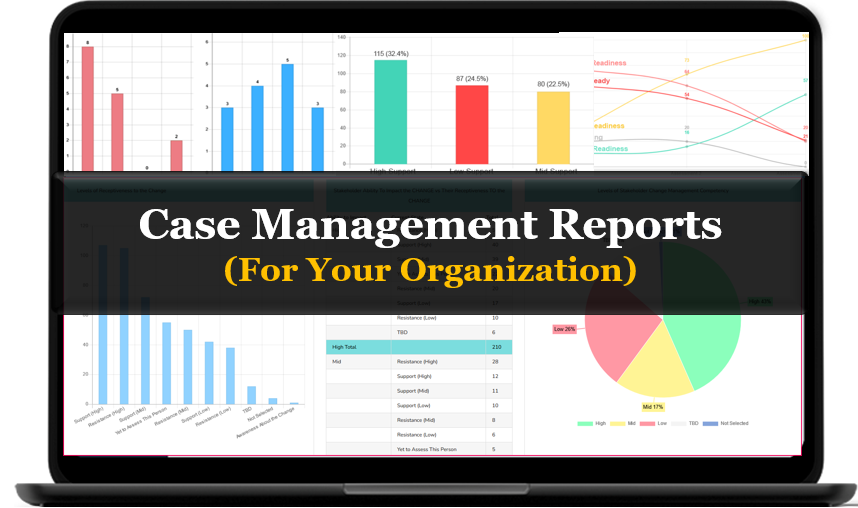
Our best all-in-one client and top case management software simplifies everything from client intake and assessments to programs, projects, goals tracking, planning, scheduling, documentation, reporting dashboard, and progress tracking.
How Digital Tools Streamline Genogram Documentation
For decades, generating a clinical genogram was a tedious manual process. Clinicians sketched complex diagrams on legal pads with pens, transported loose sheets to administrative copy machines, scanned low-resolution files into an electronic repository, and then opened an entirely separate program to type their encounter narrative.
This disconnected workflow introduces serious clinical and administrative risks:
- Lost Clinical Nuance: Hand-drawn notes often remain locked inside paper charts or unindexed PDF attachments that medical colleagues and future clinicians never read.
- Duplicate Administrative Labor: Providers must mentally re-translate visual sketches into long narrative summaries, re-typing facts across biopsychosocial assessments and progress notes.
- Static, Stale Data: Family systems change continually through births, divorces, relapses, and reconciliations. Updating a physical drawing requires completely re-sketching the entire diagram from scratch.
Clinicians looking to cut non-billable desk time can learn how to automate case management tasks across their daily practice by switching to integrated software.
These modern behavioral health platforms eliminate this friction by integrating visual assessment tools directly into the primary clinical documentation workflow.
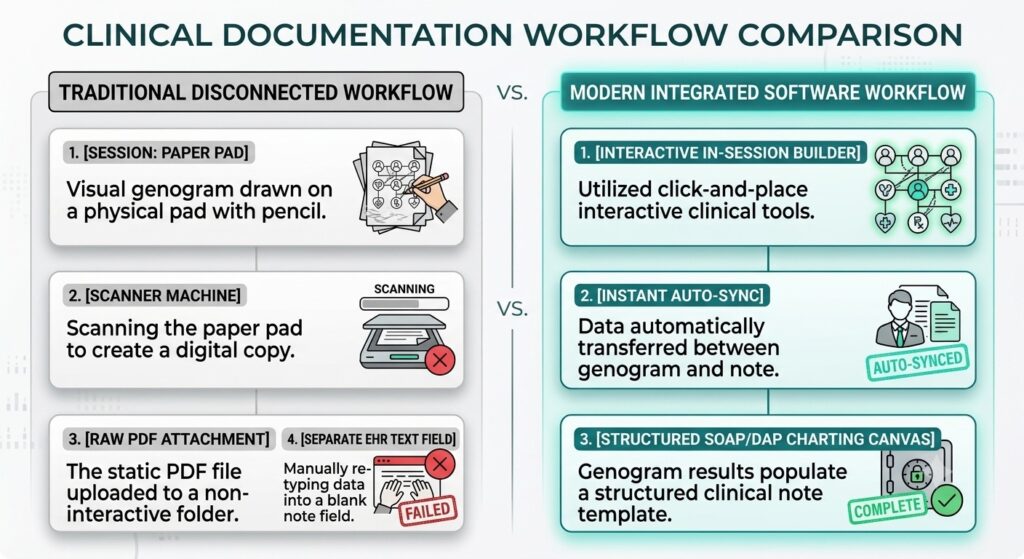
Direct Workflow Comparison: Paper Charting vs. Dedicated Platforms
| Clinical Workflow Dimension | Manual Paper-Based Methods | Specialized Case Management Platforms |
| In-Session Construction | Erasing and redrawing on paper; cramped margins; illegible handwriting | Interactive click-and-place interface using standardized symbols |
| Electronic Record Anchoring | Buried as an unindexed PDF attachment; invisible to search queries | Live clinical tool embedded directly within the client’s master profile |
| Documentation Efficiency | Manually re-typing family details from drawing into blank EHR fields | Systemic templates provide structured fields for rapid narrative synthesis |
| Longitudinal Evolution | Starting completely over on blank paper when family events occur | Editing nodes, updating relationship statuses, and adding life milestones in seconds |
| Audit Preparation | Scrambling to cross-reference disconnected files during audit requests | Unified progress notes with clear clinical links to systemic interventions |
| Interdisciplinary Sharing | Illegible symbols cause miscommunication between care team members | Standardized, exportable clinical summaries that any provider can review |

People Also Ask
What makes a clinical genogram different from a traditional family tree?
A traditional family tree tracks genealogical lineages, birth dates, and legal marriages. A clinical genogram maps psychological attributes, emotional relationship qualities (such as enmeshment, cutoffs, or volatility), generational medical vulnerabilities, and behavioral patterns across at least three generations to guide clinical assessment and treatment planning.
Can clinicians bill for constructing a genogram during psychotherapy sessions?
Yes. Developing and reviewing a genogram is an established clinical assessment and intervention technique reimbursable under standard CPT codes. Clinicians commonly bill this under code 90791 (Psychiatric Diagnostic Evaluation), 90837 (60-minute Individual Psychotherapy), or 90847 (Family Psychotherapy with Patient Present).
How should a clinician document family members who refuse to participate?
Document absent family members by noting their structural position in the genogram based entirely on the index client’s report. In the narrative clinical note, explicitly document that relational data reflects client-reported perceptions, noting any functional barriers, geographic distance, or emotional cutoffs preventing collateral participation.
How often should a genogram be updated in the medical record?
A genogram should be updated during formal treatment plan reviews (typically every 90 to 180 days), upon major family life events (such as births, deaths, divorces, or medical diagnoses), or whenever an evolving relational conflict directly affects the client’s treatment goals.
Are paper genograms stored in filing cabinets fully HIPAA-compliant?
Paper genograms are HIPAA-compliant only if protected under strict administrative, physical, and technical safeguards, including double-locked storage, signed physical access logs, and strict office perimeter security. Because physical records carry persistent risks of theft, loss, and unauthorized review, digital storage within an encrypted, HIPAA-compliant platform is the industry standard.
How do you document intergenerational trauma without diagnosing extended family members?
Use behavioral and client-reported descriptive phrasing rather than assigning unverified clinical diagnoses to non-clients. For example, document “client-reported multi-generational pattern of severe emotional dysregulation and alcohol abuse in maternal relatives” instead of recording formal diagnoses like “maternal Borderline Personality Disorder.”
How Case Management Hub Solves the Systemic Documentation Burden
Navigating complex human suffering in the therapy room requires deep empathy and focus. Leaving that room only to face a chaotic administrative burden of disconnected templates, fragmented tools, and cumbersome charting processes is one of the quickest paths to clinician burnout.
Case Management Hub was designed to eliminate that operational friction for social workers, marriage and family therapists, clinical counselors, and case managers.
Built as an all-in-one, fully HIPAA-compliant platform, Case Management Hub brings your entire clinical workflow into a single, intuitive interface:
- Connected Clinical Notes: Seamlessly create structured SOAP, DAP, and comprehensive intake assessments built specifically for relational and individual care.
- Holistic Client File Management: Maintain a single, organized home for client histories, contact records, and clinical assessments without hunting through multiple systems.
- Goal and Progress Tracking: Directly link session-by-session systemic interventions to specific treatment plan goals and objective outcome metrics.
- Integrated Practice Operations: Streamline appointment scheduling, secure client communications, billing, and clinical reporting from one central dashboard.
Stop losing your evenings to disjointed documentation and administrative headaches.
Start your 21-day free trial of Case Management Hub with full access to clinical note templates, workflow tracking tools, and client management features. No credit card required.
Frequently Asked Questions (FAQs)
How can clinicians protect third-party privacy under HIPAA when documenting non-client relatives?
Under the HIPAA Privacy Rule, a client's medical record should only contain the minimum necessary Protected Health Information (PHI) required to deliver clinical care. When charting extended family details on a genogram, avoid recording identifying information such as full legal names, Social Security numbers, dates of birth, or workplaces for relatives who are not clients. Use functional kinship labels (such as maternal aunt, age 45 or paternal grandfather) to document clinical dynamics while safeguarding third-party privacy.
What is the most realistic way to build a genogram within a standard 45-minute clinical hour?
Building a genogram in a short session requires focused boundary setting. Rather than attempting an exhaustive, four-generation kinship map in one sitting, focus the initial assessment strictly on the primary household and the immediate attachment figures tied to the presenting problem. Spend 15 minutes drafting the core structural lines during the session, and use structured digital templates to synthesize the findings into your narrative note immediately after the appointment.
How do healthcare auditors view graphic genograms compared to written narrative notes?
Auditors view graphic diagrams as supplemental clinical material, not as standalone legal documentation. An auditor will never assume medical necessity based solely on visual symbols, lines, or colors. Reimbursement decisions rely on the narrative progress note explaining why those family dynamics require professional intervention, how they impact the client's DSM diagnosis, and what specific clinical techniques were used.
What clinical protocol should be followed if constructing a genogram uncovers unexpected trauma?
If mapping family patterns brings up traumatic disclosures, such as historical abuse or concealed family events, pause the genogram exercise immediately. Shift the clinical focus toward grounding, containment, and nervous system regulation. In your progress note, document the pause in systemic assessment, describe the client's emotional response, record the stabilization techniques applied, and update your safety assessment and treatment plan accordingly.
Can medical social workers use genograms for inpatient hospital discharge planning?
Yes. Medical social workers and hospital case managers rely heavily on genograms to evaluate family caregiving capacity, identify viable post-acute living environments, and assess social determinants of health. In inpatient settings, a clear genogram quickly identifies who holds legal medical power of attorney, which relatives can assist with medication management, and which family conflicts could jeopardize post-discharge care.
How do clinical supervisors use genograms to evaluate intern and associate documentation?
Supervisors use genograms to evaluate how well trainees translate theoretical systemic concepts into real-world documentation. By reviewing how an intern moves from a visual diagram to a written DAP or SOAP note, supervisors can gauge whether the trainee recognizes clinical dynamics (such as triangulation, enmeshment, and projective identification), maintains professional boundaries, and satisfies documentation compliance standards.
👉 Try it free today - No credit card needed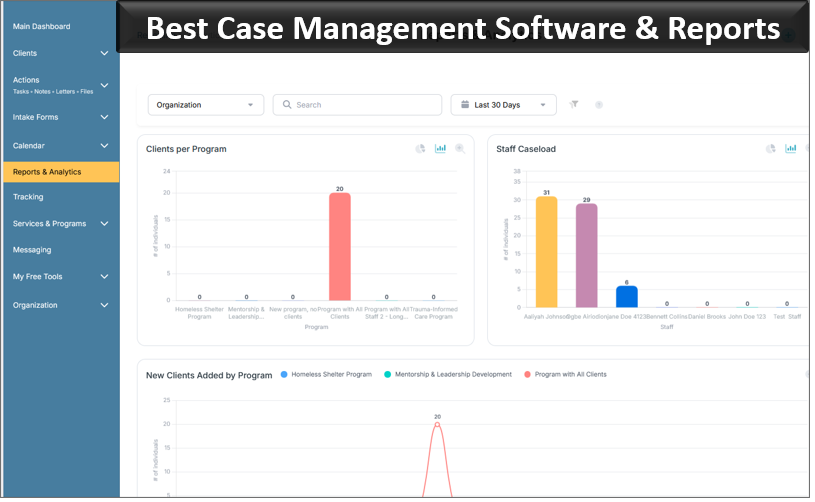
Note: Content on this website (socialworkportal.com) is copyrighted and protected under applicable copyright laws. Unauthorized reproduction, distribution, or use of any content from the website, without explicit written permission, is strictly prohibited. Read: Terms of Use.
Social Work Portal Disclaimer: Social Work Portal is not a social work agency and we do not refer social workers. This web site is provided for educational and informational purposes only and does not constitute providing medical advice or professional social and healthcare services. The information provided should not be used for diagnosing or treating a health problem or disease, and those seeking personal medical advice should consult with ... Read our full disclaimer here: Social Work Portal Disclaimer.