Best Practices for Administering PHQ-9 to Patients, Interpreting Results, and Measuring Client Success
Do you use the PHQ-2 as an initial depression screening but feel unsure what to do when a client screens positive? Many professionals struggle with when to move to the PHQ-9, how to interpret the results, and what each question is actually measuring.
Understanding the PHQ-9 tool is crucial. Decades of research have proven that this simple questionnaire accurately catches signs of depression across diverse populations. In fact, according to data published by the American Psychological Association, a PHQ-9 score of 10 or greater boasts a 88% sensitivity and 88% specificity for detecting major depression.
You’ll learn the breakdown of the PHQ-9 assessment process, how to administer the PHQ-9 with confidence, and gain practical guidance for using the results to track client outcomes.
Let’s get started
Watch this video:
or
read the guide below.
Guide Blueprint: What We Will Cover
- What are the Basics of the PHQ-9 Assessment Tool? – Understanding what the tool is and why it matters for social service agencies.
- How Do You Administer and Score the PHQ-9? – The mechanics of handing out the form, tallying the numbers, and interpreting the raw data.
- How Should You Navigate Critical Triggers and Question 9? – How to handle sensitive responses regarding suicidal ideation safely and ethically with real-world scripts.
- How Can You Use the PHQ-9 to Track Treatment Progress? – Using data to optimize client care, prevent burnout, and boost your nonprofit’s reporting power.
| ⚡Pro Tip: Bookmark or print out this page to use as a quick-reference training outline for onboarding new staff members or volunteers at your agency. |
💡All-in-one Case Management Software.
Everything in one place: clients, notes, forms, appointments, reports, and outcomes.
👉 Try it Free - No credit card needed
What are the Basics of the PHQ-9 Assessment Tool?
Before diving into the assessment itself, it helps to understand what makes this tool so valuable for nonprofits and social service programs. The Patient Health Questionnaire-9 is a brief, nine-item instrument used by professionals worldwide. It relies heavily on the DSM-5 criteria mapped to PHQ-9 questions, meaning it aligns directly with the official clinical definitions of depression used by doctors and psychiatrists.
It is not just for clinical psychologists; it has immense PHQ-9 clinical utility and administration protocols tailored perfectly for primary care settings, community outreach programs, and social service environments.
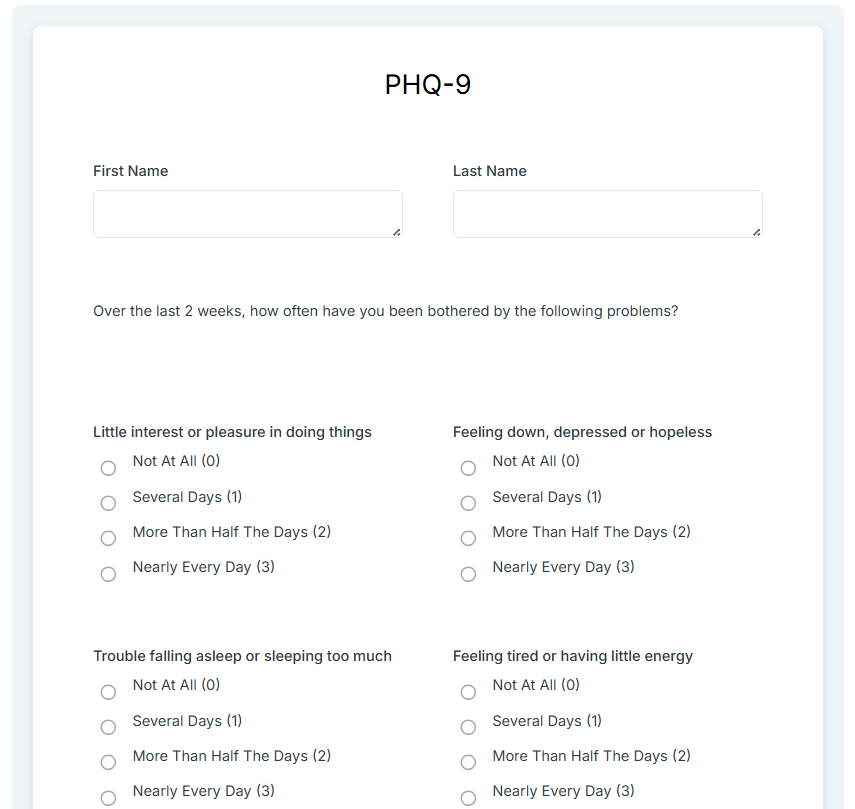
Many organizations choose a two-step approach to save time during initial screenings. They start with a shorter, two-question version called the PHQ-2. If a client flags high on those initial questions, staff immediately transition into a full PHQ-9 vs PHQ-2 screening workflow.
| ⚡Pro Tip: Take the PHQ-9 assessment yourself before you give it to clients. This helps you understand where a client might feel uncomfortable, allowing you to guide them with greater empathy. |
What’s the difference between the PHQ-2 and PHQ-9?
The answer is in the numbers at the end. The PHQ-2 has just two questions and is meant as a quick screener. The PHQ-9 has nine questions and is designed to gain more insight into the potential for a depression diagnosis.
👉 Try it Free - Free Case Management System
How Do You Administer and Score the PHQ-9?
When learning how to administer and score the PHQ 9, consistency is your best friend. The assessment asks the client how often they have been bothered by nine specific problems over the past two weeks.
The PHQ-9 Scoring Framework
For each problem, the client chooses from four basic options:
- Not at all = 0 points
- Several days = 1 point
- More than half the days = 2 points
- Nearly every day = 3 points
Once the client completes the form, your job is to calculate the Patient Health Questionnaire 9 scoring instructions. Simply add up the numbers associated with their checkboxes. The total score will range from 0 to 27. To understand what these numbers actually mean, you must look at the standardized PHQ 9 severity ranges and cut off scores:
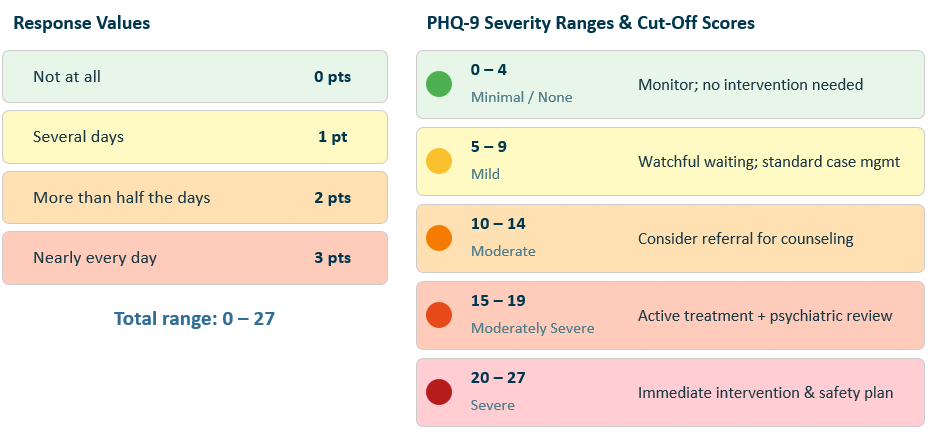
When learning how do clinicians interpret PHQ-9 results, remember that this tool does not replace human empathy or clinical interviews. Instead, it acts as a reliable guidepost.
| ⚡Pro Tip: Double-check your math. It sounds simple, but in a fast-paced nonprofit environment, it is incredibly easy to miscount a row or miss an item. |
All-in-One Case Management Software
Sign Up Today, Free
No credit card needed!
Do You Have a Team? | ||
Our best all-in-one client and top case management software simplifies everything from client intake and assessments to programs, projects, goals tracking, planning, scheduling, documentation, reporting dashboard, and progress tracking.
How Should You Navigate Critical Triggers and Question 9?
As you master best practices for administering PHQ-9 to patients, you will inevitably encounter situations that require delicate care. The most critical component of the entire test is interpreting PHQ 9 question 9 suicidal ideation. Question 9 asks the client if they have had thoughts that they would be better off dead, or of hurting themselves in some way over the past two weeks.
If a client marks anything other than a zero on Question 9, you should take immediate action. A positive answer here indicates a need for an immediate conversation. Your organization should have clear PHQ-9 diagnostic criteria for depression risk protocols in place before you start testing.


How Can You Use the PHQ-9 to Track Treatment Progress?
The real magic of this tool happens over time. Learning how to use PHQ-9 to track depression treatment progress turns a one-time snapshot into a powerful movie of a client’s journey toward healing. By comparing a PHQ-9 baseline assessment vs follow up score taken 30 or 60 days later, you can see exactly whether your programs are working.
Furthermore, tracking scores helps you screen for major depressive disorder using PHQ-9 across your entire program registry to notice if a client is deteriorating despite your best efforts, signaling it’s time to change their care plan.
Finally, you need a clean system for how to document PHQ 9 results in EHR (Electronic Health Records) or your agency’s case management software. One with a digital PHQ-9 is very helpful because it makes it easy for patients to fill out from any device and saves all the data for you for reporting purposes.
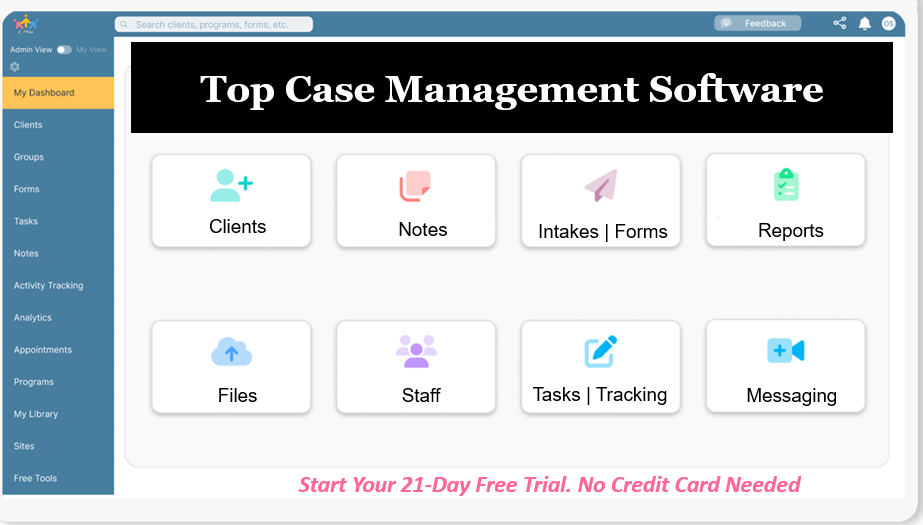
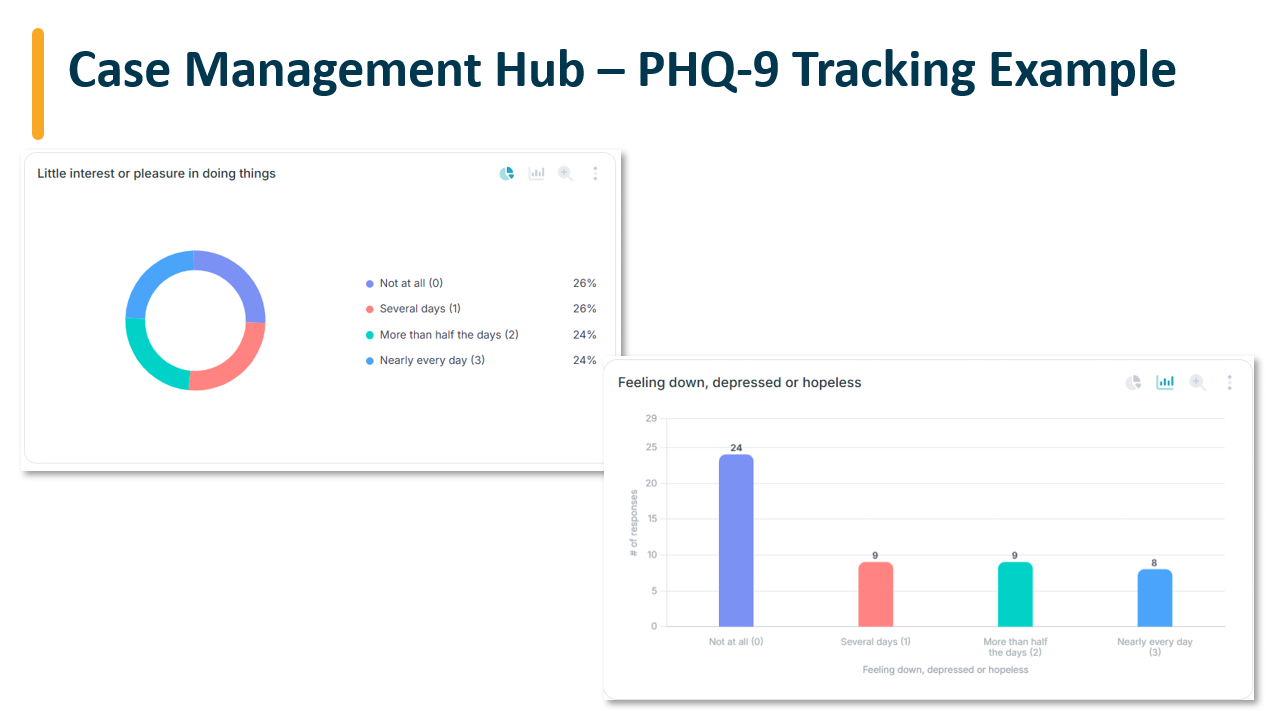
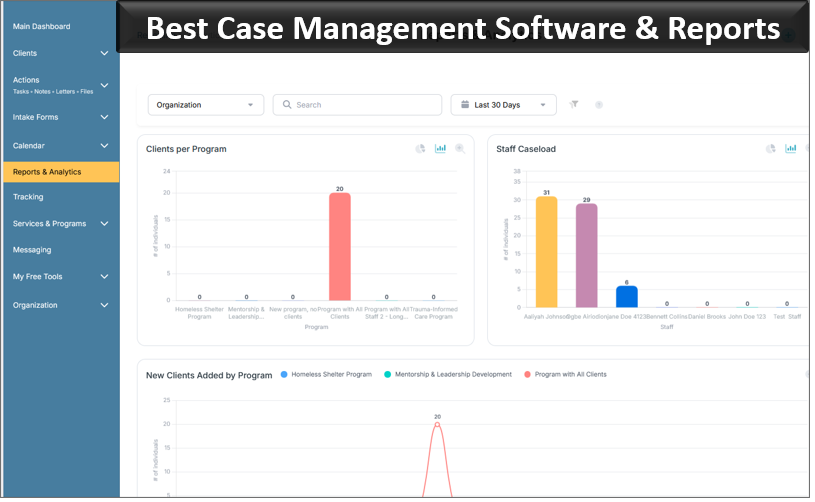
Here’s an example below of the results of the PHQ-9 across all client. (If you’d like to try this for yourself in the Case Management Hub software, you can start a free 21-day trial today (no credit card needed).
🔥Still using spreadsheets for case management?
Switch to an all-in-one case management platform.
👉 Try it Free - No credit card needed
Conclusion
Mastering the PHQ-9 is one of the simplest, most effective ways for nonprofits and social service agencies to elevate their standard of care. It takes the guesswork out of assessing depression, offering a clear, objective language that bridges the gap between frontline caseworkers and clinical professionals.
By integrating this tool into your intake routines and tracking scores over time, you protect your clients from falling through systemic cracks while building a data-driven narrative of success that funders love to support.
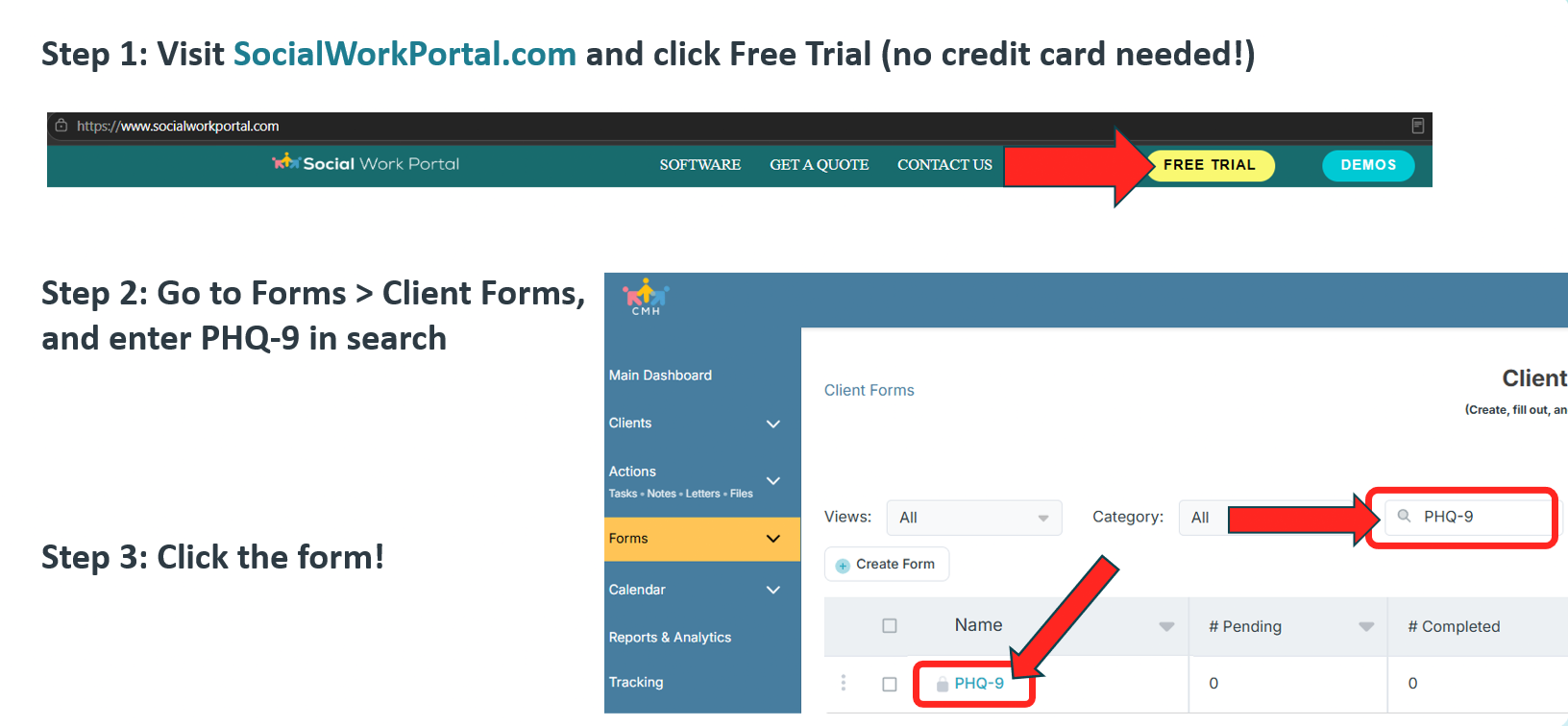
Are you looking for an easy way to administer and report on the PHQ-9 assessment? Check out a free trial of the Case Management Hub software. Head to the Forms and search the form templates for “PHQ-9.”
👉 Try it Free today - No credit card needed
Frequently Asked Questions about the PHQ-9 Assessment Tool
What is the primary purpose of using the PHQ-9 assessment in a non-clinical social service setting?
In a non-clinical social service setting, the primary purpose of the PHQ-9 is to give case managers and advocates an objective, reliable, and standardized tool to screen clients for depression symptoms.
Can a social worker or case manager use the PHQ-9 to officially diagnose a client with depression?
No, a social worker or case manager operating in a standard non-clinical role cannot use the PHQ-9 to give an official medical diagnosis of depression. The tool is strictly designed for screening, measuring symptom severity, and tracking progress over time.
How often should our nonprofit agency readminister the PHQ-9 to track client progress?
Every four to six weeks is a good timeframe for tracking client progress. Testing too frequently can lead to survey fatigue, while waiting longer than six weeks might cause you to miss critical changes in a client's mental health.
What should a staff member do immediately if a client responds positively to Question 9 on the assessment?
If a client indicates any frequency of self-harm or suicidal thoughts on Question 9, the staff member should immediately pause the session and activate the agency's established crisis safety protocol.
What should a case manager do if a client refuses to answer or skips questions on the PHQ-9?
If a client leaves questions blank on the assessment, the case manager should gently ask if they feel comfortable sharing why they skipped those items, as a blank answer often points to an area of intense distress or confusion. From a technical standpoint, you cannot calculate an official total score if more than two questions are missing.
Is the PHQ-9 assessment free for nonprofit organizations and social service agencies to use?
Yes, the PHQ-9 is completely public domain and free to use, copy, distribute, and integrate into your electronic case management systems without paying any licensing fees. (You can find a free one to use at CaseManagementHub.org.
👉 Try it free today - No credit card needed
Note: Content on this website (socialworkportal.com) is copyrighted and protected under applicable copyright laws. Unauthorized reproduction, distribution, or use of any content from the website, without explicit written permission, is strictly prohibited. Read: Terms of Use.
Social Work Portal Disclaimer: Social Work Portal is not a social work agency and we do not refer social workers. This web site is provided for educational and informational purposes only and does not constitute providing medical advice or professional social and healthcare services. The information provided should not be used for diagnosing or treating a health problem or disease, and those seeking personal medical advice should consult with ... Read our full disclaimer here: Social Work Portal Disclaimer.