Why Empowering Client Strengths in Social Work Leads to More Positive Outcomes
Social work has always wrestled with a central question: do you focus on what’s broken in a person’s life, or what’s already working? The strength-based approach answers that question directly. Instead of building a case around deficits, diagnoses, and problems, this model starts with a client’s existing skills, relationships, and resilience, then builds a plan around them.
For social workers, this isn’t just a philosophical preference. It changes how assessments are written, how conversations are structured, and how clients experience the entire helping relationship.
Let’s get started
Watch this video:
or
read the guide below.
What Is a Strength Based Approach in Social Work?
The strengths perspective was developed largely through the work of Dennis Saleebey, who argued that traditional social work models leaned too heavily on pathology. A client wasn’t just “a person with substance use disorder” or “a family in crisis.” They were also a person with coping skills, a support network, cultural knowledge, and personal history that had already carried them through hard situations.
A strength based approach asks a simple but powerful question at every stage of practice: what is this person already doing well, and how can that be expanded? Rather than treating strengths as a nice addition to a deficit-focused plan, this model treats strengths as the foundation the entire plan is built on.
This doesn’t mean ignoring real problems. Trauma, addiction, poverty, and mental illness are still named and addressed directly. The difference is in the starting point and the language used to get there.
💡All-in-one Case Management Software.
Everything in one place: clients, notes, forms, appointments, reports, and outcomes.
👉 Try it Free - No credit card needed
Why Does the Strengths Based Approach Matter?
Deficit based models can unintentionally reinforce the exact hopelessness a client is trying to escape. When someone is repeatedly described in terms of what’s wrong with them, it becomes easy for them to internalize that identity. A strengths based approach interrupts that cycle.
There’s also a practical case for it. Clients who feel heard and respected are more likely to stay engaged in services. Empowerment increases motivation, and motivation drives follow-through on goals. Social workers using this model often report stronger rapport, better attendance, and more client-led progress, simply because the client feels like a collaborator rather than a case file.
For agencies and nonprofits, this translates into better outcomes data and lower dropout rates, which matters for grant reporting and program sustainability.
👉 Try it Free - Free Case Management System
What Are the Core Principles of Strengths Based Practice?
Several principles guide this approach across settings, whether in child welfare social work, mental health, substance use treatment, or community organizing.
Every individual has strengths. Even in the middle of crisis, people have skills, values, and relationships worth identifying. The social worker’s job is to find them, not assume they don’t exist.
The client is the expert in their own life. The social worker brings professional knowledge, but the client brings lived experience. Plans built without that input tend to fail.
Trauma and struggle can coexist with growth. A person can be dealing with real hardship and still be resourceful. These aren’t contradictions.
Every environment contains resources. Communities, even under-resourced ones, hold assets: informal support networks, cultural traditions, mutual aid, local organizations.
Collaboration drives change, not correction. The relationship between social worker and client is a partnership, not a hierarchy.
Empowerment is the goal. The aim isn’t dependency on services. It’s helping clients build the capacity to manage their own lives going forward.
All-in-One Case Management Software
Sign Up Today, Free
No credit card needed!
Do You Have a Team? | ||
Our best all-in-one client and top case management software simplifies everything from client intake and assessments to programs, projects, goals tracking, planning, scheduling, documentation, reporting dashboard, and progress tracking.
How Does This Compare to a Deficit Based Approach?
A deficit-based approach centers on problems: diagnoses, risk factors, deficiencies, and what a client cannot do. Assessments read like lists of what needs to be fixed. Interventions are designed to correct behavior.
A strengths-based approach doesn’t deny those same challenges exist, but it reframes how they’re addressed. Instead of “client lacks parenting skills,” a strengths based note might read “client is motivated to learn new parenting strategies and has a supportive grandmother involved in childcare.” Same underlying situation, different framing, and a different set of next steps.
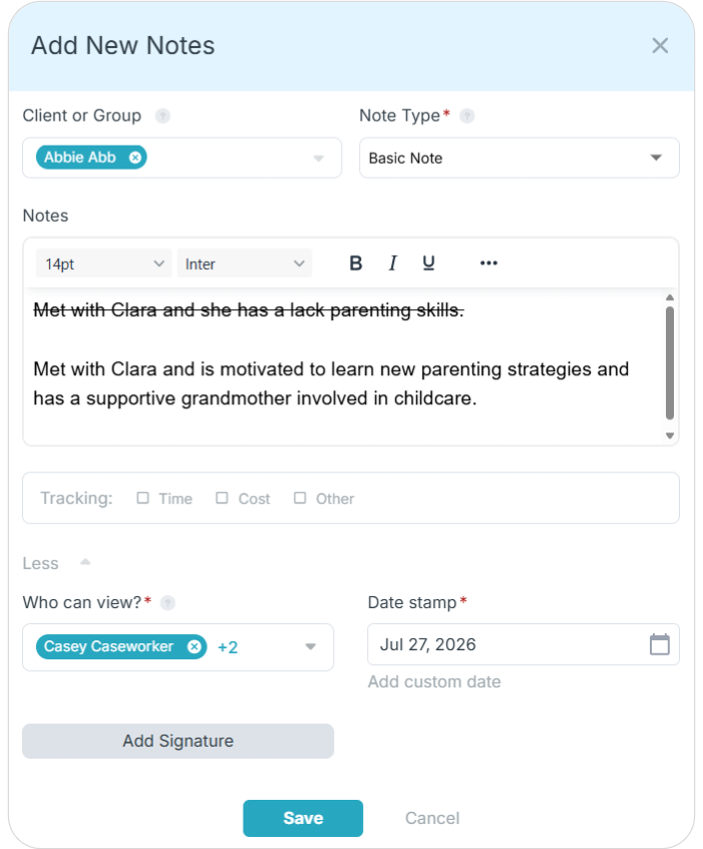
Case note from Case Management Hub
This shift matters because language shapes intervention design. A deficit framing leads to compliance-based plans. A strengths framing leads to plans built on what’s already working.

How Do Social Workers Apply This in Practice?
Strengths based practice shows up in specific, repeatable techniques.
Strengths based questions. Instead of “what problems are you having at home,” a social worker might ask “what’s helped you get through hard times before” or “who in your life do you turn to for support.” These questions surface resources rather than just risks.
Strengths based assessment. Traditional assessments often start with a problem checklist. A strengths-based version incorporates client history, support systems, coping strategies, and personal goals alongside any risk factors, giving a fuller picture of the person.
Collaborative goal setting. Goals come from the client’s own priorities, not solely from a clinical treatment plan. The social worker’s role is to help clients articulate goals they may already have but haven’t put into words.
Strengths based case notes. Documentation reflects both challenges and resources. A note might track a client’s progress alongside the specific strengths that supported that progress, which becomes useful for future planning and for other providers reading the file.
Trauma informed integration. Strengths based practice pairs naturally with trauma informed care. Both emphasize safety, choice, and collaboration rather than control.
🔥Still using spreadsheets for case management?
Switch to an all-in-one case management platform.
👉 Try it Free - No credit card needed
What Does Strengths Based Language Sound Like?
Small wording shifts carry a lot of weight. A social worker moving toward this model often practices reframing common phrases:
- “Non-compliant” becomes “not yet engaged in this particular plan”
- “Lacks insight” becomes “still building understanding of how this situation developed”
- “Chronic relapse” becomes “has faced repeated setbacks while continuing to seek recovery”
These aren’t just softer words. They reflect a genuinely different clinical lens, one that assumes capacity for change rather than fixed limitation.

👉 Try this Case Management Software free today
No credit card needed
Bringing Strengths Based Practice into Daily Work
Strengths based practice isn’t a one-time training topic. It’s a lens that has to be applied consistently, in intake interviews, in progress notes, in team meetings, and in how a case file reads months later.
That consistency is easier when the tools social workers use every day are built to support it. Case Management Hub is designed with flexible assessment and documentation fields that let social workers capture client strengths alongside challenges, rather than forcing every entry into a deficit-focused template. If you want to see how that works in practice, you can explore the case management software overview or start a free trial to try it with your own caseload.
💡All-in-one Case Management Software.
Everything in one place: clients, notes, forms, appointments, reports, and outcomes.
👉 Try it Free - No credit card needed
Common Questions About the Strengths Based Approach
Is the strengths-based approach the same as positive thinking?
Not quite. It's not about ignoring problems or putting a positive spin on serious issues. It's a structured practice framework that identifies real, usable resources alongside real challenges.
Can this approach be used with high-risk cases, like child welfare or crisis intervention?
Yes. Even in high-risk situations, identifying a family's existing strengths (a supportive relative, a willingness to engage in services, a stable routine) helps build a more realistic and sustainable safety plan than a deficit-only approach would.
Does this replace clinical diagnosis or risk assessment?
No. Diagnoses and risk factors are still documented and addressed. The strengths based approach changes how the overall case is framed and how interventions are designed, not whether real problems get acknowledged.
How long does it take to shift from deficit based to strengths-based documentation?
Many social workers report it takes a few weeks of intentional practice to change habitual language patterns, though the shift in thinking often happens faster once the underlying framework clicks.
What is the difference between a strengths-based approach and a solution-focused approach?
While both focus on positive outcomes, they differ in their primary starting point. A strengths-based approach centers on identifying and mobilizing a client’s existing personal resources, relationships, and internal capacities. A solution-focused approach, on the other hand, centers on the desired future outcome and the specific steps needed to reach it.
How do you implement strengths-based language in social work documentation and case notes?
Shifting your documentation means moving away from clinical labels or deficit-focused descriptions (like non-compliant) and toward objective, growth-oriented language. For example, instead of focusing solely on risk factors, a strengths-based case note details what strategies the client is currently using to cope, who supports them, and how they are actively participating in their care plan.
👉 Try it free today - No credit card needed
Note: Content on this website (socialworkportal.com) is copyrighted and protected under applicable copyright laws. Unauthorized reproduction, distribution, or use of any content from the website, without explicit written permission, is strictly prohibited. Read: Terms of Use.
Social Work Portal Disclaimer: Social Work Portal is not a social work agency and we do not refer social workers. This web site is provided for educational and informational purposes only and does not constitute providing medical advice or professional social and healthcare services. The information provided should not be used for diagnosing or treating a health problem or disease, and those seeking personal medical advice should consult with ... Read our full disclaimer here: Social Work Portal Disclaimer.