A Practical Guide to Building Care Plans from Intake Data
A client sits in your intake chair, hands you a wrinkled clipboard, and stares at the floor. You scan the page: sleep disruption marked nearly every day, appetite swinging downward, fatigue through the roof, and a total score of 14. Down at Item 9, they placed a cautious checkmark under “Several days.”
Now your session timer is running. You have forty-five minutes to conduct an intake, establish trust, navigate potential crisis, and map an intervention plan that will satisfy your clinical director and survive an insurance audit.
This is where the screening process so often fractures. Across outpatient programs, county agencies, and nonprofit community health clinics, the Patient Health Questionnaire-9 is frequently treated as an administrative gatekeeper: a form to file rather than a roadmap for care. Frontline caseworkers and therapists get caught between two extremes: overreacting to passive distress with traumatic, unnecessary emergency room referrals, or underreacting by filing the sheet away under “moderate symptoms” without scheduling targeted follow-ups.
To make screening meaningful, agencies must abandon static score collection and deploy dynamic clinical pathways. When you connect numerical score brackets to concrete behavioral steps, stepped-care models, and immediate safety workflows, you protect your clients from falling through the cracks while shielding your team from liability.
Let’s get started
Watch this video:
or
read the guide below.
What You’ll Learn in This Guide
- How to establish a rapid, seamless PHQ-2 to PHQ-9 clinical workflow at intake.
- How to interpret PHQ-9 severity scores to build defensible, staged intervention plans.
- How to manage Item 9 disclosures with a calm, legally protective safety protocol.
- How to write audit-proof clinical documentation using a dedicated SOAP note template for PHQ-9 depression screening.
- How automated PHQ-9 scoring in EHR systems wipes out calculation mistakes and administrative drag.
- How to benchmark clinical progress using quantitative symptom drop thresholds.
💡All-in-one Case Management Software.
Everything in one place: clients, notes, forms, appointments, reports, and outcomes.
👉 Try it Free - No credit card needed
Why Does Depression Screening So Often Lead to Zero Follow-Up Action?
Standardized depression screening is considered best practice across modern healthcare. The clinical evidence behind the tool is indisputable. A landmark study published by Dr. Kurt Kroenke and colleagues in the Journal of General Internal Medicine demonstrated that a PHQ-9 score of 10 or greater has an 88% sensitivity and an 88% specificity for detecting major depression.
Yet in daily agency practice, positive screens routinely stall out.
The breakdown is systemic. Case managers carry 40 to 60 active client files. Social workers run back-to-back crisis intakes. When screening relies on paper packets, intake staff must tally scores by hand, decipher messy handwriting, and calculate totals while trying to maintain human eye contact. In the scramble to finish paperwork before the next appointment arrives, clinicians write generic progress notes: “Client completed PHQ-9 with moderate score; will continue to monitor.”
Monitoring is not an intervention. A positive screen requires an immediate decision: Does this client need immediate crisis de-escalation, brief problem-solving counseling, a psychiatric medication consultation, or connection to food and housing resources? Without an agency-wide PHQ-9 scoring interpretation guide linked to operational pathways, providers are left guessing, and clients drift until their symptoms escalate.
How Do You Translate PHQ-9 Severity Cutoffs into Bulletproof Treatment Steps?
Moving from an abstract number to a targeted depression care plan from PHQ-9 results requires clear, non-negotiable operational cutoffs. The assessment evaluates nine DSM criteria over the preceding 14 days on a 0 to 27 scale.
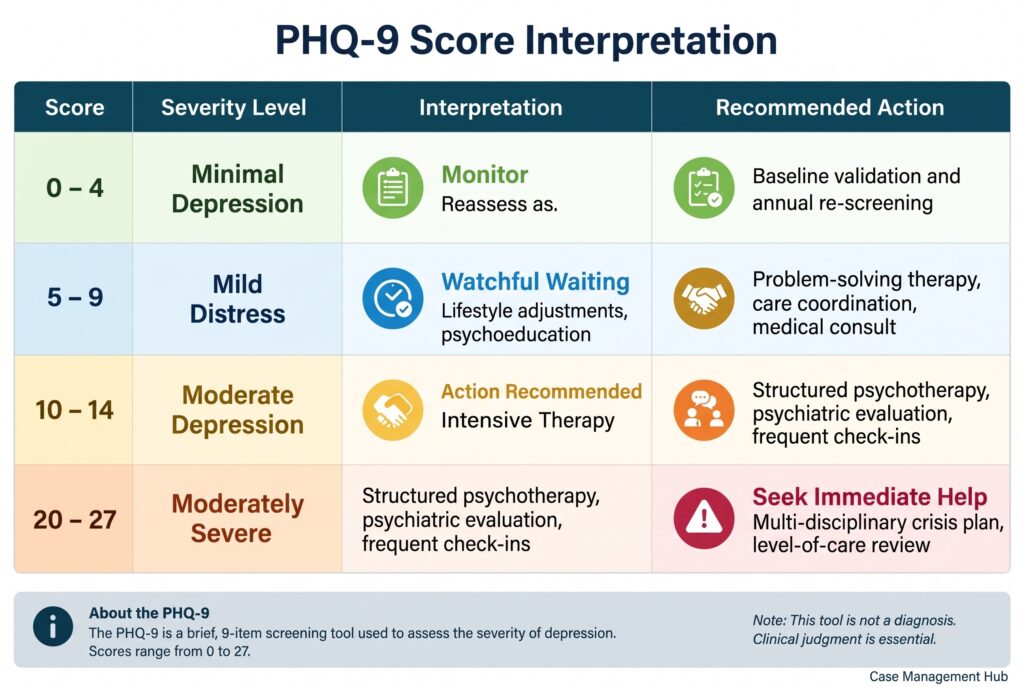
1. Scores 0 to 4: Minimal or No Depression
- The Reality in the Room: The client is managing normal day-to-day stress without debilitating vegetative or cognitive symptoms.
- The Clinical Response: Document the baseline score. Validate their current coping mechanisms. Rescreen during annual reviews or following major life transitions like job loss or medical diagnoses.
2. Scores 5 to 9: Mild Depression
- The Reality in the Room: The client feels chronically depleted, irritable, or disconnected, but they are holding their job or family routine together with effort.
- The Clinical Response: Implement structured watchful waiting. Deliver concrete psychoeducation on sleep regulation, physical movement, and behavioral activation. Re-evaluate within 30 to 60 days. If the score creeps upward, advance them along your stepped-care ladder immediately.
3. Scores 10 to 14: Moderate Depression
- The Reality in the Room: Functional cracks are widening. The client is calling in sick, isolating from family, missing bills, or struggling with cognitive fog.
- The Clinical Response: Clinical action for moderate depression PHQ-9 assessments demands active intervention. Initiate brief, structured counseling (such as Cognitive Behavioral Therapy or Solution-Focused Brief Therapy). If no meaningful relief occurs after 6 to 8 weeks, initiate a referral for a medical or psychiatric evaluation to explore pharmacotherapy options.
- For clients presenting with comorbid anxiety, pair this approach with our guide on matching GAD-7 scores to clinical interventions.” Otherwise, keep the six verified exact-match links above.
4. Scores 15 to 19: Moderately Severe Depression
- The Reality in the Room: Severe lethargy, pervasive feelings of worthlessness, major sleep disturbances, and an inability to maintain everyday adult responsibilities.
- The Clinical Response: Formulate an intensive, dual-track care plan. Pair weekly individual psychotherapy directly with a psychiatric referral. Assign a care coordinator to help the client overcome executive functioning barriers, such as scheduling appointments, managing transportation, and securing prescription coverage.
5. Scores 20 to 27: Severe Depression
- The Reality in the Room: Profound psychomotor slowing, physical neglect, acute despair, and severe functional collapse.
- The Clinical Response: Activate an immediate multi-disciplinary intervention. Evaluate whether outpatient care is clinically safe or if partial hospitalization (PHP) or intensive outpatient programming (IOP) is required. Secure client releases to coordinate with family supports, primary care physicians, and psychiatric prescribers.
👉 Try it Free - Free Case Management System
How Should You Handle Item 9 When a Client Scores Positive for Harm?
Item 9 states: “Thoughts that you would be better off dead, or of hurting yourself in some way.”
Every experienced caseworker knows the tension of seeing a checkmark on this question. Many newer clinicians freeze or overreact, calling emergency dispatch prematurely for clients expressing passive fatigue with life, which damages therapeutic rapport. Others do the opposite, glossing over it out of discomfort.
Neither response is acceptable. Any non-zero answer (1, 2, or 3) mandates an immediate, standardized PHQ-9 Question 9 safety protocol, even when the overall cumulative score is very low. A client who scores a 4 overall because of severe insomnia and guilt can still be in acute danger if Item 9 is positive.
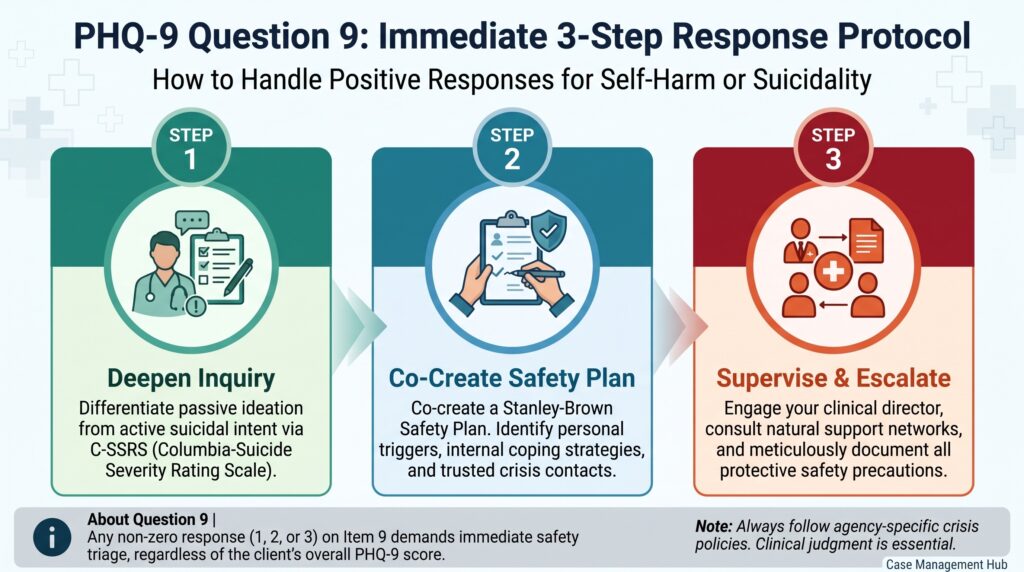
1. Differentiate Passive Distress from Active Suicide Risk
Never assume intent. Validate the client calmly: “I noticed you indicated you have had thoughts about being better off dead. Thank you for being honest about that. Can you tell me what those thoughts look like for you right now?” Transition directly to a validated secondary tool, such as the Columbia-Suicide Severity Rating Scale (C-SSRS). You must determine three things immediately: Does the client have explicit suicidal intent? Do they have a concrete plan? Do they have access to lethal means?
2. Formulate a Collaborative Safety Plan
If the client exhibits passive death wishes or chronic baseline ideation without acute plan or intent, do not send them to an emergency room. Construct a collaborative, written safety plan (such as the evidence-based Stanley-Brown model). Document their personal warning signs, self-soothing behaviors, safe public spaces for distraction, trusted friends or relatives, and accessible professional lifelines including the 988 Suicide and Crisis Lifeline.
3. Clinical Supervision and Audit-Proof Documentation
If active intent, a specific plan, or lethal means access is identified, initiate emergency clinical escalation according to agency policies. Never let an actively suicidal client leave your office unmonitored.
When charting, write explicit, defensible notes. Record that you reviewed Item 9 directly, detail the exact statements the client made, cite the secondary screener utilized, and lay out every protective factor and safety intervention put in place before session discharge.
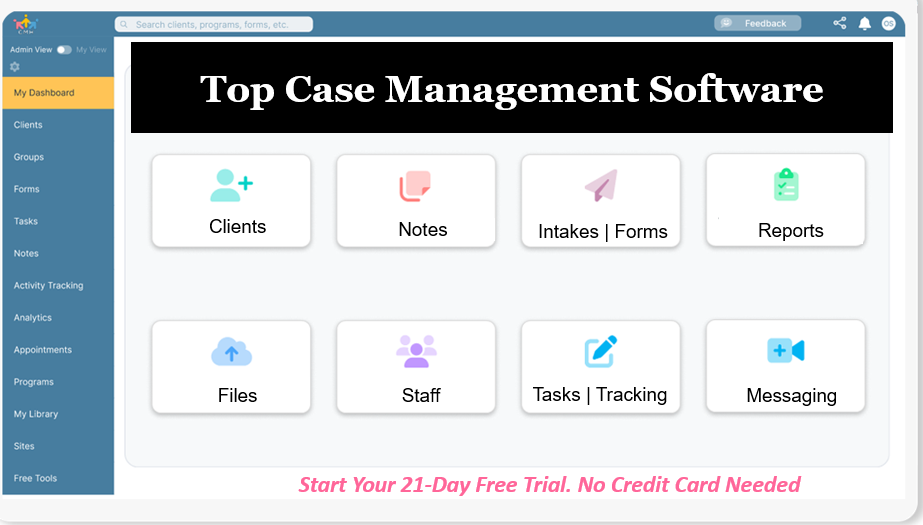
Do You Have a Team? Our best all-in-one client and top case management software simplifies everything from client intake and assessments to programs, projects, goals tracking, planning, scheduling, documentation, reporting dashboard, and progress tracking.All-in-One Case Management Software
Sign Up Today, Free
No credit card needed!
How Digital Tools Streamline PHQ-9 Depression Screenings
Relying on physical paper forms, manual grading keys, and physical filing cabinets creates severe clinical vulnerability. Manual assessments waste precious appointment minutes, invite human calculation errors, and make tracking client trends across multi-month episodes of care nearly impossible.
Implementing a modern digital PHQ-9 screening tool for social workers resolves these issues through structured automation:
- Remote Pre-Visit Intake: Clients complete an encrypted, HIPAA compliant PHQ-9 intake form on their smartphone or waiting room tablet prior to their appointment.
- Instant Scoring and Visual Flags: The platform tallies scores in real time, assigns severity cutoffs automatically, and triggers a high-visibility alert banner if Item 9 is marked.
- One-Click Documentation Population: The screening score, individual symptom breakdowns, and risk flags map directly into a DAP note depression screening PHQ-9 format or a structured SOAP clinical note template.
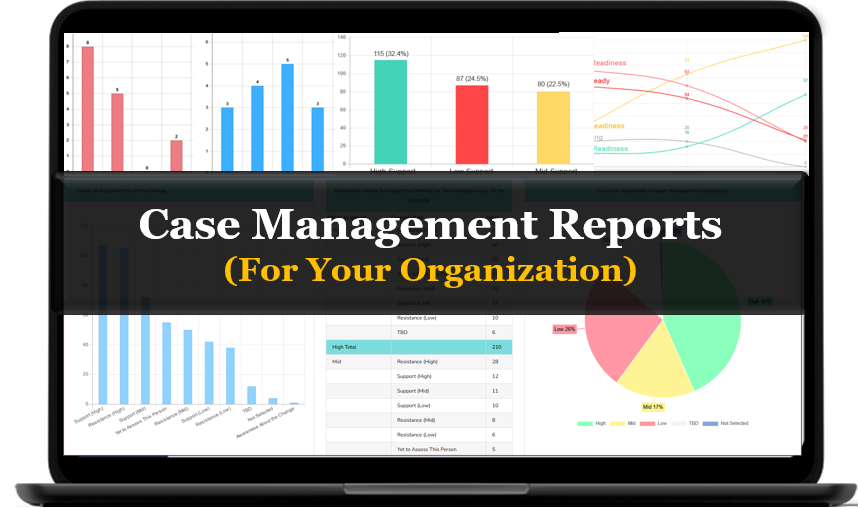
- Longitudinal Trend Visualization: Tracking PHQ-9 scores over time software produces clear visual recovery graphs. Providers and supervisors can spot treatment plateaus or sudden regressions at a glance.
- Automated Team Workflows: An automated depression screening workflow behavioral health system alerts supervisors when severe cutoffs are triggered, initiating immediate care coordination without paperwork delays.
Manual Paper Workflow vs. Modern Digital Workflow
| Operational Step | Traditional Paper Workflow | Automated Digital System |
| Intake Delivery | Paper forms handed on clipboards; handwriting often illegible | Encrypted digital form sent pre-visit via client portal |
| Score Computation | Clinician tallies points by hand; high risk of math errors | Automated scoring with zero calculation mistakes |
| Item 9 Triage | Clinician must manually scan down to catch self-harm flags | Instant visual alert banner highlights positive risk items |
| Clinical Charting | Retyping scores and narrative text manually into notes | One-click auto-population into SOAP and DAP note templates |
| Progress Tracking | Sifting through past paper sheets to evaluate symptom shifts | Real-time recovery curves comparing baseline to current score |
| Team Care Coordination | Verbal hallway catch-ups or delayed inter-office emails | Automated task routing to care navigators and supervisors |

People Also Ask About
Can unlicensed case managers and intake navigators administer the PHQ-9?
Yes. Unlicensed staff, community health workers, and intake coordinators can administer the PHQ-9 because it is a self-report tool. However, diagnostic interpretation, formal risk evaluations for positive Item 9 responses, and clinical care plan formulation must remain under the oversight of a licensed clinical supervisor.
When should a clinic use the PHQ-2 instead of the PHQ-9?
The PHQ-2 is a 2-question screener evaluating anhedonia and depressed mood, designed for rapid initial triage in high-volume settings. A score of 3 or higher on the PHQ-2 represents a positive screen, requiring immediate escalation to the full PHQ-9 for comprehensive diagnostic assessment.
How much must a PHQ-9 score drop to show real clinical progress?
A reduction of 5 points or a 50% decrease from the client’s baseline score represents a statistically and clinically meaningful treatment response. Reaching a total score below 5 indicates full clinical remission.
Does a score above 10 confirm a diagnosis of Major Depressive Disorder?
No. The PHQ-9 is a screening and symptom severity measurement tool, not an automated diagnostic instrument. While a score of 10 or greater strongly suggests major depression, a licensed clinician must conduct a clinical interview to rule out bereavement, medical conditions, substance-induced mood disorders, or bipolar disorder.
How frequently should clinicians re-administer the PHQ-9?
During active psychotherapy or medication management, readminister the PHQ-9 every 4 to 6 weeks to evaluate treatment effectiveness and adjust care plans. For clients in maintenance phases or community support programs, quarterly reassessment is standard.
What should you do when a client skips questions on the form?
If more than two questions are left blank, the total score is clinically invalid and cannot be scored. Clinicians should review the unanswered questions with the client during the session, exploring whether omissions were due to literacy barriers, confusion, or emotional distress.
How Can Case Management Hub Modernize Your Agency’s Assessment Workflow?
Translating clinical screening into consistent, high-impact client care should not require fighting obsolete software, paper clipboards, and disconnected spreadsheets.
Case Management Hub delivers an all-in-one, HIPAA-compliant platform designed by and for behavioral health professionals, social workers, and community case managers. Featuring integrated digital clinical assessments, Case Management Hub automatically scores incoming PHQ-9s, flags crisis indicators, and transfers data into audit-ready SOAP and DAP notes in seconds. Visual progress dashboards track client outcomes over time, providing the hard empirical data needed for clinical supervision, insurance reauthorizations, and grant reporting.
Free your clinical team from administrative burnout so they can focus on what actually matters: connecting with clients and guiding them toward recovery.
Start your 21-day free trial today (no credit card required) and experience how client progress tracking software for case managers can elevate your organization.
Frequently Asked Questions:
What is the exact way to document a positive PHQ-9 in a SOAP note?
In the Subjective (S) section, record the client's direct self-reported mood, coping challenges, and narrative statements regarding their symptoms over the past two weeks. In the Objective (O) section, record the exact PHQ-9 score, severity category, baseline comparison, and the Item 9 rating (e.g., PHQ-9 total: 16, Moderately Severe; Item 9: 0). In the Assessment (A) section, document your clinical rationale, diagnostic impressions, functional impairments, and suicide risk level. In the Plan (P) section, document specific therapeutic modalities, safety precautions enacted, psychiatric referrals sent, and the target reassessment date.
What are the legal liability risks if a clinician ignores a positive Item 9?
Failing to document an explicit evaluation and safety intervention following a positive Item 9 response exposes providers and agencies to extreme malpractice liability. If an adverse event occurs, medical records that show a positive self-harm score with no documented clinical inquiry, risk assessment, or protective safety plan serve as clear evidence of failure to meet standard of care.
How do we keep digital depression screening completely HIPAA compliant?
Digital screening requires end-to-end data encryption, unique user credentials, comprehensive system audit logs, and an executed Business Associate Agreement (BAA) with your software vendor. Free, consumer-grade online survey tools lack these required protections and violate federal privacy regulations.
How should caseworkers respond when a client flatly refuses to complete the questionnaire?
Never force compliance or withhold non-emergency services due to a declined screener. Validate the client's autonomy and explain the tool's purpose: This questionnaire helps us understand what feels heaviest right now so we can focus our time on what you need most. If they still decline, respect the refusal, note it in their file, and gather clinical observations organically through open-ended interviewing.
Can the PHQ-9 be used accurately across diverse cultural backgrounds?
Yes. The PHQ-9 has been validated across dozens of languages and cultural groups globally. However, clinicians must remain alert to cultural differences in symptom expression. Many cultural groups articulate psychological pain through somatic channels, reporting chronic bodily fatigue, sleep disturbances, or headaches rather than identifying with labels like depression or sadness.
How do sequential PHQ-9 scores protect program funding and help pass audits?
Healthcare payers, Medicaid managed care organizations, and philanthropic grantors increasingly demand measurement-based care documentation. Tracking quantitative score drops across client cohorts provides defensible, objective proof that your agency's clinical interventions produce measurable improvements in client functioning.
👉 Try it free today - No credit card needed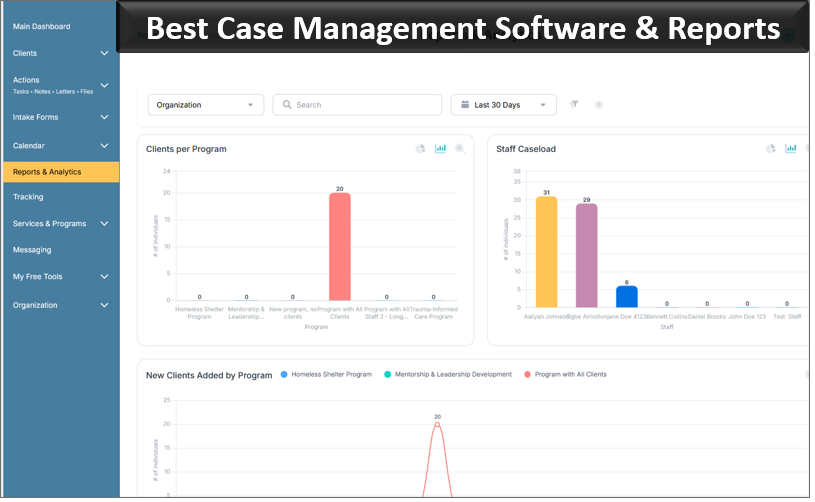
Note: Content on this website (socialworkportal.com) is copyrighted and protected under applicable copyright laws. Unauthorized reproduction, distribution, or use of any content from the website, without explicit written permission, is strictly prohibited. Read: Terms of Use.
Social Work Portal Disclaimer: Social Work Portal is not a social work agency and we do not refer social workers. This web site is provided for educational and informational purposes only and does not constitute providing medical advice or professional social and healthcare services. The information provided should not be used for diagnosing or treating a health problem or disease, and those seeking personal medical advice should consult with ... Read our full disclaimer here: Social Work Portal Disclaimer.