LCSW Hours Tracking Breakdown (with Free LCSW hours tracking log!)
Earning a Master of Social Work (MSW) is a massive milestone, but it is only the first phase of the journey toward independent clinical practice. For postgraduate clinicians, the transition from classroom theory to specialized fieldwork is structured around one specific objective: meeting state-mandated post-graduate hours to advance from a licensed social worker (LSW) to a licensed clinical social worker (LCSW).
Understanding how to meet LCSW hours requirements is essential for moving your career forward, ensuring billing autonomy, and avoiding compliance issues. Tracking this progression accurately determines how quickly you can sit for your clinical exam.
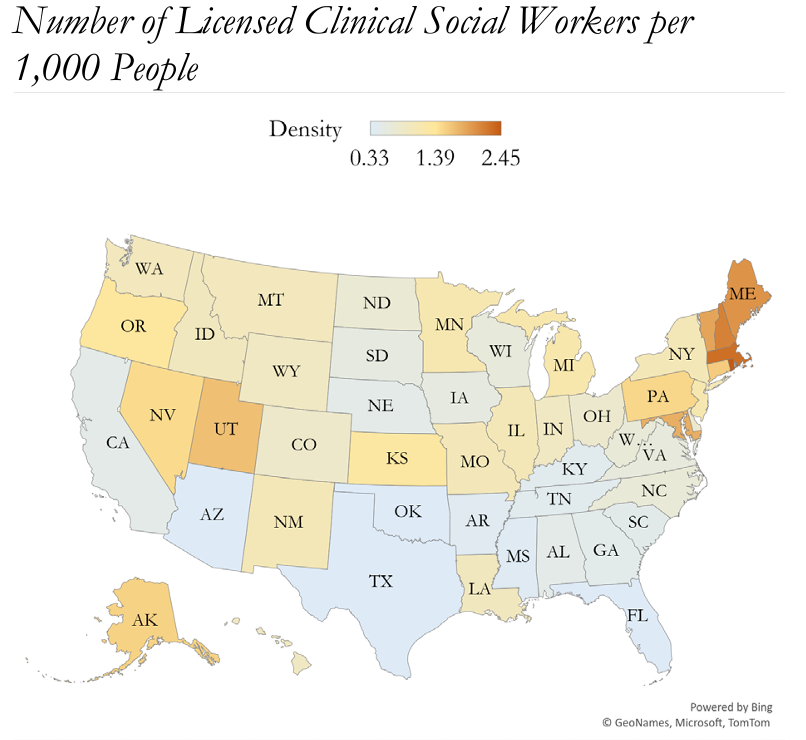
This chart from the 2024 Social Work Workforce Study Series illustrates the need for more LCSWs in many U.S. States.
Below, we’ll simply LCSW hours tracking for you, including:
- The Clinical Hour Breakdown: How direct client contact differs from indirect
- The True Licensure Timeline: Realistic benchmarks for completing your hours
- Supervision Deep Dive: Navigating the strict limits placed on individual vs. group hours.
- Audit-Proof Log Strategy: Best practices for documenting your time accurately to avoid board delays.
- State Cross-Over Risks: How to protect your hours if you plan to move across state lines.
- Tech-Driven Optimization: Using clinical tools to minimize the administrative headache of time-tracking.
Let’s get started
Watch this video:
or
read the guide below.
Everything in one place: clients, notes, forms, appointments, reports, and outcomes. 👉 Try it Free - No credit card needed💡All-in-one Case Management Software.
What Counts as Qualifying Clinical Social Work Experience?
Understanding the precise criteria for qualifying clinical social work experience is the foundational step of your licensure journey. State boards do not accept general social work tasks. Instead, your hours must directly align with clinical therapeutic interventions, assessment, and treatment planning under approved conditions.
You can compare LCSW licensing requirements by jurisdiction at the Association of Social Work Boards website.
The Core Components
Licensure hours are generally divided into distinct categories that must be balanced simultaneously:
- Direct Client Contact: Face-to-face therapy, psychosocial assessments, crisis intervention, and group counseling.
- Indirect Hours: Case management, clinical documentation, treatment planning, and attending case consultations.
- Clinical Supervision: Dedicated time spent reviewing cases with an accredited supervisor.
Common Challenges
The biggest hurdle for most associates is the strict division between direct and indirect tasks. If a non-profit agency assigns a clinician to a heavy workload of administrative care coordination, the clinician may work forty hours a week but only accumulate fifteen hours of qualifying direct client contact. This imbalance unexpectedly extends the timeline for licensure.
Comparison Elements: Direct vs. Indirect Hours
| Feature | Direct Client Contact | Indirect Clinical Hours |
| Primary Activity | Face-to-face therapy, intakes, crisis work | Note-writing, research, care coordination |
| Board Scrutiny | High; strict minimum percentage thresholds | Moderate; capped at a maximum percentage |
| Documen- tation Need | Must link directly to a clinical client ID | Must link to case preparation or administration |
Decision-Making Factors
When accepting a postgraduate social work position, candidates must ask employers for an explicit breakdown of the weekly schedule. If the ratio of direct client contact is under fifty percent, achieving the required hour total will take significantly longer.
👉 Try it Free - Free Case Management System
How Long Does It Take to Get LCSW Hours Under Supervision?
The timeline required to complete your clinical hours varies depending on employment status, state regulations, and supervisor availability. Most jurisdictions require a specific volume of hours distributed over a set minimum and maximum timeframe.
Quantitative LCSW Benchmarks
You’ll find that most states mandate at least 3,000 hours of qualifying clinical social work experience, typically completed over a minimum of two years and a maximum of six years. Within those clinical hours, boards usually require 100 to 150 hours of total supervision, which must be split intentionally between individual and group sessions.
In a typical scenario, a full-time clinician working forty hours per week finishes 3,000 hours in approximately two years, provided their direct-to-indirect ratio is balanced. However, a part-time clinician working twenty hours per week at a private practice or specialized non-profit will require three to four years to reach that exact same threshold.
Understand the “Speed Trap” with LCSW Licensure
The primary risk here is the “speed trap.” Some associates believe that working sixty hours a week will allow them to fast-track their licensure in twelve months. State boards explicitly prevent this by enforcing a strict minimum timeframe (usually 24 months). Any hours gathered outside that statutory window are completely disqualified during an audit.
All-in-One Case Management Software
Sign Up Today, Free
No credit card needed!
Do You Have a Team? | ||
Our best all-in-one client and top case management software simplifies everything from client intake and assessments to programs, projects, goals tracking, planning, scheduling, documentation, reporting dashboard, and progress tracking.
What Is the Difference Between Individual and Group Supervision Hours?
A common area of confusion for many clinical social workers is understanding the distinct caps and definitions applied to individual versus group supervision. Both are vital for professional growth, but boards regulate them differently.
Operational LCSW Supervision Definitions
- Individual Supervision: A one-on-one session between you and an accredited LCSW clinical supervisor, focused entirely on your specific caseload, clinical ethics, and therapeutic skills.
- Group Supervision: A session led by an approved supervisor with a small cohort of associate clinicians (typically limited to six or eight participants by the board).

Practical Insights & Decision-Making Factors
Group supervision provides excellent exposure to diverse clinical styles and varied client cases. However, relying too heavily on group hours can cause problems. Many states place a strict ceiling on group supervision, dictates that no more than fifty percent of your total supervision hours can occur in a group format.
When establishing a supervision contract, ensure your supervisor can guarantee the necessary one-on-one availability. If an agency only offers group supervision due to high staffing demands, you may need to hire an outside, independent accredited LCSW clinical supervisor to keep your hours on track.

How Can You Effectively Log and Document Licensure Hours?
An audit by a social work board can occur during your application process or years after you receive your license. Failing to document your hours accurately can result in your application being rejected, forcing you to restart the process.
The Risk of Disorganization
A practical challenge for clinicians is keeping up with delayed documentation. Tracking hours on scattered paper logs or incomplete digital files makes it difficult to maintain precise records. When it comes time for your social work board licensure verification, your supervisor must sign off on exact numbers. If your records do not match their personal notes, the board will stall your application.
Streamline LCSW Hours Tracking with Free Tools
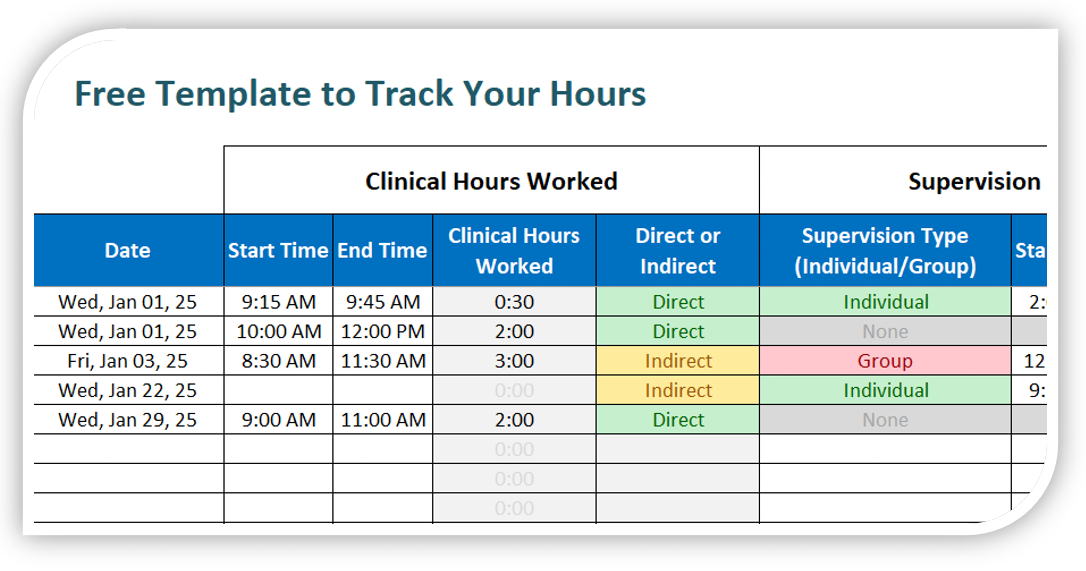
To eliminate tracking errors, clinicians should use standardized templates that separate direct client contact, indirect work, and supervision types. Using a clear system ensures your hours align directly with your state’s licensing categories. An online LCSW hours tracking tool with a timer is generally more efficient than manual sheet, but we have both for you below!
Download a Free LCSW Tracking Sheet (Manual): To ensure your hours are fully compliant and ready for an audit, we have created a comprehensive, downloadable LCSW Hours Tracking Log. This free resource provides structured columns for separating direct versus indirect work, tracking individual and group supervision, and maintaining clear records for your supervisor’s signature.
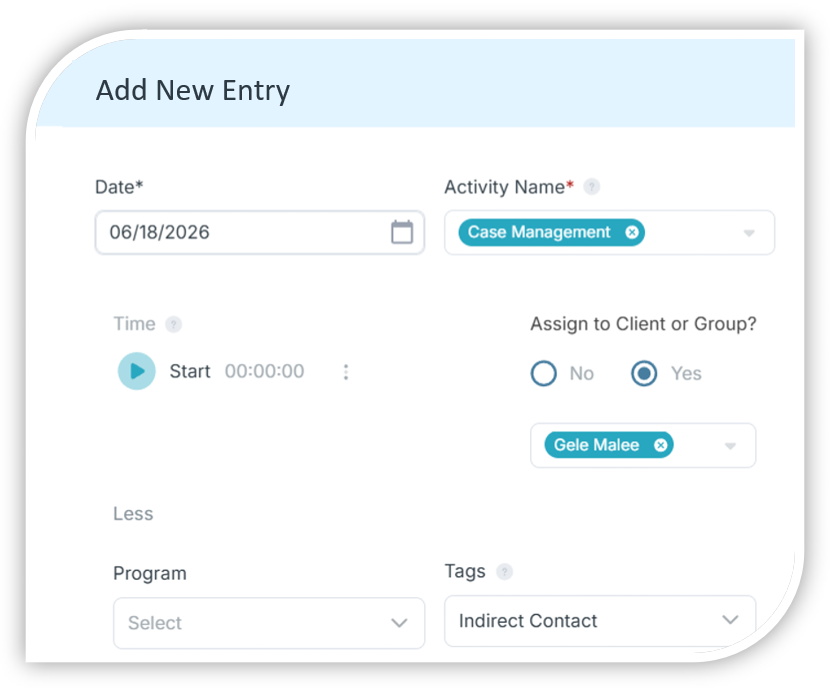
Free Trial of a Case Management Platform with Hours Tracking: The Case Management Hub is a cloud-based system that can be accessed from any device (great for field work!). It includes three ways to enter LCSW time tracking – using a timer, adding the time manually, or adding a to and from time. Tracking entries can also be categorized any way you like! The 21-day free trial doesn’t require a credit card.
🔥Still using spreadsheets for case management?
Switch to an all-in-one case management platform.
👉 Try it Free - No credit card needed
Why Do State-by-State Variations Cause Licensure Delays?
Social work licensure requirements are not standardized across the United States and Canada. Every single state board operates independently, creating a complicated landscape of distinct rules and local regulations.
Before beginning your fieldwork, print your specific state board’s current application packet. Do not rely on advice from colleagues who went through the process in a different state or under an older set of rules. Keep a copy of your initial supervision agreement filed safely away, as it defines the rules governing your hours throughout your residency.
👉 Try this Case Management Software free today
No credit card needed
How Can Case Management Software Simplify the Licensure Path?
While individual clinicians use basic tracking logs to monitor their personal progress, agencies, non-profits, and growing practices face a much larger administrative challenge. Managing multiple associates, assigning supervisors, and maintaining audit-ready documentation requires a more cohesive system than fragmented spreadsheets.
This is where a dedicated clinical platform changes the game. Transitioning to an integrated case management software allows organizations and busy clinicians to manage clients, appointments, scheduling, intakes, and forms inside a single ecosystem.
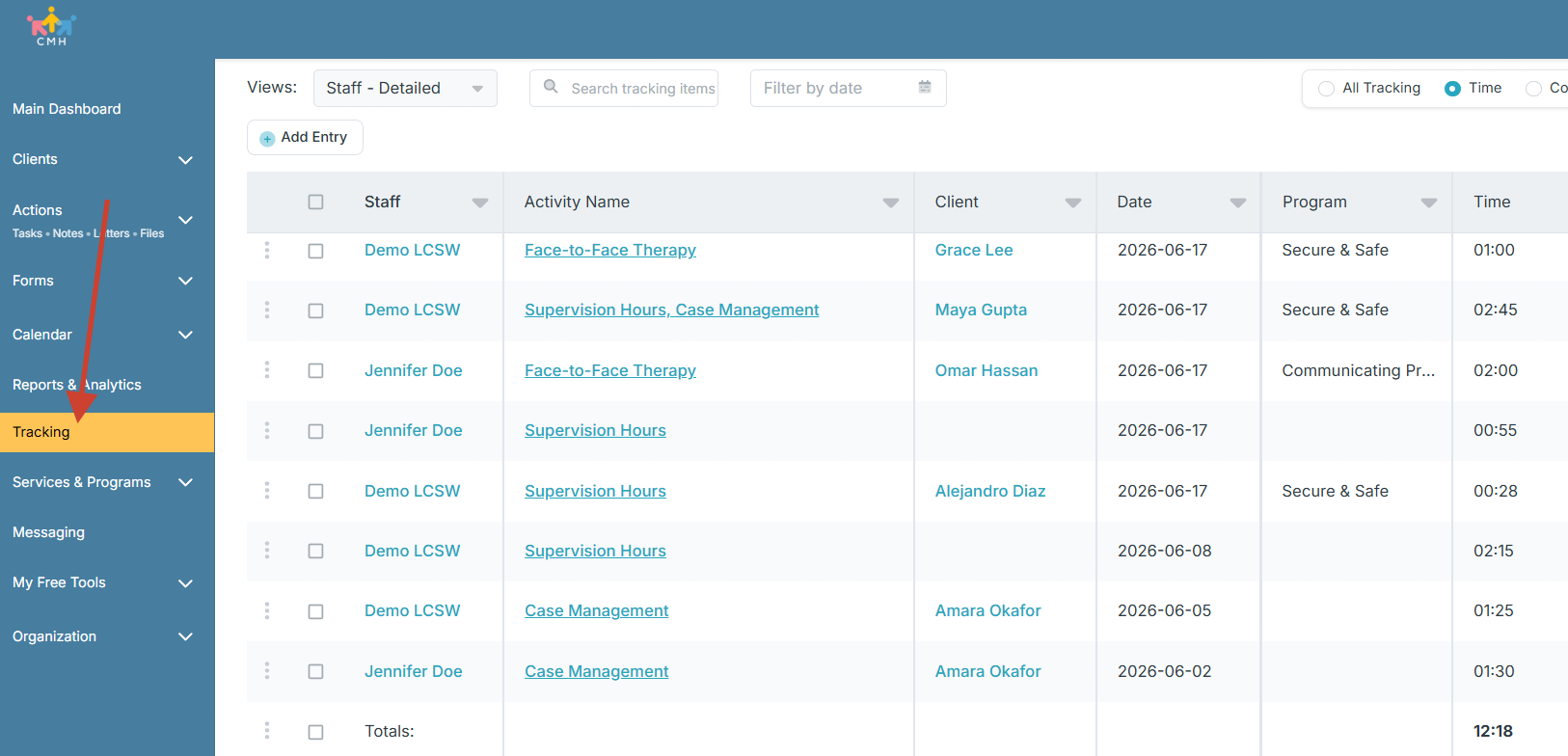
The Tracking Module in the Case Management Hub Software makes tracking LCSW hours quick and easy!
💡All-in-one Case Management Software.
Everything in one place: clients, notes, forms, appointments, reports, and outcomes.
👉 Try it Free - No credit card needed
The Connected Case Manager Workflow
When a clinician writes an official note or records a session, the system can automatically log the time, link it to client, and categorize it as direct or indirect clinical work.
For agencies looking to simplify this oversight and eliminate administrative friction, the Case Management Hub an all-in-one platform built specifically for social services. It streamlines everything from HIPAA-compliant secure data storage to daily time logs.
To see how integrated tracking can support your team, explore the platform and sign up for a free trial of Case Management Hub today.
👉 Try it Free today - No credit card needed
LCSW Hours Tracking Frequently Asked Questions
What happens if my clinical supervisor leaves the agency before I finish my hours?
If your accredited LCSW clinical supervisor leaves, you must stop counting your hours immediately until a new, board-approved supervision contract is signed. Always request a signed verification form covering the exact hours completed under the departing supervisor before their last day on site.
Can I count private practice experience toward my clinical hours?
This depends entirely on your state board. Some states allow associates to gain qualifying clinical social work experience in a private practice setting, provided they are employed directly and supervised on-site. Other states may may not allow it.
What is the maximum number of hours I can log in a single week?
Many state boards cap weekly loggable hours between forty and fifty hours. Even if you work sixty hours during a busy week at a community agency, the board will truncate your log to the maximum legal limit during the evaluation process.
Do holiday hours or paid time off count toward my direct or indirect totals?
Not generally. Only hours spent performing actual clinical duties, documentation, or supervision count toward your licensure. Paid time off, sick leave, and holidays must be excluded from your official logs.
Can group supervision hours completely replace individual supervision?
Not generally. State boards enforce specific ratios for supervision. Group sessions are usually capped at fifty percent of your total required supervision hours, meaning you must complete the remaining balance through one-on-one individual supervision
How far back can my logged hours go before they expire?
Most jurisdictions enforce an expiration window, typically ranging from five to six years from your initial registration date as an associate. Hours earned outside of this window expire and cannot be counted toward your application.
👉 Try it free today - No credit card needed
Note: Content on this website (socialworkportal.com) is copyrighted and protected under applicable copyright laws. Unauthorized reproduction, distribution, or use of any content from the website, without explicit written permission, is strictly prohibited. Read: Terms of Use.
Social Work Portal Disclaimer: Social Work Portal is not a social work agency and we do not refer social workers. This web site is provided for educational and informational purposes only and does not constitute providing medical advice or professional social and healthcare services. The information provided should not be used for diagnosing or treating a health problem or disease, and those seeking personal medical advice should consult with ... Read our full disclaimer here: Social Work Portal Disclaimer.