The Frontline Playbook for Compliant Screening and Escalation
Frontline caseworkers and intake staff face a difficult boundary. You are expected to spot severe client distress, yet your role strictly prohibits making clinical or psychiatric diagnoses.
Every day, teams administer the Patient Health Questionnaire-9 (PHQ-9) for intake and grant compliance. But because the tool mirrors DSM criteria, lines blur quickly. Reviewing a high score, telling a client they have “clinical depression,” and charting that phrase in a progress note creates an immediate scope-of-practice violation.
Adhering strictly to the National Association of Social Workers Code of Ethics protects both your clients and your agency. The risks of uncredentialed charting are real: failed audits, funding clawbacks, and dangerous delays during crisis escalations. Preventing scope violations does not mean stopping screening. It means replacing clinical guesswork with clear, audit-proof operational protocols.
Let’s get started
Watch this video:
or
read the guide below.
What You’ll Learn in This Guide
- The exact legal boundary separating non-clinical symptom screening from clinical psychiatric evaluation.
- The Frontline Scripting Protocol: verbatim dialogue for introducing the PHQ-9 and de-escalating positive Question 9 responses.
- The Banned Terms Charting Matrix: side-by-side DAP/SOAP phrasing showing what words trigger audit sanctions and what to write instead.
- Step-by-step operational SOPs for in-person, telehealth, and field intakes.
- How modern digital systems automate score calculations, restrict permissions, and alert supervisors instantly.
- Complete agency risk management protocols to protect unlicensed workers and agency licensure.
Free Download: PHQ-9 Screening Checklist
Download your free PHQ-9 Screening Boundaries & Crisis Triage Audit Sheet to keep at intake desks, guide staff through Question 9 escalations, and protect your agency during supervisory file reviews.
Download Your Free Resources Here
💡All-in-one Case Management Software.
Everything in one place: clients, notes, forms, appointments, reports, and outcomes.
👉 Try it Free - No credit card needed
What Is the Legal Boundary Between Symptom Screening and Clinical Diagnosis?
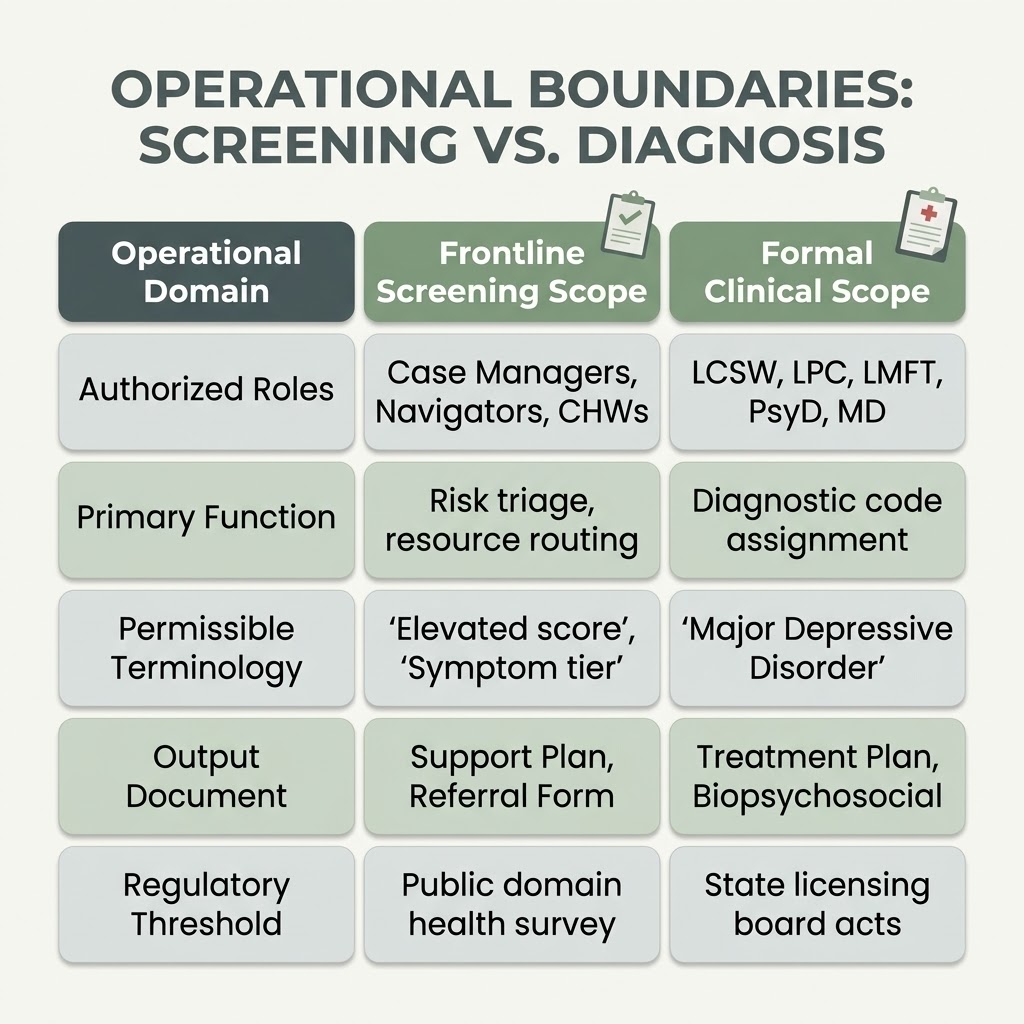
Administering the PHQ-9 is fully legal for non-clinical caseworkers because the tool is a standardized, public-domain self-report instrument. The legal violation occurs only when an unlicensed professional interprets, analyzes, or labels the underlying medical cause of those numbers.
A screening questionnaire serves one operational purpose: identifying risk markers that require practical resource allocation or clinical escalation. A clinical diagnosis, by contrast, is a formal legal determination made by an independently licensed professional (such as an LCSW, LPC, PsyD, MD, or PMHNP) that establishes etiology, rules out competing physiological issues, and justifies medical necessity for clinical treatment.
According to research published in The Journal of the American Medical Association (JAMA), the PHQ-9 has an 88% sensitivity and 88% specificity for major depressive disorder at a cutoff score of 10. That leaves a 12% margin for false positives. A client experiencing acute situational bereavement, thyroid dysfunction, severe vitamin deficiency, or neurodivergent burnout can easily score a 14 on the PHQ-9 without meeting clinical criteria for major depression.
When a non-clinical caseworker tells a client they have clinical depression, they are guessing without medical authority.
How Should Staff Introduce the PHQ-9 to Clients?
When clients feel judged or analyzed, they either mask their answers or disengage entirely. Non-clinical staff should demystify the assessment before handing it over or reading the questions. The goal is to normalize the process as an objective check-in on practical functioning.
Frontline Script: Introducing the Screener
Worker: “As part of our intake today, we have a short 9-question survey that we complete with everyone we support. It asks about common life stressors like sleep changes, low energy, and appetite over the past two weeks.
You and I will look at the score together. It does not give you a medical label, and it is not a test with right or wrong answers. It simply helps us understand how daily stressors are impacting your routine right now so we can connect you with the right programs, resources, or specialized support. If you are comfortable, let’s walk through it together.”
This approach establishes safety, removes clinical ambiguity, and sets the baseline that this form is a collaborative planning tool, not an interrogation.
Rushing through behavioral screeners without clear client orientation remains one of the most common nonprofit client intake mistakes, creating immediate rapport breakdowns and defensive response patterns.
What Is the Verbatim Protocol for Handling Question 9 Positive Responses?
Question 9 asks whether the respondent has had thoughts that they would be better off dead, or of hurting themselves in some way over the past two weeks. If a client selects anything other than zero (1, 2, or 3), non-clinical staff must execute an immediate safety protocol.
Non-clinical staff must never attempt to conduct a suicide lethality assessment, probe for intent, or negotiate safety contracts independently. That is a clinical responsibility.
While licensed supervisors utilize clinical lethality models, frontline staff trained in assessing safety and risk in case management know how to maintain client rapport while executing mandatory administrative safety handoffs.
Your duty is connection, support, and immediate escalation.
Consulting the NIMH Depression Clinical Overview offers non-clinical teams helpful background on how severe depressive episodes and acute suicidal ideation manifest in diverse client populations.
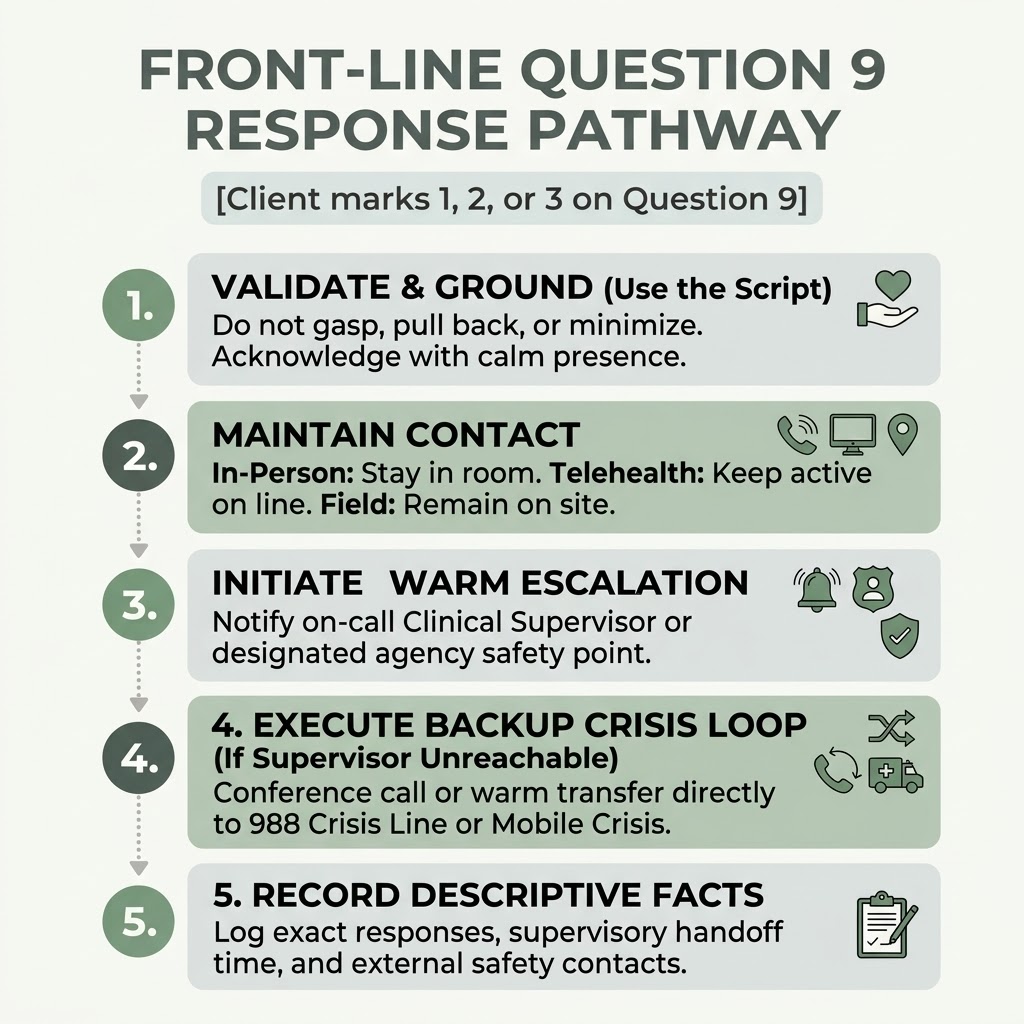
Script: Immediate In-Session Crisis De-escalation
Worker: “Thank you for being open and honest with me on Question 9. I see that you noted having thoughts about hurting yourself or that you would be better off dead. That tells me things have felt overwhelming lately, and I want to make sure you have real, dedicated support.
Because your safety comes first, our agency standard is that whenever a client notes these feelings, we connect immediately with our clinical supervisor. I am going to have my supervisor step into our meeting right now so we can talk through this together and make sure you leave today with a safe plan. I am going to stay right here with you while we connect.”
What Frontline Staff Must Never Say
- “Are you sure you meant to check that box?”
- “You do not seem like someone who would actually hurt yourself.”
- “Promise me you will not do anything silly tonight.”
- “Let us finish our housing intake first, and then we will talk about that question.”
The Banned Terms Charting Matrix: How to Write Audit-Proof Case Notes
Case notes are legal documents scrutinized during program re-accreditation, insurance audits, and public agency reviews. When compliance officers inspect files, non-clinical notes containing clinical diagnostic terminology are flagged as uncredentialed practice.
Non-clinical caseworkers must document observable behavior, direct quotes, numerical tallies, and administrative next steps.
Adhering to structured frameworks for writing defensible SOAP and DAP case notes keeps documentation objective while ensuring audits never uncover uncredentialed diagnostic claims.
Compliant Case Note Template (DAP Format)
- Data (Objective Facts): Conducted scheduled 45-minute in-person case management intake. Client completed the 9-item standardized health survey. Total screener score: 12/27 (Moderate category). Question 9 score: 0. Client reports sleep disruption (sleeping 3-4 hours nightly) and reduced appetite over the past two weeks.
- Assessment (Non-Clinical Functioning): Client demonstrates self-awareness regarding current life stressors and expressed readiness to address nutritional and emotional wellness. Functional barriers include unstable housing and lack of personal transit.
- Plan (Concrete Action Steps): Provided list of local food pantry distribution centers. Initiated external electronic referral to licensed outpatient behavioral health provider for diagnostic assessment. Scheduled next case management follow-up for Tuesday at 10:00 AM.
Operational SOPs: Managing Screening Across In-Person, Remote, and Field Intakes
Procedures must account for physical environments. A protocol designed for a medical clinic office will fail a outreach worker meeting a client at a bus station or an intake specialist working over Zoom.
How Digital Tools Streamline PHQ-9 Compliance and Eliminate Liability
Paper forms and unencrypted spreadsheets create continuous compliance vulnerabilities. Staff make manual addition mistakes, file folders are left exposed on intake desks, and crisis flags on Question 9 sit unnoticed until someone audits the file days later.
Modern case management software resolves these issues by building organizational compliance directly into the digital intake process.
Step 1: Automated Calculations via Pre-Configured Rating Fields
Instead of asking staff to compute checks across nine rows under tight time constraints, interactive digital forms sum up the score in real time. The system maps raw numbers to standardized symptom bands automatically, removing the chance that a caseworker miscounts and mis-triages a client.
Step 2: Instant Automated Triggers for Question 9
When an intake is completed on a digital form, the software scans individual field responses. If Question 9 is marked above zero, an automated high-severity notification pings the designated clinical supervisor immediately, ensuring that no client in crisis slips through an administrative crack.
Step 3: Enforcing Strict Role-Based Access Controls
Non-clinical caseworkers need access to demographic information, service history, and objective screening scores without viewing licensed psychotherapy notes.
Pairing digital permissions with properly executed and compliant HIPAA release forms guarantees that external clinical referrals and records transfers remain protected under federal standards.
Advanced software permits granular permissions, ensuring that frontline workers see only what their credentialing permits, fully protecting client privacy and maintaining organizational compliance.
Configuring user roles and access tiers in this manner directly complies with federal HHS HIPAA Security Rule Guidelines by limiting non-clinical workforce members to the minimum necessary electronic protected health information.
Step 4: Tracking Longitudinal Progress Across 30 and 60 Days
Screening becomes valuable when it informs care over time. Rather than hunting through historical paper records, digital platforms compile repeated assessments into longitudinal visual trend graphs.
Establishing structured routines for turning PHQ-9 scores into client action plans ensures that elevated symptom tiers lead directly to practical social stabilization rather than static numbers in a file.
Multidisciplinary teams can review clear trend lines to confirm whether supportive wraparound services are contributing to client stabilization.
People Also Ask
Can non-clinical staff tell clients their PHQ-9 score?
Yes, non-clinical staff can share the numeric score and show the standardized category name (such as mild, moderate, or severe symptoms). Staff must clarify that this score represents the client’s self-reported feelings over the last two weeks, not a medical or psychiatric diagnosis.
What should a case manager do if a client skips Question 9?
If a client leaves Question 9 blank, the case manager should gently highlight the item and ask if they feel comfortable answering it. If the client refuses, never force the issue. Document the omission neutrally in the case note and alert your clinical supervisor so the clinical team can explore the omission during subsequent care.
Does a positive Question 9 score automatically mean emergency services must be called?
No, a positive response on Question 9 indicates thoughts of death or self-harm, not necessarily an imminent emergency. Calling police or emergency responders should only occur when an imminent, life-threatening danger exists and the client cannot be kept safe through internal clinical handoffs, crisis lines, or voluntary de-escalation protocols.
What is the primary difference between a PHQ-4 and a PHQ-9?
The PHQ-4 is a rapid 4-question screener that combines two depression questions (PHQ-2) and two anxiety questions (GAD-2) to assess general distress. The PHQ-9 is a 9-item assessment that measures depressive symptoms exclusively across all official DSM criteria.
For fast-paced community settings, mastering using the PHQ-4 for mental health triage allows frontline teams to identify co-occurring anxiety and depression in under two minutes before initiating full assessments.
Can an agency be sued for a caseworker’s scope-of-practice violation?
Yes, agencies face legal and regulatory exposure under vicarious liability and state licensing statutes if unlicensed staff perform unauthorized medical or clinical evaluations. Violations can lead to state board fines, loss of clinic licenses, and exclusion from Medicaid billing networks.
Can non-clinical case managers create depression intervention goals?
Non-clinical caseworkers can set supportive, barrier-removal goals (such as attending weekly support groups, setting sleep hygiene routines, or establishing medical transportation). Goals targeting clinical symptom reduction or therapeutic modalities must be directed by licensed healthcare providers.
Standardize Compliant Screening Workflows with Case Management Hub
Protecting your agency from scope violations while delivering compassionate, reliable care requires infrastructure built for modern social service teams.
Case Management Hub is an all-in-one, HIPAA-compliant platform designed to keep frontline caseworkers supported and clinical directors in complete control. By replacing fragmented spreadsheets and loose intake papers with unified digital systems, your organization establishes airtight operational safeguards across every client touchpoint.
- Automated Rating Fields: Deploy standardized PHQ-9, PHQ-2, and GAD-7 screeners that calculate scores, classify symptom ranges, and attach results directly to the client profile.
- Real-Time Safety Notifications: Configure automated alerts that notify clinical supervisors the moment a client flags Question 9 or triggers elevated risk bands.
- Granular Role-Based Permissions: Restrict access so unlicensed workers, interns, and licensed therapists only view the files, fields, and clinical notes appropriate to their professional roles.
- Objective Charting Templates: Standardize documentation with pre-built DAP and SOAP note structures that keep frontline case recording objective, descriptive, and audit-ready.
- Longitudinal Trend Reporting: Track score changes across 30-, 60-, and 90-day intervals with automated visual graphs that prove program outcomes for grant renewals and board reports.
Take the guesswork and liability out of frontline screening workflows.
Start Your Free 21-Day Trial of Case Management Hub (No credit card required).
Frequently Asked Questions
How should non-clinical programs manage client record subpoenas
When an agency receives a legal subpoena for records, non-clinical staff must never turn over files directly. Every subpoena must be routed through your agency's designated compliance officer or legal counsel. Notes that contain uncredentialed clinical diagnoses from unlicensed staff create immediate legal liability in custody disputes, personal injury lawsuits, and disability claims.
What should caseworkers do if a client scores 20+ but insists they feel completely fine?
Staff must avoid arguing with the client or attempting to convince them they are ill. Record the factual numbers objectively: Client completed screener with a score of 21. Client stated verbally that they feel fine and attributed fatigue to irregular work shifts. Because a score of 20 or higher indicates severe symptoms, the case manager must initiate a mandatory warm referral to a clinical supervisor for evaluation, while continuing to respect client autonomy.
How often should agency compliance officers conduct documentation audits?
Compliance leads should audit a randomized sample of at least 10% of all non-clinical case notes monthly. Audits must use an objective checklist that flags prohibited diagnostic terminology (such as depressed, anxious, traumatized, or bipolar) and confirms that every elevated screener has a corresponding supervisor notification or clinical handoff logged in the record.
What is the safe protocol when screening a non-English speaking client?
The PHQ-9 has been translated and validated in dozens of languages. Agencies must utilize an officially validated translated instrument rather than having an ad-hoc interpreter translate clinical terms on the fly. Misinterpreting cultural idioms of distress during non-standardized verbal translation can invalidate results or cause false crisis flags.
Can an agency bill Medicaid for a PHQ-9 administered by an unlicensed caseworker?
Medicaid billing regulations vary by state. Many jurisdictions allow reimbursement for screening under behavioral health integration (BHI) or early periodic screening codes, provided the screening is administered under the documented supervision of a licensed billing provider. Always consult your state Medicaid agency's behavioral health billing manual before claims submission.
How does an agency handle a client who becomes hostile when asked screening questions?
If a client shows irritability or hostility during administration, staff should pause immediately and validate their autonomy: We do not have to finish these questions right now. My focus is on helping you with what matters most to you today. Document the interaction factually: Intake screener paused after item 3 per client preference; client opted to focus on housing search assistance. Never chart the client as resistant, uncooperative, or hostile in a clinical tone.