Navigating Board Compliance and Seamless Practice Management
Securing clinical supervision outside of your primary employment represents a pivotal investment in your professional career. For MSW graduates pursuing LCSW licensure, provisionally licensed social workers (LMSW/CSW), and agency employees in settings without on-site clinical supervisors, an outside agreement is often the only route to complete required clinical hours.
However, outside arrangements introduce unique ethical, legal, and operational responsibilities. You are bridging two distinct operational environments: your workplace employer and your independent clinical supervisor. Without a legally sound, comprehensive external social work supervision contract, clinicians face rejected clinical hours, disputes over board documentation, and ambiguous liability lines.
Understanding the components of a binding agreement helps ensure your supervised clinical practice proceeds smoothly and meets state regulatory expectations.
Let’s get started
Watch this video:
or
read the guide below.
What You Will Learn
- How state licensing board mandates determine contract eligibility
- Core structural components of an enforceable clinical agreement
- Methods to resolve tripartite liability between agencies, associates, and supervisors
- Best practices for documenting clinical hours and maintaining HIPAA compliance
- Key decision factors when selecting an outside clinical supervisor
- Clear solutions for dispute resolution, remediation, and termination
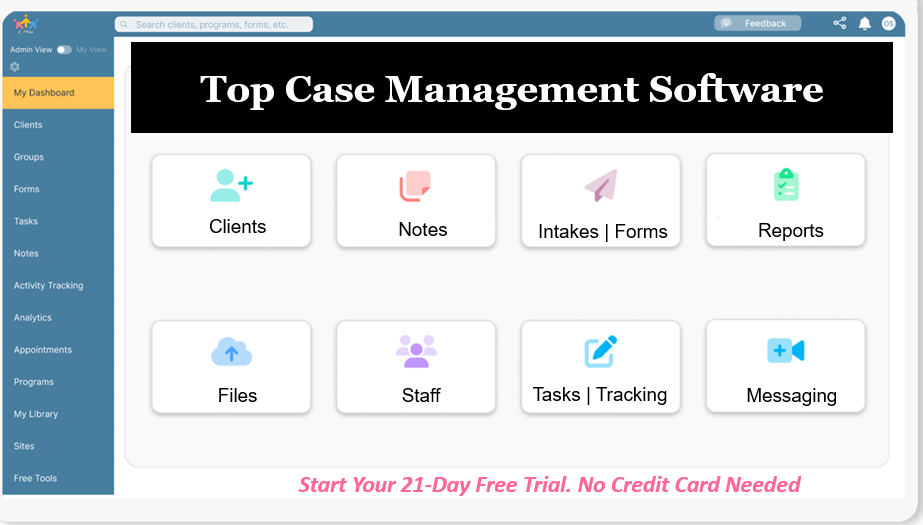
💡All-in-one Case Management Software.
Everything in one place: clients, notes, forms, appointments, reports, and outcomes.
👉 Try it Free - No credit card needed
Why Must You Review State Board Mandates First?
Before signing any agreement or paying an initial retainer, you must review the specific regulatory statutes established by your state social work licensing board. Licensure boards enforce strict requirements regarding who qualifies as an approved supervisor and which post-degree hours are counted toward independent clinical practice.
Many jurisdictions require that prospective supervisors maintain an unrestricted clinical license for a minimum number of years and complete certified supervisory continuing education courses. Furthermore, states enforce clear restrictions on tele-supervision versus in-person meetings, alongside rigid limits on the ratio of individual to group supervision hours.
According to data compiled by the Association of Social Work Boards (ASWB) in their licensing examinations analysis, roughly 75% to 80% of candidates pass the ASWB Clinical Exam on their initial attempt. The remaining candidates face repeat testing cycles where passing rates decline significantly. Clinical supervisory hours form the foundation for mastering the clinical reasoning and ethics tested on these examinations.
Missing a critical administrative detail, such as submitting a required supervisory plan prior to your first meeting, can lead to your licensing board invalidating months of clinical casework. Always obtain the official supervision verification form for LCSW licensure directly from your jurisdiction’s regulatory board before formalizing your contract terms.
What Key Clauses Belongs in an LCSW Clinical Supervision Agreement Template?
A complete LCSW clinical supervision agreement template serves as a binding professional service agreement. Drafting a strong contract eliminates ambiguity and establishes mutual accountability from your first meeting.
Professional Scope and Learning Objectives
Your agreement must define clear clinical supervision goals and learning objectives. Rather than relying on generic goal statements, define concrete milestones covering psychosocial assessments, evidence-based clinical interventions, differential diagnosis, crisis de-escalation, and ethical boundaries.
The agreement should document:
- The associate’s obligation to present transparent clinical casework, including countertransference dilemmas and complex diagnostic profiles.
- The supervisor’s duty to provide structured feedback and objective developmental assessments.
- Adherence to formal standards, such as the NASW guidelines for external clinical supervision and the NASW Code of Ethics.
Financial Obligations and Meeting Cadence
Financial misunderstandings and scheduling confusion represent the most common causes of disrupted supervisory arrangements. Address all logistical elements directly within the contract:
- Meeting Frequency: Detail the exact schedule, meeting location, or board-approved remote platform.
- Fee Structure: State the hourly fee, accepted payment methods, and invoice due dates.
- Cancellations: Outline required cancellation notice windows and define late-cancellation charges.
- Paperwork Fees: State whether your supervisor assesses fees for time spent auditing clinical logs, evaluating case summaries, or preparing final licensure paperwork.
👉 Try it Free - Free Case Management System
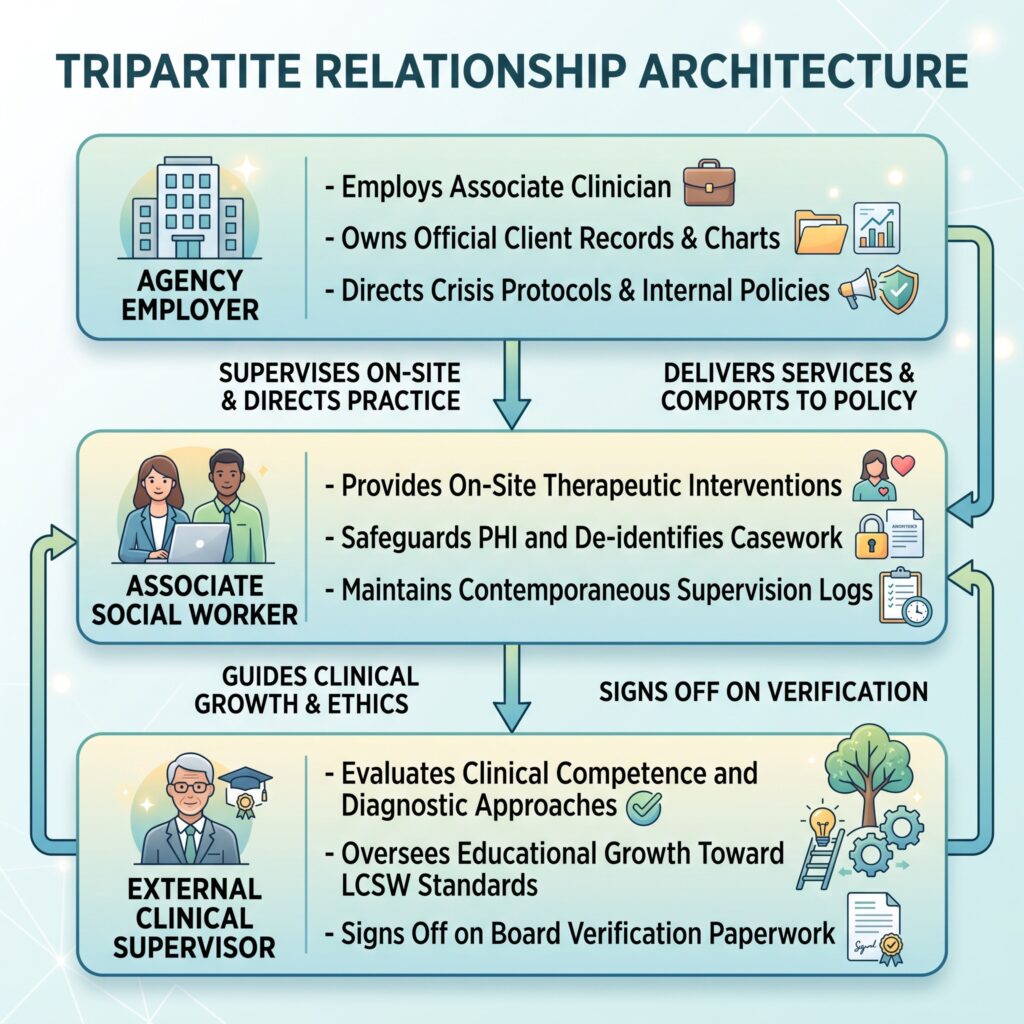
How Do You Manage the Tripartite Dynamic Between Agency, Associate, and Supervisor?
Conducting outside supervision for social work licensure creates a three-party operational relationship involving your agency employer, yourself as the associate, and your independent supervisor. Navigating this structure requires proactive boundary management.
| Consideration | Primary Employer (Agency) | External Clinical Supervisor |
| Primary Responsibility | Client service delivery, agency outcomes, employee performance | Clinical skill development, ethics oversight, licensure readiness |
| Record Ownership | Holds absolute ownership of client records and clinical files | Retains supervisory case notes, attendance logs, and evaluations |
| Crisis Intervention | Dictates mandatory on-site emergency workflows and crisis management | Provides post-incident consultation and debriefing support |
| Liability Scope | Primary vicarious liability for direct client care | Professional liability for supervisory guidance and board endorsement |
Agency Authorization and Consent
You must secure formal, written approval from your agency leadership before beginning outside clinical supervision. Most healthcare organizations and non-profit settings require an approved consent addendum to confirm that discussing casework externally does not violate workplace policies or client confidentiality rules.
Client Confidentiality and Information Redaction
Transferring client information outside the workplace presents compliance concerns under federal privacy standards. The contract must clarify how Protected Health Information (PHI) will be de-identified. Remove all names, street addresses, birthdates, and identifying biographical facts prior to presenting case histories in supervisory meetings.
Emergency Protocols and Vicarious Liability
Your agreement must document how to address acute emergencies, such as imminent self-harm, threats of violence toward others, or mandatory child abuse reporting. On-site crises must follow your employer’s emergency chain of command first. Your external contract should define the protocol for notifying your supervisor afterward to review clinical responses and ethical documentation.
Do You Have a Team? Our best all-in-one client and top case management software simplifies everything from client intake and assessments to programs, projects, goals tracking, planning, scheduling, documentation, reporting dashboard, and progress tracking.All-in-One Case Management Software
Sign Up Today, Free
No credit card needed!
How Can Practice Management and Hour Tracking Tools Strengthen Compliance?
Documenting multi-year clinical hours on loose paperwork creates significant vulnerability during state licensing audits. State boards often reject licensure applications containing inconsistent logs, missing signatures, or discrepancies between direct client contact hours and supervisory meetings.
Modern associates and supervisors rely on digital tracking systems to keep logs accurate and secure:
- Contemporaneous Verification: Logging sessions each week ensures you track individual sessions, group meetings, and client hours accurately. Both parties should sign logs on a monthly cadence instead of attempting to reconstruct years of records right before submitting application paperwork.
- Centralized Record Storage: Retaining signed contracts, meeting notes, quarterly assessments, and board authorization documents in a unified repository prevents lost paperwork.
- Administrative Efficiency: Using automated billing, shared calendar scheduling, and structured documentation workflows allows both professionals to focus on clinical competency rather than administrative burdens.
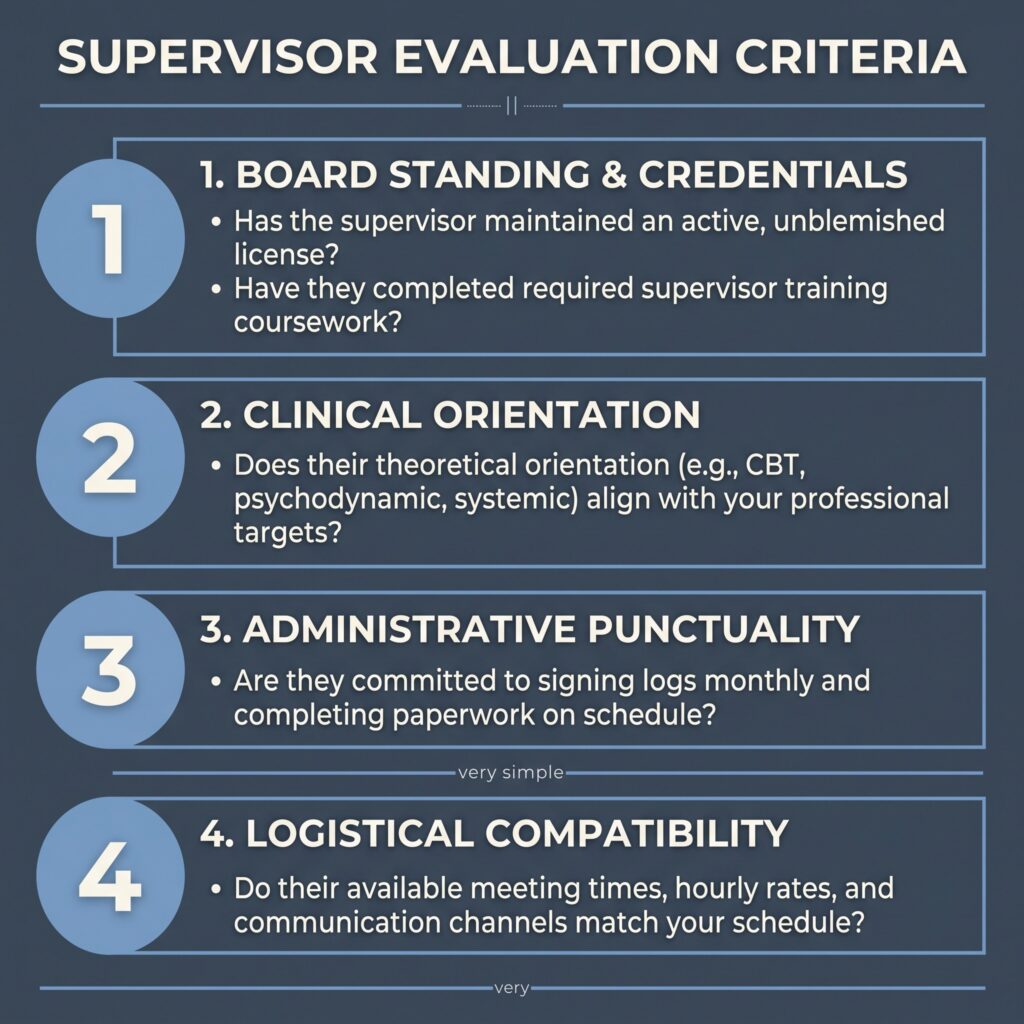
What Factors Should Guide Your Decision When Choosing an Outside Supervisor?
Selecting an outside clinical supervisor requires thoughtful evaluation of credentials, communication styles, and practical fit. Because you are financing this clinical instruction independently, vetting candidates carefully protects both your budget and your licensure timeline.
What Happens When Challenges Arise in the Supervisory Relationship?
Even well-planned supervisory partnerships can encounter challenges. Including explicit dispute-resolution, remediation, and termination procedures within your agreement shields both parties if expectations diverge.
Performance Evaluations and Objective Feedback
Your contract should mandate structured evaluations at designated milestones, such as quarterly or bi-annually. Regularly scheduled reviews ensure constructive feedback is provided early, preventing surprise disagreements when it is time to sign final board verification documents.
Remediation Frameworks
If a supervisor identifies deficits in clinical skills, documentation, or ethical execution, the agreement should outline a fair remediation process. This clause should require written notification, measurable remediation benchmarks, and a concrete timeframe for re-evaluation before any negative assessment is delivered to an oversight agency.
Notice Periods and Verification Protections
Ensure your contract contains a mutual exit clause, typically requiring 30 days written notice to conclude the arrangement. The contract must confirm that upon termination, the supervisor will promptly sign off on all completed, verified hours accrued in good standing up to the separation date.

People Also Ask
What is an external social work supervision contract?
An external social work supervision contract is a formal agreement between a provisionally licensed social worker and an independent clinical supervisor. It outlines hourly rates, meeting schedules, learning objectives, client confidentiality safeguards, and regulatory responsibilities for accrued clinical hours.
Can an outside supervisor sign off on LCSW clinical hours?
Yes, outside supervisors can sign off on clinical hours as long as they meet state licensing board criteria, hold an active license, and have completed mandated supervisor training. Some states require board registration before hours begin.
How much does outside clinical social work supervision cost?
Individual clinical supervision generally ranges from $75 to $175 per hour, depending on geographic location, clinical specialization, and session length. Group supervision options usually offer a lower hourly rate.
Does my employer need to know about my external supervision?
Yes, your employer must be informed and provide written approval. Because you discuss clients treated at your workplace, your employer must approve clinical disclosures to protect client privacy and ensure compliance with workplace policies.
How do I log hours for outside social work supervision?
Hours should be logged immediately after each session using detailed paper forms or dedicated digital tracking software. Record the date, meeting length, session format, topics addressed, and obtain regular supervisor signatures.
What should I do if my supervisor refuses to sign my verification form?
Consult your contract’s dispute resolution clause, provide contemporaneous signed monthly logs, and attempt a structured resolution meeting. If resolution fails, reach out to your state licensing board to request alternative verification procedures.
Streamline Your Social Work Practice and Supervision Workflows
Managing client records, supervision meeting notes, tracking clinical hours, and handling paperwork across multiple platforms can quickly become overwhelming. Using dedicated, HIPAA-compliant practice management software simplifies administrative tasks for both individual clinicians and growing practices.
With Case Management Hub, you get an all-in-one system to manage clients, track goals, create assessments, schedule appointments, and store case documentation securely in one convenient place.
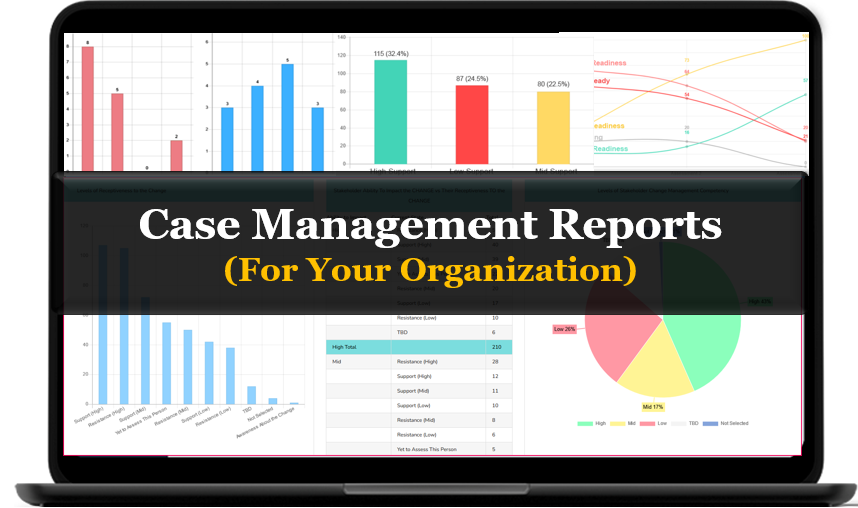
See how easy it is to setup client goals and review progress through a reports dashboard:
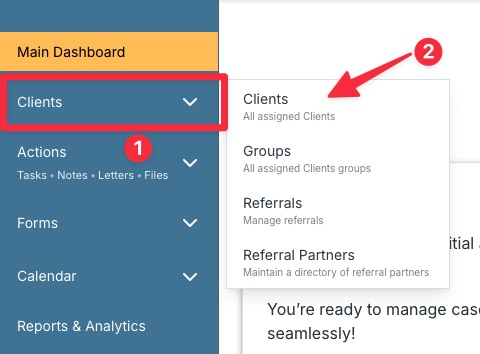
Step 1:
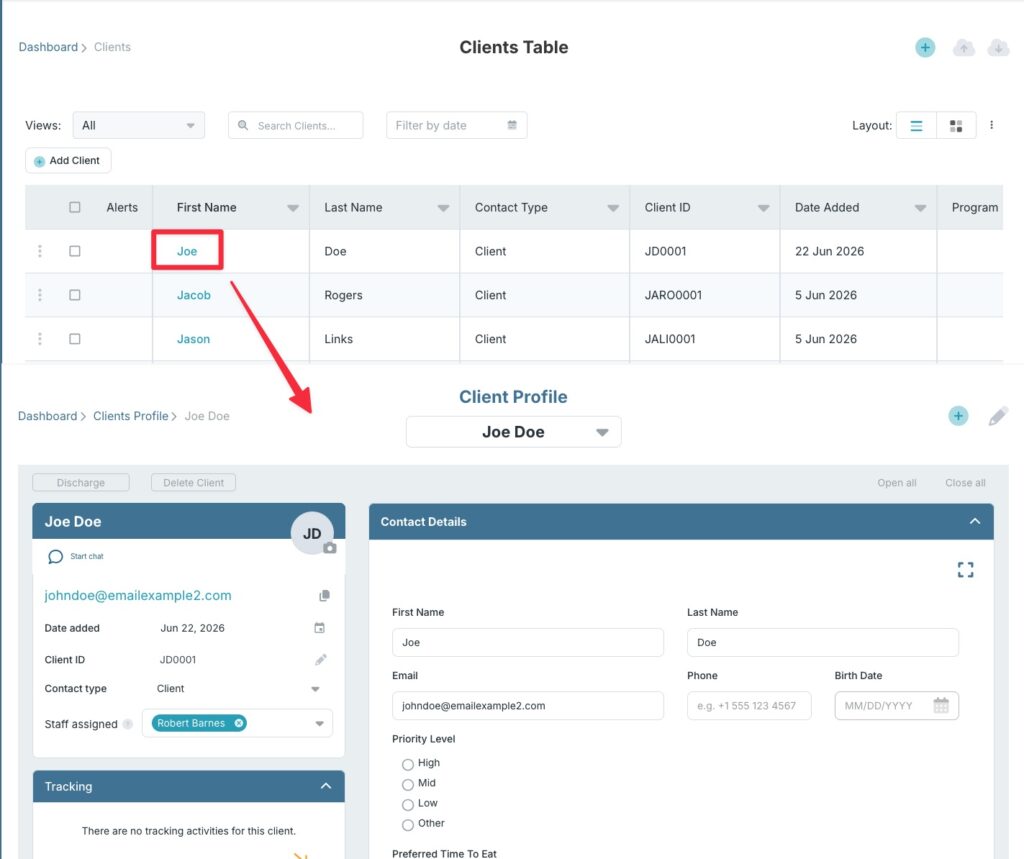
Navigate to the Client’s table and open a client profile.
Step 2:
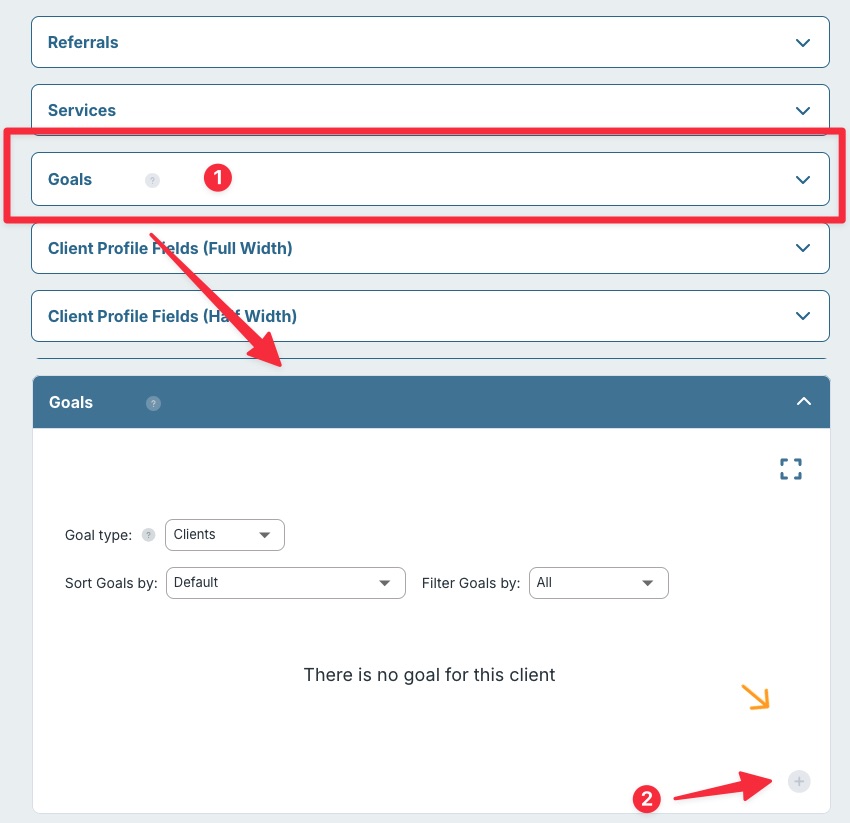
Scroll down to the Goals section and click the title to expand. Click the plus button to create new goal.
Step 3:
Give your goal a name and add in each of the steps required to achieve the goal. Start with the first step and add each subsequent step underneath it. When done, click Save.
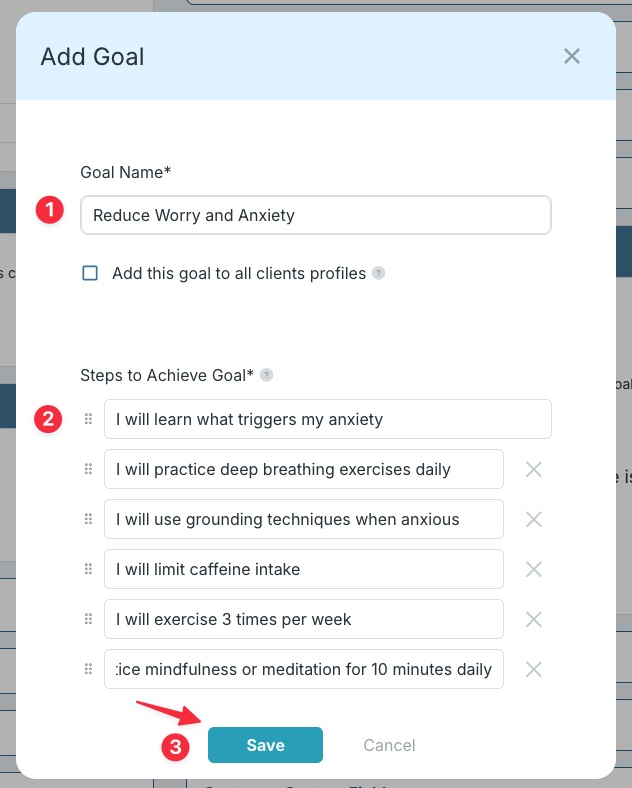
Tip: Goals can added automatically to all clients by placing a checkmark in “Add this goal to all students profiles”.
Step 4:
From the Goals section, you can manually mark steps as done, sort goals by date added, and filter out pending, in-progress, or completed goals.
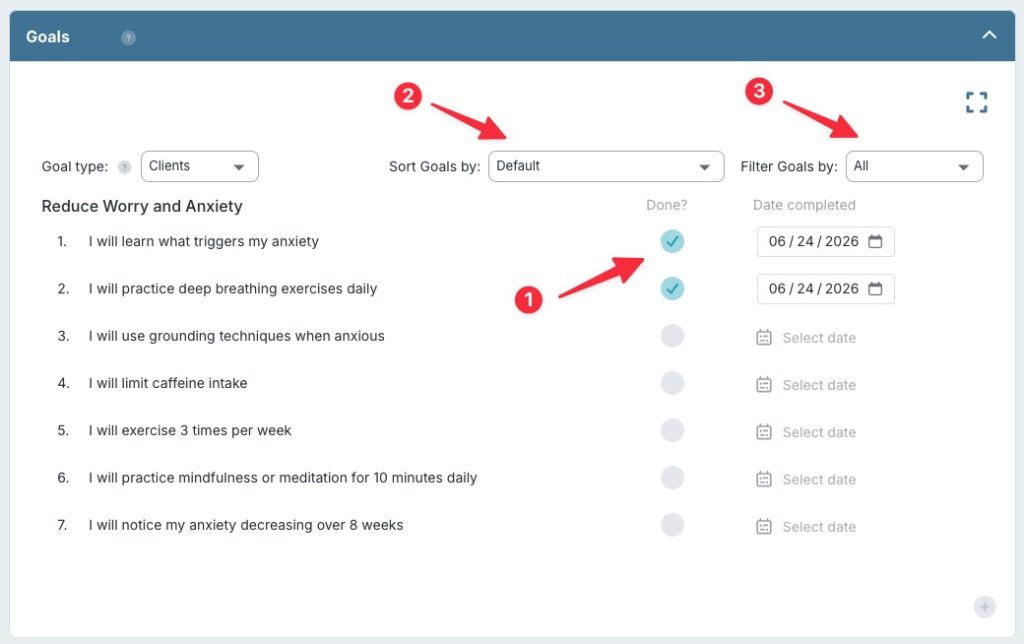
Tip: As you mark goals as done, the date completed field will automatically be filled in with today’s date, however you can change this by simply clicking on it and selecting the new date.
Step 5:
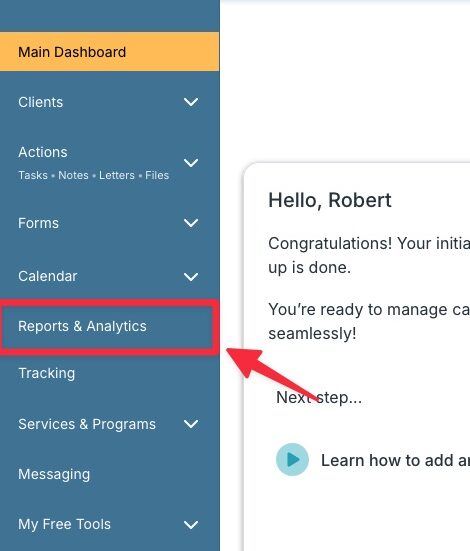
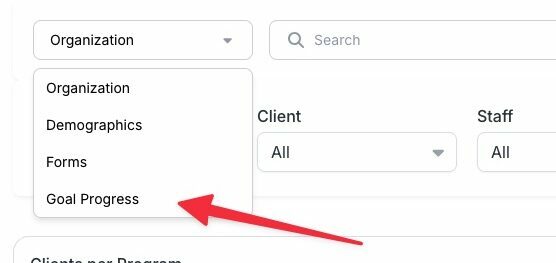
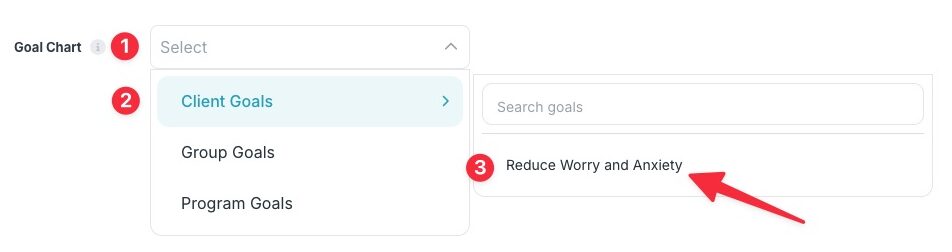
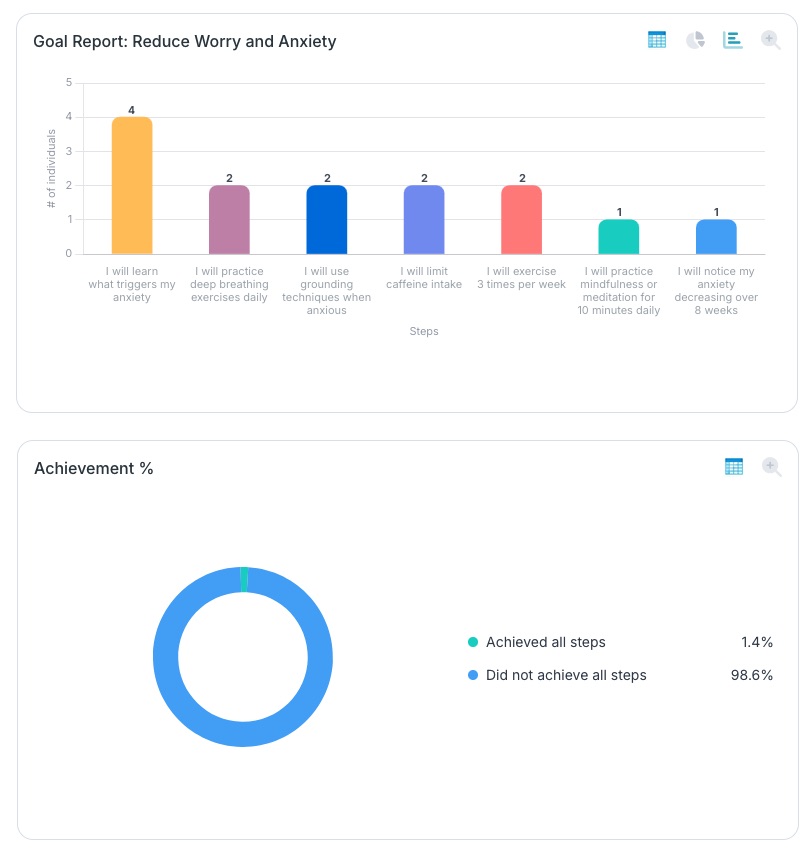
Review goal progress by heading to the Reports and Analytics module, selecting Goal Progress, and then selecting which goals. View reports on how many times a step was marked as done as well as the achievement percentage.
Start your free 21-day trial today with no credit card required, and experience how intuitive digital tools can keep your daily practice organized and audit-ready.
Frequently Asked Questions
Can I complete all my clinical supervision hours through tele-supervision?
Each state licensing board sets its own rules regarding remote supervision. While many jurisdictions permit video conferencing, some establish caps on remote hours or require a portion of meetings to take place in person. Always verify current limits with your licensing board.
What is the difference between administrative and clinical supervision?
Administrative supervision focuses on agency procedures, workload management, job performance, and workplace policy compliance. Clinical supervision centers on therapeutic technique, diagnostic assessment, clinical ethics, and professional development toward independent licensure.
Can I have more than one external clinical supervisor at the same time?
Most licensing boards permit concurrent clinical supervisors, provided that each relationship has an approved supervision agreement on file and the total accrued hours meet weekly state limitations.
What happens if I change jobs while accruing clinical hours?
If you change jobs, you must notify your licensing board, complete exit paperwork with your current supervisor, and establish a new supervisory agreement reflecting your updated employment setting and clinical scope of practice.
Is external clinical supervision tax deductible for social workers?
In many cases, fees paid for professional clinical supervision, required board certifications, and licensing examination preparations qualify as deductible professional development expenses. Consult a certified tax professional regarding your situation.
What makes a supervision contract legally binding?
A supervision contract becomes legally binding when it contains a clear offer, mutual acceptance of articulated terms, lawful subject matter, defined consideration (such as payment for supervisory time), and valid signatures from both parties.
👉 Try it free today - No credit card needed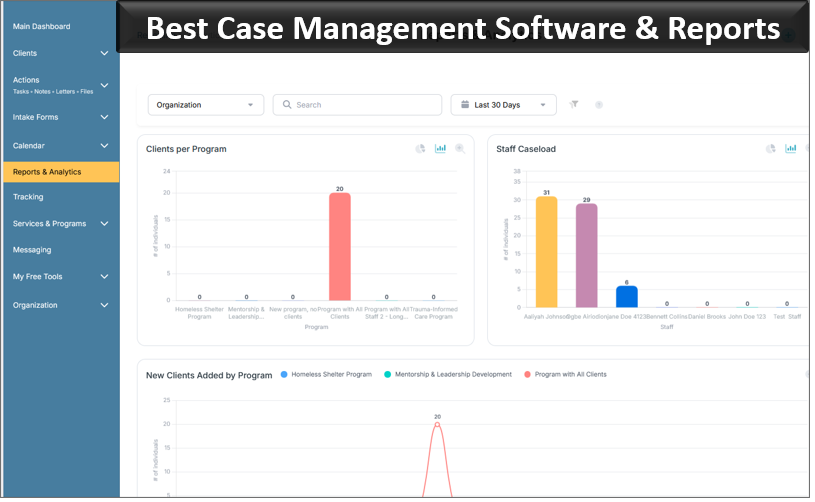
Note: Content on this website (socialworkportal.com) is copyrighted and protected under applicable copyright laws. Unauthorized reproduction, distribution, or use of any content from the website, without explicit written permission, is strictly prohibited. Read: Terms of Use.
Social Work Portal Disclaimer: Social Work Portal is not a social work agency and we do not refer social workers. This web site is provided for educational and informational purposes only and does not constitute providing medical advice or professional social and healthcare services. The information provided should not be used for diagnosing or treating a health problem or disease, and those seeking personal medical advice should consult with ... Read our full disclaimer here: Social Work Portal Disclaimer.