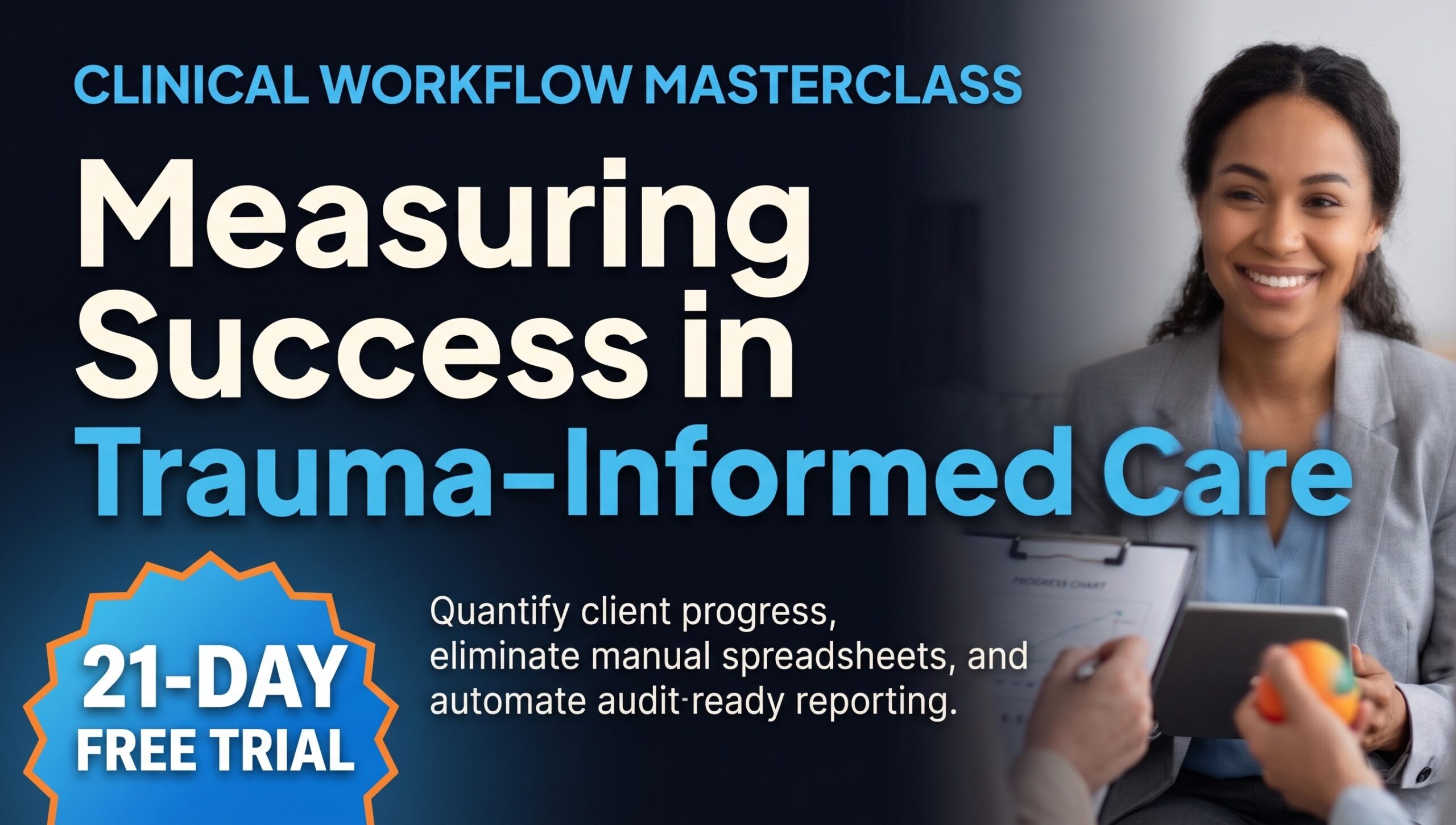
Practical Frameworks, Clinical Metrics, and Digital Workflows to Prove Client Outcomes
Measuring progress in human services often creates a fundamental tension between human empathy and clinical accountability. You entered social work or community mental health to help survivors heal, rebuild safety, and reclaim their autonomy. Yet every month, leadership teams, grant funders, and healthcare payers demand quantifiable proof that your programs work.
When your organization attempts to track recovery through manual spreadsheets or disjointed paper files, valuable qualitative breakthroughs get buried. Practitioners end up logging administrative hours instead of serving clients, while clinical supervisors struggle to translate relational progress into concrete reports. Understanding how to measure trauma informed care outcomes requires an integrated approach. You need objective data to prove program impact alongside subjective feedback that honors lived experience.
Let’s get started
Watch this video:
or
read the guide below.
What You’ll Learn in This Guide
- Why traditional outcome measurement methods fail trauma survivors and how to fix them.
- The essential quantitative vs qualitative metrics trauma recovery programs must monitor.
- How to standardize trauma informed outcome metrics for social workers without increasing administrative burnout.
- A clear comparison between manual evaluation workflows and modern digital platforms.
- How digital tools streamline trauma care measurement to produce audit-ready, HIPAA-compliant reports.
- Concrete answers to the most common clinical and operational evaluation questions.
💡All-in-one Case Management Software.
Everything in one place: clients, notes, forms, appointments, reports, and outcomes.
👉 Try it Free - No credit card needed
Why Is Evaluating Trauma-Informed Care in Behavioral Health So Difficult?
Assessing progress in trauma-informed environments presents distinct challenges compared to standard clinical care. Traditional social work metrics often rely on rigid behavioral markers: did the client attend twelve sessions, secure full-time employment within thirty days, or test negative on every screening? In trauma care, healing rarely follows a straight line. A survivor establishing healthy emotional boundaries might step back from an unhealthy workplace, appearing on paper as a loss of employment even though it represents clinical stabilization.
The primary obstacle is that measuring client progress in trauma informed case management requires tracking internal safety, agency, and autonomic regulation alongside external milestones. Relying strictly on superficial metrics risks retraumatizing individuals by reducing complex survivorship to transactional checkmarks.
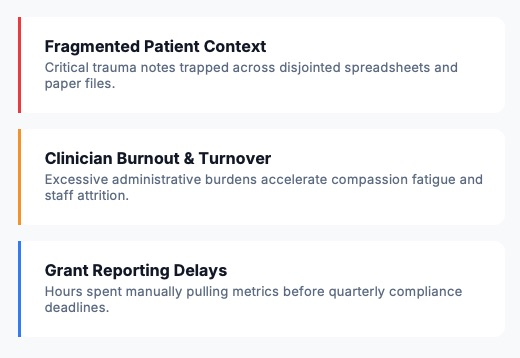
According to data published by the National Council for Mental Wellbeing, behavioral health providers spend roughly 30 to 40 percent of their working hours on administrative documentation. When that documentation lives across disconnected spreadsheets, paper assessments, and legacy systems, clinicians face extreme administrative fatigue, directly undermining the quality of client engagement.
What Quantitative vs Qualitative Metrics Should Your Agency Track?
A balanced evaluation model combines objective clinical baselines with narrative, client-led indicators. Evaluating trauma informed care in behavioral health demands both dimensions to present an accurate picture of recovery to stakeholders.
Quantitative Metrics
- Standardized Assessment Scores: Tracking baseline-to-discharge score differentials using evidence-based trauma outcome measurement tools such as the PCL-5 (PTSD Checklist for DSM-5) or the Child Trauma Screen.
- Crisis Intervention Reductions: Logging drops in emergency room visits, psychiatric holds, unscheduled crisis line contacts, and inpatient admissions.
- Care Plan Goal Attainment: Measuring the percentage of client-identified milestones achieved using standardized scaling methods like Goal Attainment Scaling (GAS).
- Engagement and Retention Rates: Monitoring completed appointments, reduced no-show patterns, and sustained service tenure without punitive discharge policies.
Qualitative Metrics
- Perceived Environmental and Emotional Safety: Gathering systematic feedback on whether the client experiences physical safety, transparent communication, and emotional predictability during sessions.
- Self-Efficacy and Autonomy: Tracking documented shifts in the client’s internal locus of control, emotional regulation capabilities, and daily decision-making confidence.
- Coping and Grounding Utilization: Clinical observations capturing whether the client identifies triggers and applies self-soothing or grounding techniques in real-world environments.
- Therapeutic Alliance and Feedback: Regular sentiment checks derived from client feedback tools for trauma informed care, measuring trust, collaboration, and agency.
Which Evidence-Based Tools Accurately Capture Client Progress?
Selecting the right evaluation instruments ensures your data satisfies funder audits while remaining clinically meaningful. Leading evidence-based trauma outcome measurement tools include:
- PCL-5 (PTSD Checklist for DSM-5): A 20-item self-report scale that assesses the 20 DSM-5 symptoms of PTSD. Administering this tool at intake, mid-treatment, and discharge quantifies symptom relief reliably.
- The Trauma-Informed Practice (TIP) Scales: Instruments designed specifically to capture client perceptions of safety, trust, collaboration, and empowerment within human service organizations.
- Child and Adolescent Needs and Strengths (CANS): A multi-purpose tool that evaluates trauma exposure, behavioral emotional needs, and functional strengths to guide individualized treatment plans.
- Goal Attainment Scaling (GAS): A numeric tracking method that quantifies individualized client goals on a graduated scale (from -2 for baseline to +2 for exceptional progress), turning unique personal victories into structured, aggregate data.
👉 Try it Free - Free Case Management System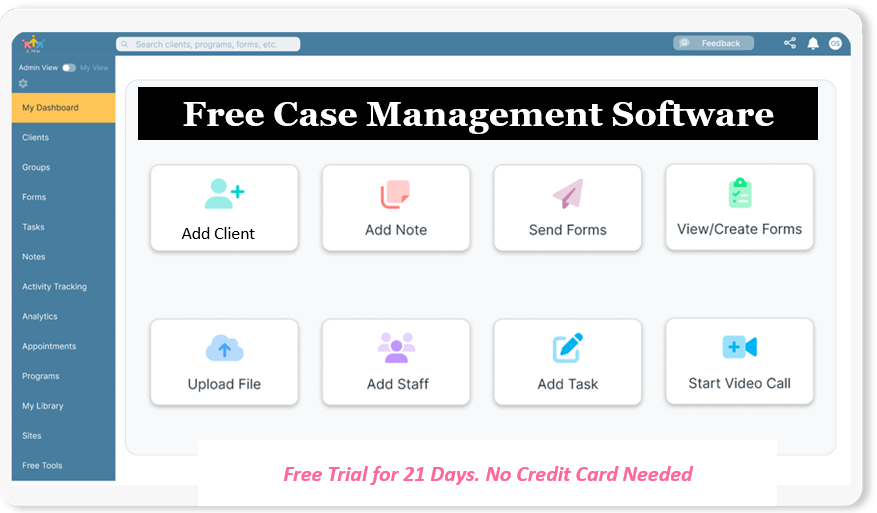
How Can Organizations Track Secondary Trauma and Agency Burnout?
Evaluating the impact of your services is impossible if your clinical workforce is depleted. Secondary trauma tracking and agency burnout indicators must be treated as formal operational metrics alongside client outcomes. Frontline workers navigating severe traumatic narratives frequently experience secondary traumatic stress and compassion fatigue.
Assessing organizational trauma informed care compliance requires leadership to measure staff retention, sick leave usage, and supervisee satisfaction. Utilizing validated instruments such as the Professional Quality of Life (ProQOL) scale allows clinical supervisors to monitor burnout, compassion fatigue, and compassion satisfaction anonymously across quarters. When organizations support frontline practitioners with structured peer supervision, manageable caseloads, and modern tools that cut clerical friction, clinical outcomes rise across the entire client census.
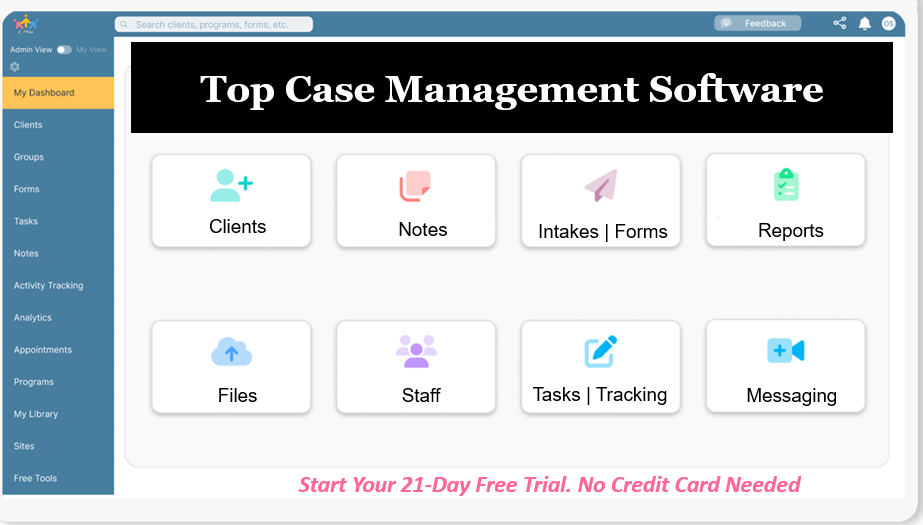
Do You Have a Team? Our best all-in-one client and top case management software simplifies everything from client intake and assessments to programs, projects, goals tracking, planning, scheduling, documentation, reporting dashboard, and progress tracking.All-in-One Case Management Software
Sign Up Today, Free
No credit card needed!
How Digital Tools Streamline Trauma Care Measurement
Manual evaluation workflows fail because they isolate critical observations within physical folders or static spreadsheets. Adopting trauma informed case management software transforms fragmented data into organized clinical intelligence. Here is how modern platforms eliminate manual barriers at each stage of care:
- Digital Intake Forms for Trauma Screening: When clients arrive, paper clipboards and lengthy questionnaires can trigger hypervigilance. Digital intake forms allow clients to complete screenings privately at their own pace on secure portals. The responses flow directly into the client record, flagging specific needs without requiring repetitive, intrusive questioning.
- SOAP and DAP Note Templates for Trauma Care: Clinicians often struggle to capture subjective recovery within standard session documentation. Purpose-built SOAP and DAP note templates prompt clinicians to record emotional regulation, autonomous choices, and trauma responses consistently, standardizing qualitative data automatically.
- Automated Client Progress Tracking for Behavioral Health: Rather than manually graphing assessment scores in separate files, clinical progress tracking software for social workers automatically plots score trends over time. Clinicians and clients can review progress charts together, turning data reviews into collaborative, empowering therapeutic conversations.
- Aggregated Reporting for Grants and Compliance: Compiling donor or county outcome reports manually takes days. A modern HIPAA compliant outcome reporting tool generates anonymized, aggregate reports on goal completion rates, symptom reductions, and service reach in seconds.
Workflow Comparison: Manual Documentation vs. Automated Platforms
| Feature / Task | Manual Spreadsheets & Paper Files | Automated Case Management Platforms |
| Intake & Screenings | Paper clipboards; manual re-entry into spreadsheets; high error and drop-off rates. | Digital intake forms for trauma screening; responses map directly to the chart. |
| Session Notes | Inconsistent narrative logs; critical trauma observations lost in dense text blocks. | Structured SOAP and DAP note templates for trauma care; standardized clinical tracking. |
| Milestone Monitoring | Difficult to track across long caseloads; updates rarely occur outside audit deadlines. | Automated client progress tracking for behavioral health; visual goal progression charts. |
| HIPAA & Data Privacy | Physical file locks; insecure spreadsheet files shared via local drives or email. | Role-based permissions, end-to-end encryption, and fully HIPAA-compliant audit trails. |
| Funder Reporting | Days spent aggregating metrics; high risk of formula errors and missing client records. | Instant generation of aggregated outcome reports filtered by program or funder. |

People Also Ask
What are the primary metrics used to measure trauma-informed care?
Trauma-informed care relies on both clinical symptom metrics (such as PCL-5 scores) and relational indicators, including client-reported safety, goal attainment percentages, and reductions in acute crisis interventions.
How often should trauma-informed progress be evaluated?
Formal clinical assessments are typically administered at intake, every 90 days during care plan reviews, and at service discharge. Qualitative feedback on safety and trust should be reviewed during regular supervision and quarterly client check-ins.
Can qualitative breakthroughs be converted into measurable data?
Yes. Frameworks like Goal Attainment Scaling (GAS) and validated client perception surveys convert personal goals and feelings of agency into standardized numeric values suitable for statistical tracking.
How does trauma-informed measurement differ from traditional casework measurement?
Traditional casework focuses primarily on compliance and static service completions. Trauma-informed measurement evaluates the quality of the therapeutic alliance, reductions in distress, personal empowerment, and the prevention of retraumatization.
Why is tracking staff secondary trauma necessary for measuring program success?
High staff burnout and secondary traumatic stress directly correlate with reduced quality of care, frequent client handoffs, and poor clinical outcomes. Healthy practitioners are essential for delivering consistent, safe care.
What digital tools support trauma-informed documentation?
Specialized systems include HIPAA-compliant electronic platforms that combine digital intake forms, standardized DAP and SOAP templates, automated progress tracking, and centralized reporting dashboards.
Transform Your Clinical Tracking with Case Management Hub
Documenting trauma-informed care should never stand between you and the individuals you serve. Case Management Hub is an all-in-one, HIPAA-compliant platform designed by human service professionals for social workers, case managers, and behavioral health teams.
Instead of wrestling with disconnected spreadsheets and rigid legacy software, Case Management Hub brings your entire workflow together:
- Client tracking and secure demographic records.
- Specialized SOAP and DAP note templates tailored for trauma-informed observations.
- Intuitive digital intake forms and standardized screening workflows.
- Dynamic goal and progress tracking that turns qualitative milestones into clear visuals.
- Integrated appointment scheduling, secure messaging, billing, and custom outcome reporting.
Eliminate documentation fatigue and give your team the tools to demonstrate measurable client growth with clarity and ease.

Start your 21-day free trial of Case Management Hub
No credit card required. Full access to all features.
Frequently Asked Questions
How do we measure success when a client experiences a trauma recurrence or behavioral relapse?
Relapse or temporary regression is often a natural phase of navigating traumatic stress. In a trauma-informed framework, success is measured by how the client navigates the recurrence compared to baseline. Clinicians evaluate whether the client reached out for support earlier, utilized grounding techniques to de-escalate, avoided dangerous behaviors, or recovered their baseline regulation faster. Documenting these internal coping responses in structured clinical notes demonstrates clear clinical resilience even when external circumstances fluctuate.
How can our agency implement standardized trauma screening without overwhelming or triggering clients?
Screening must prioritize client autonomy and pacing. Introduce digital intake tools that clients can complete in private environments, and always clarify that questions are voluntary. Practitioners should explain why the information is gathered, how it informs care, and that the client remains in control of what they disclose. Standardized tools should never be used as cold checklists; they serve as conversational frameworks grounded in safety and mutual trust.
How do we fulfill strict grant reporting requirements without violating trauma-informed care principles?
Grant funders require hard data, but those metrics do not need to come at the expense of trauma-sensitive care. By using case management software with custom outcome reporting, your agency can aggregate anonymized data points, such as percentage improvements on validated symptom inventories, rates of housing stability, and completed treatment plans. This satisfies funder demands for return on investment while keeping individual client narratives safe, confidential, and respected.
Will transitioning to an all-in-one digital case management system increase administrative burdens on our clinicians?
While adopting any new platform involves an initial adjustment, modern platforms significantly reduce ongoing documentation time. Features like pre-configured DAP and SOAP templates, automated screening calculations, centralized client communications, and unified scheduling eliminate repetitive data entry across multiple disconnected files. Agencies typically see a measurable reduction in weekly paperwork hours once initial onboarding is complete.
How can small non-profit agencies with tight budgets manage outcome tracking software?
Small non-profits often lose valuable funding opportunities because they lack the tools to prove program success to donors. Utilizing client goal tracking software for non-profit agencies provides the structured data needed to secure competitive grants. Investing in accessible cloud-based platforms eliminates expensive IT infrastructure costs, avoids data loss from corrupted spreadsheets, and ensures small teams maintain audit-ready, professional records affordably.
What steps ensure that outcome data collection remains fully HIPAA compliant?
Maintaining compliance requires strict safeguards around protected health information (PHI). Organizations must ensure that any software collecting screenings, notes, or messages uses end-to-end data encryption, enforces multi-factor authentication, executes a formal Business Associate Agreement (BAA), and restricts record access through role-based permissions. Storing client outcome data across unencrypted spreadsheets or free consumer cloud drives poses severe regulatory risks and violates ethical obligations to survivor safety.
👉 Try it free today - No credit card needed
Note: Content on this website (socialworkportal.com) is copyrighted and protected under applicable copyright laws. Unauthorized reproduction, distribution, or use of any content from the website, without explicit written permission, is strictly prohibited. Read: Terms of Use.
Social Work Portal Disclaimer: Social Work Portal is not a social work agency and we do not refer social workers. This web site is provided for educational and informational purposes only and does not constitute providing medical advice or professional social and healthcare services. The information provided should not be used for diagnosing or treating a health problem or disease, and those seeking personal medical advice should consult with ... Read our full disclaimer here: Social Work Portal Disclaimer.