A Nonprofit Guide to Outcome Tracking
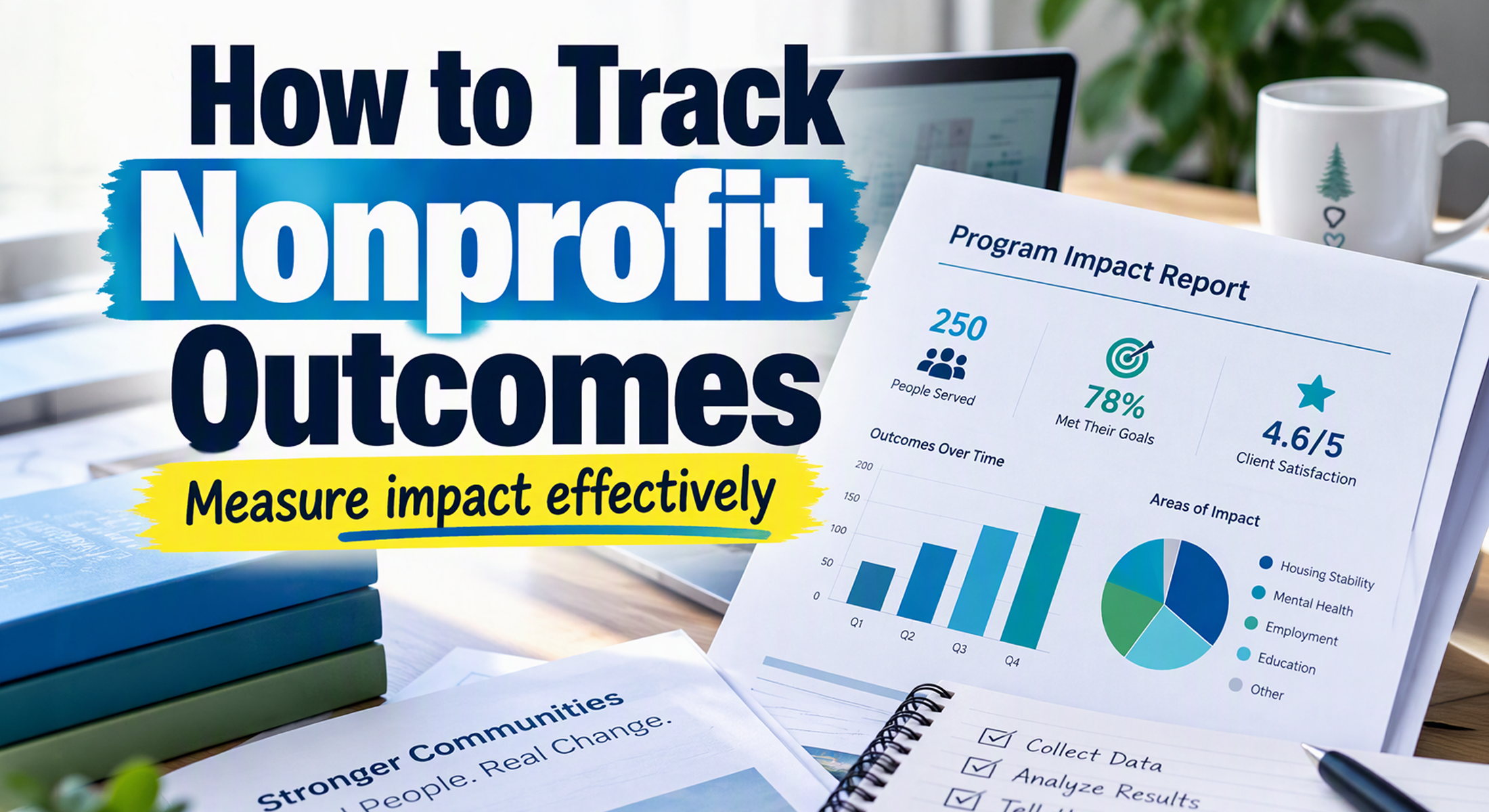
Every nonprofit can tell you how many people it served last year. Far fewer can tell you whether those people are better off. Funders, boards, and the communities you serve are asking the second question more and more. Outcomes tracking is how you answer it, and a logic model is the map that makes it possible.
Measuring nonprofit impact means looking beyond just how many people you serve to what impact your program is having in their lives.
Read on to turn outcome questions into a practical plan. You’ll learn how to build a logic model, choose measures that show meaningful change, and avoid common tracking mistakes.
Let’s get started
Watch this video:
or
read the guide below.
Tracking Outputs vs. Outcomes: The Difference Matters
Outputs count what you do. Outcomes describe what changes for the people you serve.
- Output: 200 clients attended a job-readiness workshop.
- Outcome: 90 clients secured employment within six months, and 70 of them were still employed a year later.
Outputs show activity. Outcomes show impact. Funders want both, but outcomes are what make your case.
💡All-in-one Case Management Software.
Everything in one place: clients, notes, forms, appointments, reports, and outcomes.
👉 Try it Free - No credit card needed
What is a Logic Model?
A logic model is a one-page visual that shows how your program is supposed to work, from the resources you put in to the long-term change you hope to see. It forces a team to spell out its assumptions: if we do this, then that should happen.
Most logic models have five parts:
- Inputs: staff, funding, volunteers, partners, and technology.
- Activities: what the program does, such as case management, counseling, or workshops.
- Outputs: the direct, countable products of those activities.
- Short-term outcomes: changes in knowledge, skills, or attitudes.
- Long-term outcomes (impact): lasting changes in behavior, circumstances, or community conditions.
👉 Try it Free - Free Case Management System
How to Build a Nonprofit Outcome Logic Model in 6 Steps
- Start with the end. Name the long-term change your program exists to create.
- Define who you serve. Be specific about the population and the need.
- Work backward. Ask what has to change first for the long-term outcome to happen. Those are your short-term outcomes.
- List activities and outputs. Only include activities that clearly connect to an outcome.
- Name your inputs. Be honest about the resources you actually have.
- Test the logic. Read it left to right as “if… then…” statements. Gaps in the chain are gaps in your program design.
Involve frontline staff and, where you can, the people you serve. They know which assumptions hold up in real life.
Do You Have a Team? Our best all-in-one client and top case management software simplifies everything from client intake and assessments to programs, projects, goals tracking, planning, scheduling, documentation, reporting dashboard, and progress tracking.All-in-One Case Management Software
Sign Up Today, Free
No credit card needed!
Outcome Tracking Logic Model Examples
Housing Stability Impact Tracking
- Inputs: two case managers, a rental assistance fund, landlord partnerships.
- Activities: intake assessments, individualized housing plans, budgeting coaching, landlord mediation.
- Outputs: 120 households assessed, 120 plans created, 600 coaching sessions held.
- Short-term outcomes: households improve budgeting skills and secure a lease.
- Long-term outcomes: households remain stably housed at 12 months.
Youth Mentoring Impact Tracking
- Inputs: a program coordinator, trained volunteer mentors, and school partnerships.
- Activities: mentor matching, weekly one-on-one sessions, and monthly group events.
- Outputs: 60 youth matched and 1,500 mentoring hours logged.
- Short-term outcomes: youth report a stronger relationship with a trusted adult and better school engagement.
- Long-term outcomes: participants improve their attendance and graduate on time.

Logic Model Template
Use this logic model template as a starting point for tracking nonprofit outcomes and impact. Copy it into a document or spreadsheet and fill in the last column for your program.
| Component | Question to answer | Your program |
| Inputs | What resources do we have? | — |
| Activities | What do we do with those resources? | — |
| Outputs | What do we produce, and how much? | — |
| Short-term outcomes | What changes in knowledge, skills, or attitudes? | — |
| Long-term outcomes | What lasting change do we want to see? | — |
Finish by reading each row as an if-then statement. If a row does not lead logically to the next one, revise it before you start collecting data.
Switch to an all-in-one case management platform. 👉 Try it Free - No credit card needed🔥Still using spreadsheets for case management?
How to Choose Program Outcome Indicators You Can Actually Track
An indicator is the specific, measurable evidence that an outcome happened. Good indicators are:
- Clear: everyone on the team understands them the same way.
- Measurable: you can collect the data with reasonable effort.
- Time-bound: they specify when you will measure.
- Meaningful: they connect directly to the outcome, not just to activity.
Here are a few nonprofit outcome indicators examples:
- The percentage of households housed 12 months after exit
- The percentage of clients who reach a service plan goal
- The average change in a standardized assessment score
- The percentage of participants employed 90 days after completing the program
Each of these is stronger than something like “number of housing referrals made,” which only counts activity.
Keep the list short. Three to five indicators per outcome is plenty for most programs, and one or two is often better.
👉 Try this Case Management Software free today
No credit card needed
Common Mistakes to Avoid
- Tracking too much. More data is not better data. Collect only what you will use.
- Confusing outputs with outcomes. If it counts activity, it is an output.
- Building the model once and filing it away. Revisit it at least yearly.
- Skipping follow-up. Many of the most important outcomes show up after a client leaves the program.
- Scattered data. Spreadsheets, paper files, and separate systems make outcome reporting slow and unreliable.
Client Outcomes Tracking with Case Management Software
A logic model only works if the data behind it is consistent and easy to collect. Case management software supports client outcomes tracking by capturing assessments, service plans, goals, and progress notes in one secure place, so nonprofit outcomes measurement builds up as part of everyday work instead of an end-of-quarter scramble. Look for tools that let you define goals and measures per client, track change over time, and report across a program, all with HIPAA-compliant safeguards for sensitive client information.
👉 Try it Free today - No credit card needed
Tracking Nonprofit Impact for Stakeholders – Key Takeaways
- Outputs count activity. Outcomes show change.
- A logic model connects resources, activities, and results in one clear picture.
- Choose a few meaningful, measurable indicators and track them consistently.
- Build data collection into daily case work so reporting is a by-product, not a project.
Charting Nonprofit Impact: Frequently Asked Questions
What is the difference between outputs and outcomes?
Outputs count what your program does, such as the number of clients served or workshops held. Outcomes describe what changes for the people you serve, such as finding stable housing or keeping a job. Funders usually want both, but outcomes show your real impact.
What is a logic model, and why do nonprofits use one?
A logic model is a one-page visual that shows how your program is meant to work, from inputs and activities to outputs and short- and long-term outcomes. Nonprofits use it to plan programs, spot gaps in their reasoning, communicate with funders and boards, and decide what to measure.
How many indicators should we track for each outcome?
Most programs do well with three to five indicators per outcome, and one or two is often enough. Choose indicators that are clear, measurable, time-bound, and tied directly to the outcome. Tracking too much leads to data nobody uses.
How often should we update our logic model?
Review it at least once a year, and again whenever your program, population, or funding changes. Treat it as a working document. Frontline staff are often the first to notice when an assumption no longer holds.
Do we need to follow up with clients after they leave the program?
Often, yes. Many important outcomes, like staying housed or employed, show up months after a client exits. Even a simple follow-up at 6 or 12 months gives you much stronger evidence than data collected only during service.
How can case management software help with outcomes tracking?
Case management software keeps assessments, service plans, goals, and progress notes in one place, so outcome data builds up as part of everyday work. Look for goal and measure tracking per client, change over time, program-level reporting, and HIPAA-compliant security.
👉 Try it free today - No credit card needed
Note: Content on this website (socialworkportal.com) is copyrighted and protected under applicable copyright laws. Unauthorized reproduction, distribution, or use of any content from the website, without explicit written permission, is strictly prohibited. Read: Terms of Use.
Social Work Portal Disclaimer: Social Work Portal is not a social work agency and we do not refer social workers. This web site is provided for educational and informational purposes only and does not constitute providing medical advice or professional social and healthcare services. The information provided should not be used for diagnosing or treating a health problem or disease, and those seeking personal medical advice should consult with ... Read our full disclaimer here: Social Work Portal Disclaimer.