Mastering Live Session Pacing, Systemic Interviewing, and Audit-Proof Documentation
Every clinician knows the sinking feeling that hits midway through an intake session. You sit across from a new client with a clipboard or an oversized sketchpad, trying to capture their family history. You map the client, their partner, and their siblings. Then the client mentions that their father was married twice before, their mother cut off contact with her own parents thirty years ago, and two maternal uncles died from chemical dependency.
Suddenly, your paper margins run out. You are furiously erasing pencil marks, tearing the paper, and staring down at a confusing spiderweb of jagged conflict lines. Worst of all, you have spent thirty-five minutes looking down at a diagram instead of looking at the person in front of you. The client is dysregulated, you are behind schedule, and at 8:00 PM you still have to hand-type a coherent assessment into your EHR.
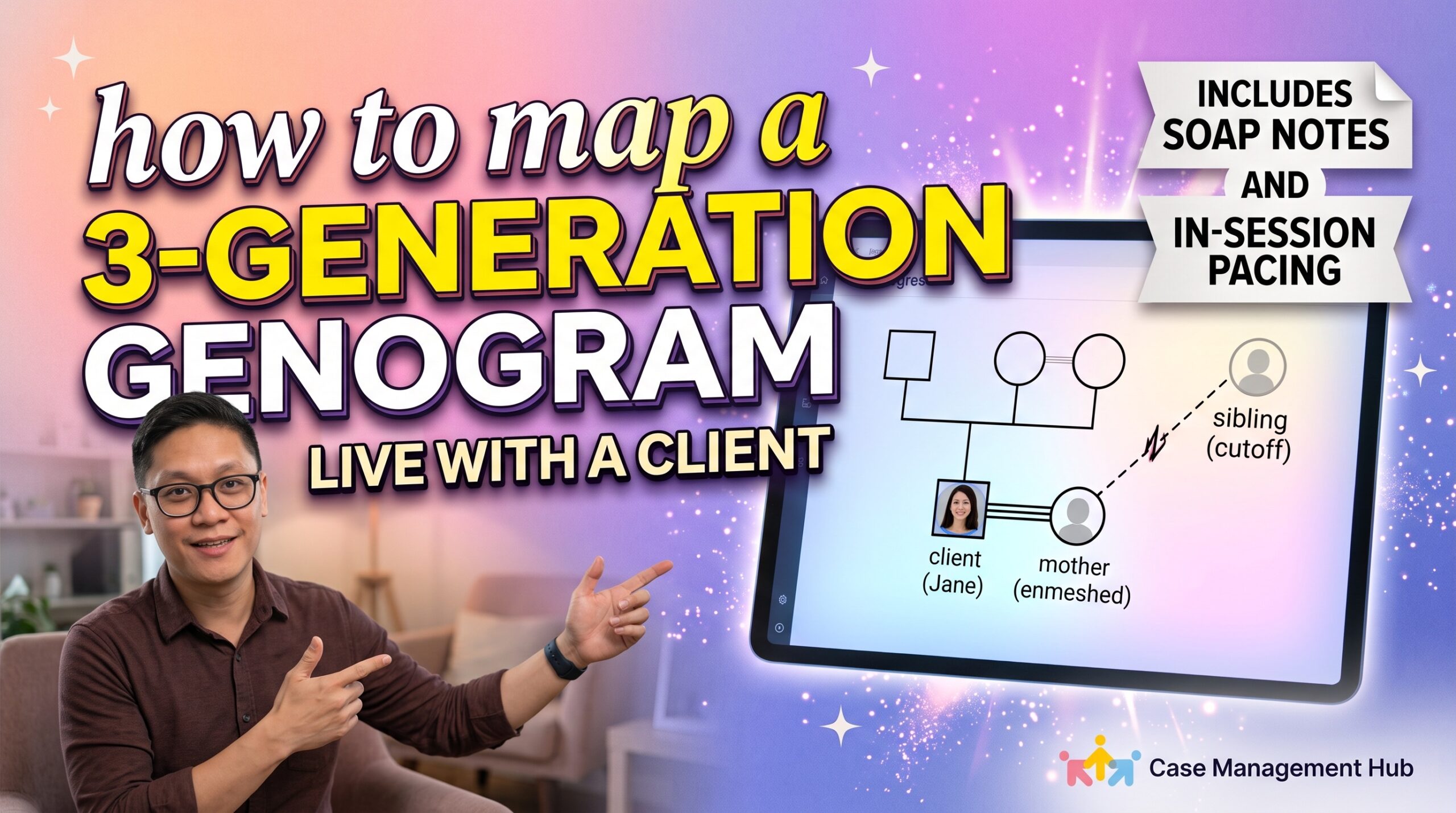
Co-creating a three-generation genogram in real time should never cost you therapeutic presence or your sanity after hours. When executed with intentional pacing and sharp systemic inquiry, live mapping becomes an intervention in itself. It pulls the client out of self-blame, externalizes generational trauma onto the page, and hands you an audit-proof foundation for medical necessity.
Let’s get started
Watch this video:
or
read the guide below.
What You’ll Learn in This Guide
- A battle-tested session pacing framework to map three generations in fifty minutes without losing client connection.
- High-yield circular and systemic interview questions that reveal invisible family rules, triangles, and loyalty contracts.
- Verbatim clinical scripts to navigate sudden disclosures, family secrets, and client affective overwhelm.
- Clear McGoldrick-Gerson notation standards for recording complex kinship, boundary fractures, and medical history.
- How modern digital tools replace fragile paper sketches with dynamic, audit-ready clinical charts.
- A complete, audit-tested SOAP progress note connecting complex family dynamics to an ICD-10 psychiatric diagnosis.
💡All-in-one Case Management Software.
Everything in one place: clients, notes, forms, appointments, reports, and outcomes.
👉 Try it Free - No credit card needed
Why Is Mapping a 3-Generation Genogram Critical in Clinical Assessment?
Clients rarely arrive in therapy saying, “I am caught in an unexamined multigenerational transmission process.” They arrive saying, “I have panic attacks before visiting my mother,” or “My partner says I am emotionally shut down.”
A standard intake questionnaire isolates symptoms into flat data points. A three-generation genogram, rooted in the foundational work of Murray Bowen and standardized by Monica McGoldrick and Randy Gerson, provides the ecological context behind those symptoms.
When you map three generations (the client and their siblings, parents and aunts or uncles, and both maternal and paternal grandparents), you illuminate how anxiety, depression, and trauma travel across time.
Presenting conditions like Generalized Anxiety Disorder, Major Depressive Disorder, and somatic distress are frequently maintained by systemic triangulation, emotional cutoffs, and rigid parentification. When a client visually tracks that their grandfather, mother, and older brother all relied on substance use or emotional withdrawal during marital conflict, their perspective shifts fundamentally.
The shame of personal pathology gives way to curiosity about learned systemic survival strategies. That structural realization is the cornerstone of clinical differentiation.
How Do You Introduce a Genogram to a Client Without Overwhelming Them?
If you announce an intensive family mapping exercise without framing its clinical rationale, clients with acute symptoms will feel alienated or interrogated. A client in the middle of a major depressive episode will naturally wonder why they need to talk about their maternal grandmother’s marriage.
Set clear collaborative expectations before picking up a pen or opening your software.
Clinical Introduction Script:
“Today, we are going to sketch out what we call a family map or a genogram across three generations. Think of this as pulling back the camera lens on your life. Right now, you are feeling overwhelmed by anxiety in your marriage. By mapping the relational patterns, coping styles, and pressures you grew up with, we can pinpoint where these triggers were learned and how to break them. You are in total control of the pacing. You share only what you know, and if we hit a topic that feels heavy, we can hit pause immediately.”
This framing creates psychological safety, establishes clear clinical boundaries, and secures informed consent while linking the exercise directly to their presenting distress.
👉 Try it Free - Free Case Management System
What Are the Standard Genogram Symbols Every Clinician Must Know?
Standardized notation ensures that any clinical supervisor, covering therapist, or insurance auditor can read your chart and immediately understand the family system. While informal variations exist in private practice, sticking to established McGoldrick-Gerson conventions keeps your clinical records standardized and defensible.
1. Individual Demographics
- Squares: Male individuals.
- Circles: Female individuals.
- Diamonds: Non-binary, gender-expansive, or unspecified individuals.
- Double Outer Line: The index client (identified patient).
- Internal ‘X’: Deceased individual, with age at death marked above the symbol.
2. Legal and Partner Bonds
- Solid Horizontal Line: Legal marriage or long-term committed partnership.
- Dashed Horizontal Line: Cohabitation, casual dating, or uncommitted partnership.
- Single Slash (/): Physical separation.
- Double Slash (//): Legal divorce or formal termination of partnership.
3. Emotional and Relational Connectors
- Two Solid Parallel Lines: Close, reciprocal connection.
- Three Solid Parallel Lines: Overly enmeshed, fused, or boundary-diffuse relationship.
- Jagged Zig-Zag Line: Active hostility, chronic conflict, or relational volatility.
- Dashed Single Line: Distant, alienated, or low-contact relationship.
- Broken Line with a Solid Vertical Bar: Complete emotional cutoff or estrangement.
- Triple Line Blended with Zig-Zag: Fused, enmeshed, and intensely conflictual relationship.
4. Health and Behavioral Markers
When mapping chemical dependency, psychiatric hospitalizations, or severe medical conditions, shade the bottom half or bottom-left quadrant of the individual’s shape. Always include a clean, corresponding key in your clinical file noting the specific condition.
What Systemic Questions Cut Through Dry Family History to Reveal Core Dynamics?
A clinical genogram should never sound like an administrative census. Asking only for birth dates, marriage anniversaries, and job titles yields a biographical tree, not a therapeutic assessment.
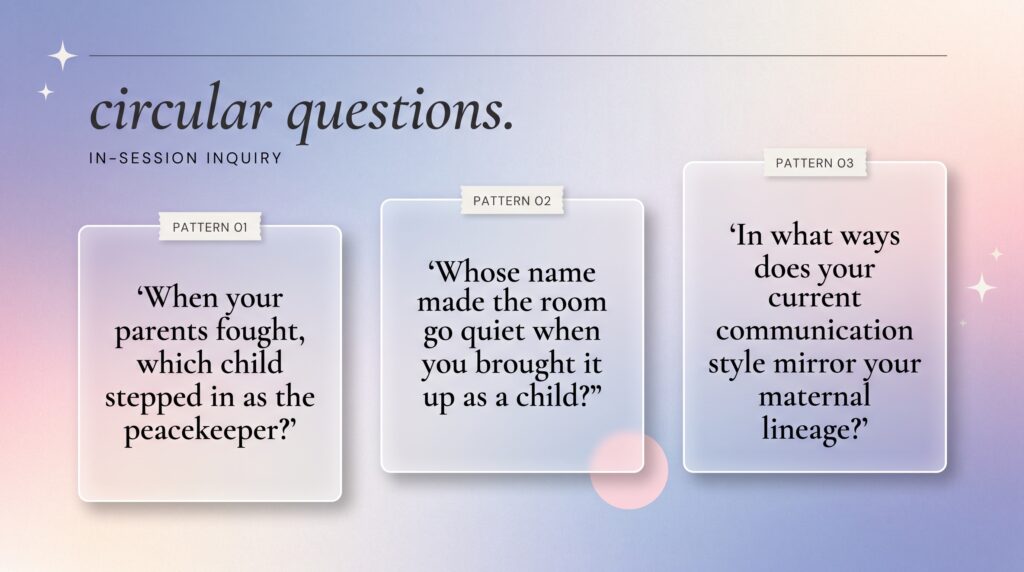
Use systemic and circular questioning to track alliances, loyalty binds, and systemic roles across generations.
1. Structural Boundaries and Coalitions
- “When your parents had a disagreement, which child did your mother turn to for comfort?”
- “Who was the designated protector in your home when your father’s temper flared?”
- “Which two people in your family cannot be in the same room without tension erupting?”
2. Intergenerational Rules and Loyalty Binds
- “What was the unspoken household rule about showing vulnerability or anger?”
- “Who in your family carried the expectation of perfection, and who was cast as the scapegoat?”
- “What happened in your family system when someone tried to move away or establish independence?”
3. Emotional Cutoffs and Family Taboos
- “Whose name caused the room to go silent whenever it was brought up at family gatherings?”
- “How long has the separation between your mother and her sister lasted, and who preserves that silence?”
- “What family secret was understood by everyone in the house but spoken aloud by no one?”
How Can You Map a 3-Generation Genogram in a 50-Minute Intake?
Running out of time mid-drawing is the primary reason clinicians abandon live genogramming. Without strict phase management, an intake interview can quickly derail into a forty-minute narrative about one difficult relative.
Structure your fifty-minute clinical intake into four deliberate phases:
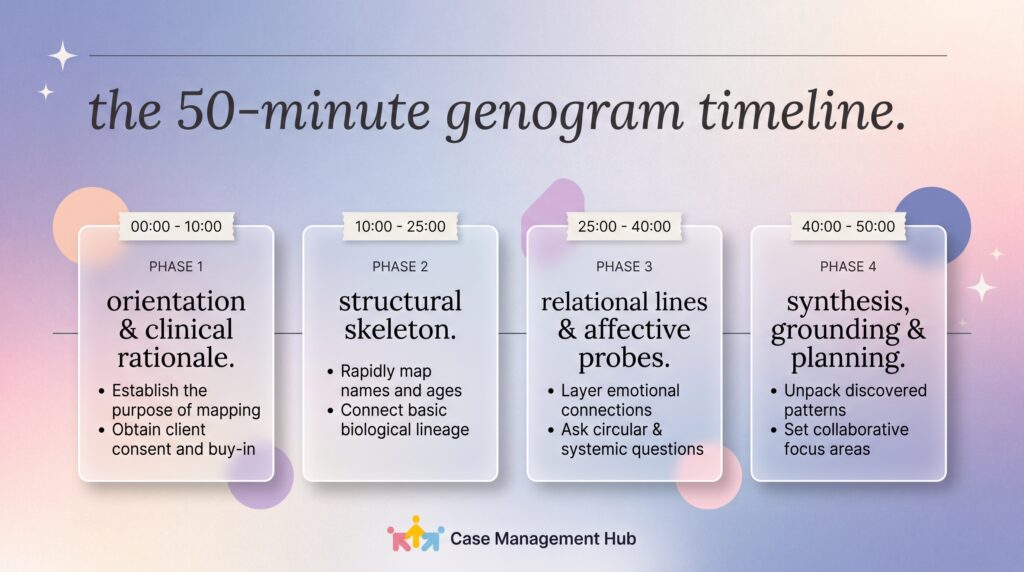
Phase 1: Orientation and Rationale (Minutes 0 to 10)
Review the presenting problem, explain why mapping family patterns will accelerate treatment, and outline the four stages of the session so the client understands the trajectory.
Phase 2: Mapping the Structural Skeleton (Minutes 10 to 25)
Draw the basic framework rapidly. Start with the index client, add their primary partner and children, then move up to parents, aunts, uncles, and grandparents.
Record only names, approximate ages, and deceased statuses. If the client launches into detailed storytelling here, gently redirect:
“Hold that story for just five minutes. Let us get everyone’s name on the board first, and then we will dive into exactly what happened between them.”
Phase 3: Layering Relational Connectors (Minutes 25 to 40)
Layer in the emotional qualities: conflicts, estrangements, enmeshments, and substance patterns. Apply your circular questions here. Look for recurring triangles and cross-generational echoes that directly mirror the client’s current presenting complaint.
Phase 4: Synthesis, Grounding, and Planning (Minutes 40 to 50)
Step back from the map together. Ask: “Looking at this entire picture from the outside, what patterns jump out at you that you never noticed before?”
Help the client regulate their nervous system through grounding, validate their emotional effort, and set clear homework or treatment goals for session two based on the findings.
How Do You Navigate Emotional Flooding and Family Secrets Live in Session?
Mapping multi-generational systems touches raw generational wounds. Clinicians must know how to maintain clinical safety when disclosures threaten to overwhelm the client.
Script for Acute Affective Flooding or Dissociation
When you notice somatic distress (shallow breathing, clenched posture, or glazed eyes), put down your marker or step away from the screen immediately. Never keep drawing while a client is spiraling.
Grounding Script:
“Let us pause right here. Take your eyes off the map for a second and look over at me. Take a deep, slow breath down into your belly. What we are mapping right now carries decades of emotional weight. You do not have to carry or solve all of this today. Feel your feet flat on the floor. Tell me three neutral objects you see in this room right now.”
Script for Handling Hidden Paternity or Stigmatized Secrets
When a client unexpectedly discloses an affair, hidden adoption, or concealed abuse, manage the disclosure without disrupting the intake timeline.
Containment Script:
“Thank you for trusting me with that. That took courage to say out loud. I am placing a quiet note right here on this line so we remember to return to it. We do not have to unpack the entire history of that event this afternoon, but we will make space to explore how that secrecy impacted your safety growing up.”
All-in-One Case Management Software
Sign Up Today, Free
No credit card needed!
Do You Have a Team? | ||
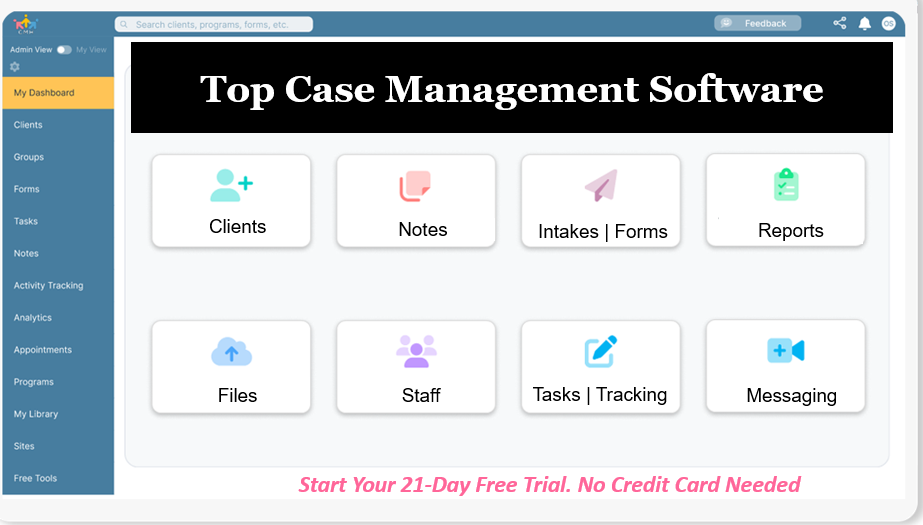
Our best all-in-one client and top case management software simplifies everything from client intake and assessments to programs, projects, goals tracking, planning, scheduling, documentation, reporting dashboard, and progress tracking.
How Digital Tools Streamline Genogram Mapping and Clinical Workflows
Relying on physical markers, legal pads, or disconnected graphic design programs introduces heavy clinical and administrative friction.
A landmark peer-reviewed study in the Annals of Family Medicine (Arndt et al., 2017) revealed that ambulatory healthcare clinicians spend nearly two hours on electronic health record documentation and administrative duties for every single hour of face-to-face patient care. Clerical overhead consumes approximately 44% of an average clinical workday.
When clinicians are forced to sketch a genogram on a loose pad of paper, scan it into a desktop folder, upload a sideways PDF into an EHR, and manually re-type family history into a narrative progress note, administrative exhaustion skyrockets.
Modern, purpose-built clinical software solves these compounding bottlenecks:
- Fluid Canvas Adjustments Without Tearing Paper: Clients rarely disclose family histories in chronological order. When a client suddenly remembers a half-sibling on the maternal side, paper sketches become messy webs of crossed-out ink. Digital tools let you insert nodes, shift entire generational tiers, and re-route lines instantly.
- Centralized Assessment Records: Instead of burying a physical drawing in a manila folder where it cannot be accessed during telehealth or clinical supervision, digital platforms store interactive maps directly within the client’s longitudinal health profile.
- Automated Conversion to Progress Notes: Clinical software bridges the gap between visual mapping and narrative documentation, allowing therapists to extract relational patterns directly into structured assessment fields.
- Interactive Telehealth Collaboration: Secure digital canvases allow virtual clients to observe their family structure take shape in real time via encrypted screen sharing, deepening collaborative engagement.
Manual Workflows vs. Automated Digital Workflows
| Clinical Task | Manual Paper Workflow | Automated Digital Workflow |
| Diagram Creation | Hand-drawing shapes; messy scribbles when surprise relatives are recalled. | Single-click parent, sibling, and partner nodes with auto-aligning tiers. |
| Clinician Presence | Head down for twenty minutes drawing lines; eye contact repeatedly broken. | Intuitive interface allows effortless adjustments while maintaining active clinical presence. |
| Progress Note Charting | Retyping family history, trauma timelines, and relational bonds into blank narrative boxes. | Structured demographic and relational data transfers directly into SOAP and DAP templates. |
| Telehealth Integration | Awkwardly holding a physical sketchpad up to a webcam or describing lines verbally. | Encrypted, collaborative screen sharing on an interactive digital canvas. |
| Audit and Compliance Safety | Loose sketches risk being misfiled, damaged, or rejected as illegible by insurance auditors. | Secure, date-stamped digital records integrated directly into the HIPAA-compliant chart. |
What Does an Audit-Proof Genogram Progress Note Look Like?
An insurance auditor examining a claim under CPT 90837 (60-minute individual psychotherapy) or CPT 90847 (family psychotherapy with patient present) will inspect your progress note for one critical metric: medical necessity.
A bare diagram stored as an attachment provides zero billing defense. The written note must prove that evaluating intergenerational family patterns directly targets the client’s diagnosed psychiatric condition.
Here is an audit-tested SOAP note based on a completed three-generation genogram:
Clinical Progress Note (SOAP Format)
Client Name: Elena Vance
Date of Service: October 13, 2026
CPT Code: 90837 (60 Minutes)
Primary Diagnosis: Generalized Anxiety Disorder (ICD-10: F41.1)
- Subjective (S):
Client presents with severe somatic tension, sleep-onset insomnia (averaging 4 hours per night), and panic-like anxiety prior to interactions with extended relatives. Client states: “I feel like I am constantly waiting for an explosion, and if I do not keep my mother happy, everything falls apart.” Client reports escalating marital friction over maternal boundary violations.
- Objective (O):
Co-created a three-generation clinical genogram with client targeting relational dynamics, affective coping styles, and boundaries.
- Generational Tier 1 (Grandparents): Maternal lineage reveals chronic untreated chemical dependency and emotional volatility. Paternal lineage reflects complete emotional cutoff following grandfather’s abandonment.
- Generational Tier 2 (Parents): Maternal caregiver exhibits severe emotional enmeshment with client; history of parentifying client following paternal divorce fourteen years prior. Active conflictual cutoff between maternal caregiver and sibling.
- Generational Tier 3 (Client Subsystem): Client exhibits diffuse interpersonal boundaries with mother and rigid conflict avoidance with primary partner.
- In-Session Behavioral Observations: Client demonstrated elevated vocal pitch and motor agitation (wringing hands) when diagramming maternal conflict lines; achieved regulated diaphragmatic breathing and lowered shoulder tension following externalization of systemic caretaking roles.
- Assessment (A):
Client’s acute anxiety symptoms (F41.1) are functionally maintained by entrenched systemic triangulation and learned cross-generational parentification within the family of origin. Genogram assessment demonstrates that client’s somatic panic attacks spike during attempts to differentiate from maternal demands. Client’s presenting anxiety functions as an emotional stabilizer for family homeostasis rather than an isolated neurochemical distress pattern. Client demonstrated high reflective insight during externalization, identifying how learned childhood roles perpetuate current marital strain. Prognosis for boundary differentiation is favorable.
- Plan (P):
Continue weekly individual psychotherapy (CPT 90837) focused on Bowenian differentiation, structural boundary assertion, and nervous system down-regulation. Client assigned between-session task: complete a boundary log tracking somatic distress ratings (SUDS 1 to 10) before and after placing phone calls to maternal caregiver. Next session will utilize the visual genogram to role-play assertive boundary communications.

People Also Ask
What is the difference between a genogram and an ecomap?
A genogram diagrams internal biological, legal, and emotional relationships across generations of a family system. An ecomap maps the client’s relationship with external ecological environments, such as workplaces, schools, healthcare providers, religious institutions, and community agencies.
How many generations are required for a clinical genogram?
Clinical standard practice requires three generations: the index client and their siblings, their parents and aunts or uncles, and both maternal and paternal grandparents. This depth exposes multi-generational transmission patterns without cluttering the clinical chart.
Can a genogram be mapped during an individual therapy session?
Yes. Mapping family lineage in individual psychotherapy helps clients identify learned relational roles, unpack subconscious loyalties, externalize guilt, and prepare for emotional differentiation from family-of-origin patterns.
How do you represent non-binary and transgender individuals on a genogram?
Under modern inclusive clinical conventions, a diamond or inverted triangle designates non-binary or gender-expansive individuals. Transgender individuals are documented using their affirming gender symbol, with optional clinical annotations indicating transition history if relevant to care.
What should you do when a client knows nothing about their biological family?
Validate the absence of information and map what is known. For clients who experienced foster care, closed adoption, or generational estrangement, blank or severed branches are clinically diagnostic, representing ambiguous loss, disconnected lineages, and systemic rupture.
What CPT codes should you use when mapping a genogram?
Genogram mapping is billed under standard clinical encounter codes, such as CPT 90791 (psychiatric diagnostic evaluation), CPT 90837 (60-minute individual psychotherapy), or CPT 90847 (family psychotherapy with patient present), supported by documented medical necessity.
Streamline Your Clinical Mapping with Case Management Hub
Documenting multi-generational family dynamics should never require wrestling with messy paper sketches, lost attachments, or repetitive EHR documentation. Case Management Hub is an all-in-one, HIPAA-compliant platform designed by and for behavioral health professionals, social workers, and case managers.
With Case Management Hub, you can track client histories, build structured clinical assessments, generate audit-tested SOAP and DAP notes, schedule appointments, and coordinate care plans inside a single intuitive system. Connect your assessment workflows directly to client records and billing tools, eliminating administrative drag so you can focus entirely on your clients.
Upgrade your clinical documentation and streamline your practice today.
Start your 21-day free trial of Case Management Hub with no credit card required.
Frequently Asked Questions (FAQs)
How do I document family secrets on a genogram without violating ethics?
Record sensitive disclosures using objective, behavioral language while avoiding informal diagnostic labels for unconsenting family members. Frame the documentation around the client's personal experience of the secret and its functional impact on household communication. If recording sensitive details in the primary chart presents immediate safety risks to the client, record specific details within protected psychotherapy notes.
How do I manage a client who becomes dysregulated during live mapping?
Monitor the client's nervous system closely for indicators like hyperventilation, flat affect, or dissociation. If distress spikes, pause the mapping immediately. Shift away from the visual diagram, engage the client in bilateral sensory grounding or rhythmic breathing, and remind them that the map is a clinical tool under their control that can be paused at any time.
How can I map a genogram collaboratively during telehealth sessions?
Use a secure, HIPAA-compliant platform with interactive screen-sharing features. Allow the client to see the diagram develop in real time, or invite them to annotate the screen directly. Ensure that no other client windows, identifiers, or electronic files are visible on your shared display.
How do cultural expectations influence genogram boundaries?
Relational dynamics that look like enmeshment or boundary diffusion under individualistic Western frameworks often reflect adaptive collectivism, filial respect, and kinship solidarity in many cultures. Always interpret structural boundaries and family hierarchies through the client's specific cultural lens and lived experience.
How should I document blended families with multiple complex relationships?
For families involving multiple divorces, half-siblings, and co-parenting configurations, arrange relationships along a clean chronological timeline beneath partner connector lines. Use clear dashed lines and dates to distinguish legal marriages from cohabitations, preventing visual clutter across generational tiers.
How can I stop spending so much time drawing and maintain eye contact?
Chart only foundational structural shapes and ages during initial intake phases. Defer adding complex emotional connectors, medical shading, and historical annotations until the skeleton is established. Prioritize active presence and interpersonal connection over visual perfection during live sessions.
👉 Try it free today - No credit card needed
Note: Content on this website (socialworkportal.com) is copyrighted and protected under applicable copyright laws. Unauthorized reproduction, distribution, or use of any content from the website, without explicit written permission, is strictly prohibited. Read: Terms of Use.
Social Work Portal Disclaimer: Social Work Portal is not a social work agency and we do not refer social workers. This web site is provided for educational and informational purposes only and does not constitute providing medical advice or professional social and healthcare services. The information provided should not be used for diagnosing or treating a health problem or disease, and those seeking personal medical advice should consult with ... Read our full disclaimer here: Social Work Portal Disclaimer.