The Essential Guide to Forensic Social Work Credentials and Practice
Entering the justice system as a behavioral health professional means stepping directly into the gap between punitive legal mandates and therapeutic rehabilitation. Caseworkers and clinicians in this sector face distinct challenges: heavy caseloads, strict judicial filing deadlines, complex forensic confidentiality mandates, and systemic inequities.
Data from the Bureau of Justice Statistics indicates that approximately 68% of released prisoners are rearrested within three years, and up to 83% within nine years. This persistent cycle underscores why qualified forensic professionals are critically needed. Criminal justice social workers evaluate individuals, provide clinical treatment, and coordinate community-based resources to dismantle the underlying drivers of crime, such as untreated mental illness, severe poverty, and substance use disorders.
Whether you are an undergraduate evaluating your career options or an experienced clinician looking to pivot into legal settings, this guide outlines the operational steps required to succeed in forensic practice.
Let’s get started
Watch this video:
or
read the guide below.
What You Will Learn in This Guide
- The educational credentials and licensing steps necessary to enter forensic practice.
- Key job profiles across courts, juvenile diversion, public defense, and corrections.
- Methods for navigating ethical conflicts between carceral policies and the NASW Code of Ethics.
- Core forensic documentation skills, including writing court evaluations and formatting SOAP and DAP progress notes.
- Workflows that replace fragmented paper logs with specialized criminal justice case management software.
- Realistic answers to common questions regarding career entry, legal liability, and secondary trauma.
💡All-in-one Case Management Software.
Everything in one place: clients, notes, forms, appointments, reports, and outcomes.
👉 Try it Free - No credit card needed
What Does a Criminal Justice Social Work Career Path Look Like?
The criminal justice social work career path spans multiple settings where the legal system intersects with behavioral health. Rather than working solely within traditional social service offices, forensic practitioners operate in correctional facilities, specialized problem-solving courts, juvenile justice programs, and defense agencies.
Professionals in this space provide psychosocial assessments, serve as expert court liaisons, facilitate trauma-informed group therapy, and build discharge plans for clients re-entering community life. Regardless of the exact setting, the central focus remains consistent: addressing the criminogenic needs and psychological vulnerabilities that lead to legal involvement.
Forensic social workers collaborate with multidisciplinary legal teams, including defense attorneys, prosecuting attorneys, judges, probation officers, and medical teams. The work requires an understanding of legal statutes and constitutional rights, paired with strong clinical competencies in harm reduction and behavioral health interventions.
What Are the Core Forensic Social Work Requirements and Licensure Standards?
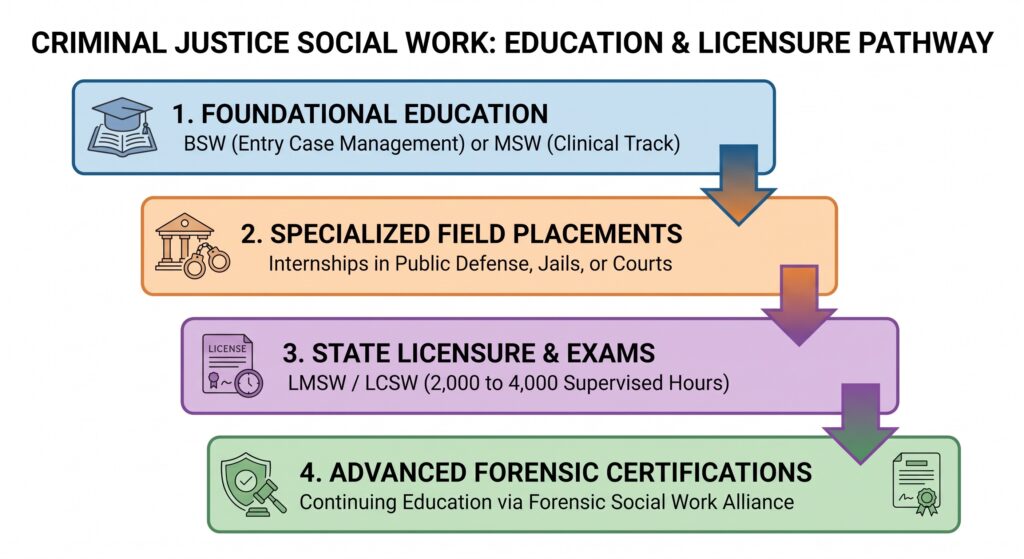
Securing a role in this specialty requires a combination of formal social work education, clinical licensing, and specialized training in legal-system dynamics.
1. Educational Degrees
- Bachelor of Social Work (BSW): Qualifies graduates for entry-level community support positions, intake screening, and non-clinical re-entry navigation.
- Master of Social Work (MSW): The industry standard for court liaisons, mitigation specialists, and correctional clinicians. Choose programs with forensic specializations or dual degree options (MSW/JD or MSW/MS in Criminology).
2. State Clinical Licensure
Clinical positions inside state facilities, psychiatric detention centers, or diversion dockets require clinical credentials (such as an LCSW or LICSW). These credentials require completing between 2,000 and 4,000 supervised post-graduate clinical hours and passing the Association of Social Work Boards (ASWB) clinical examination.
3. Forensic Credentials and Continuing Education
Credentials from professional organizations such as the Forensic Social Work Alliance (formerly NOFSW) validate expertise in trial testimony, forensic psychological assessments, civil commitments, and ethics.
👉 Try it Free - Free Case Management System
What Types of Forensic and Court-Based Roles Can You Pursue?
Forensic social workers work in four primary functional domains:
Adult Drug and Mental Health Courts
Specialized problem-solving courts rely heavily on the social worker role in adult drug courts. Practitioners evaluate participants for clinical suitability, recommend diversionary treatment plans to the bench, monitor toxicology results, and verify that participants attend mandatory community sessions.
Public Defense and Mitigation
Acting in mitigation specialist social work duties, practitioners examine systemic factors, multi-generational trauma, neurological injuries, and socioeconomic deficits in an accused individual’s background. They compile detailed mitigation reports that help defense teams advocate for diverted sentences, treatment alternatives, or reduced penalties.
Youth Advocacy and Family Systems
Applying juvenile justice diversion programs best practices, specialists work to keep young offenders away from formal detention centers. Interventions include functional family therapy, restorative justice conferences, and school re-engagement strategies to stop the school-to-prison pipeline.
Institutional Corrections and Release Planning
Correctional social workers run therapeutic groups and individual counseling sessions inside state and federal prisons. As release approaches, workers build a prisoner re-entry case management plan covering transitional housing, community mental health linkages, Medicaid reinstatements, and immediate post-release employment support.
How Do You Navigate Ethical Boundaries in Correctional Social Work?
Practicing inside an adversarial legal system introduces distinct professional tensions. Forensic professionals must balance custodial safety protocols with client self-determination.
Key ethical safeguards include:
- Informed Consent and Limits of Confidentiality: Before beginning an assessment, inform the client which details must be reported to the judge or probation officer and which remain clinically confidential.
- Objective Fact-Based Documentation: Document verified observations and clinical findings rather than legal guilt or innocence.
- Dual Roles: Avoid acting as both an investigative evaluator for the prosecution and a treating therapist for the same individual.
- Cultural Competence and Systemic Advocacy: Address racial disparities, language barriers, and economic disadvantages that disproportionately affect court-involved clients.
How Digital Tools Streamline Criminal Justice Social Work
Managing court-mandated caseloads requires balance between direct human services and administrative compliance. Case files for criminal justice clients involve probation conditions, drug screening dates, medical records, and mandatory court filings. Relying on paper charts, separate spreadsheets, and disjointed computer files often leads to lost data, missed court dates, and severe clinician burnout.
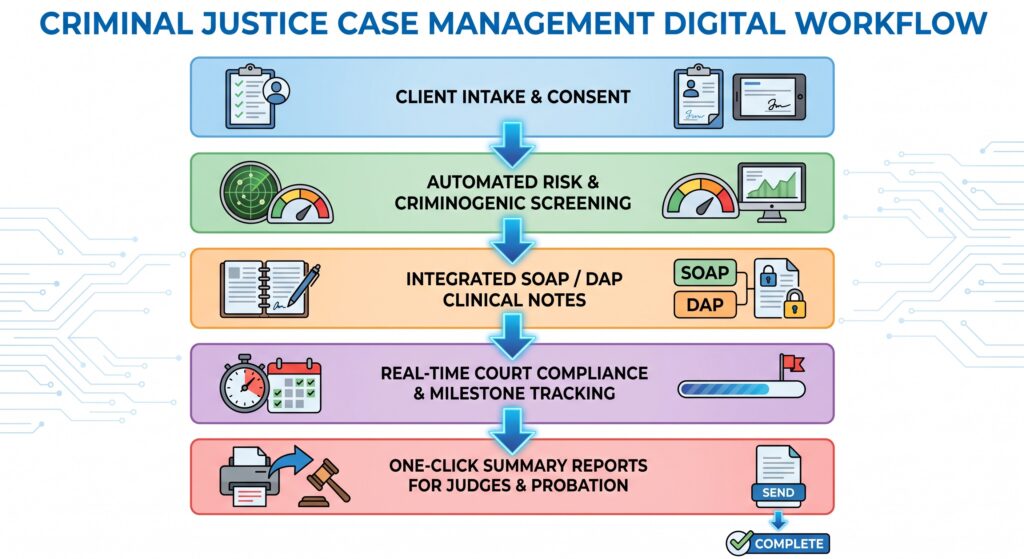
Modern case management software resolves these issues by consolidating client management into an organized digital environment:
1. Centralized Intake and Risk Screening
Standardize digital intakes using validated criminogenic risk tools. Responses automatically populate client profiles, eliminating duplicate data entry and highlighting immediate safety risks.
2. Clinical Documentation Templates
Standardized DAP notes format for probation and parole clients alongside a SOAP notes template for correctional social workers keep progress notes focused and consistent. Clinicians can complete high-volume notes efficiently while documenting client compliance and legal conditions.
3. Integrated Milestone Tracking
Court compliance tracking software for social workers records community service hours, weekly support group attendance, and randomized toxicology results. Automatic alerts notify case managers when an individual misses a mandatory condition, allowing for immediate intervention before a court violation occurs.
4. HIPAA-Compliant Court Reporting
Workers can separate confidential psychotherapy notes from court-reportable summaries. This protects sensitive medical details while giving attorneys and judges clear data on program compliance.
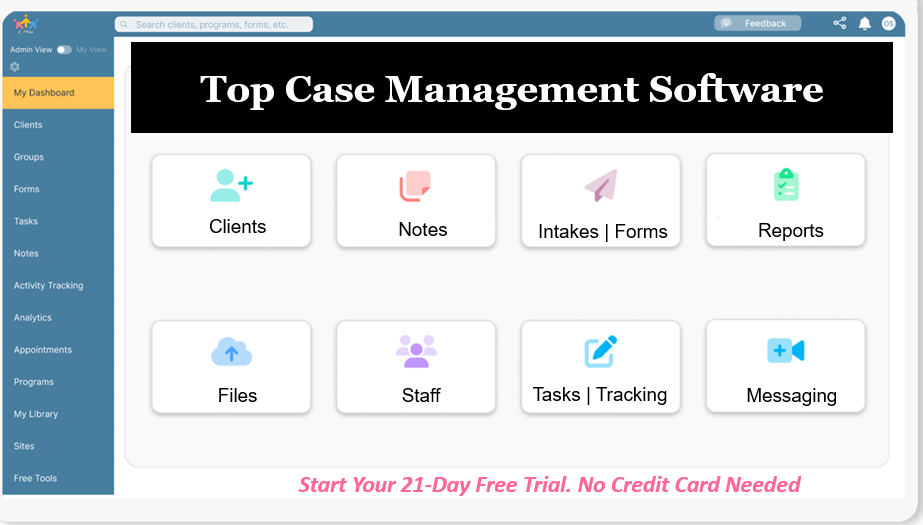
Do You Have a Team? Our best all-in-one client and top case management software simplifies everything from client intake and assessments to programs, projects, goals tracking, planning, scheduling, documentation, reporting dashboard, and progress tracking.All-in-One Case Management Software
Sign Up Today, Free
No credit card needed!
Manual Workflows vs. Automated Digital Workflows
| Operational Task | Traditional Manual Process | Automated Digital Workflow |
| Intake Assessment | Paper-based intake forms filed into locked cabinets; duplicate data entry across files. | Digital assessment forms with auto-populating fields and automated criminogenic scoring. |
| Progress Notes | Handwritten or unsecured word processor notes; variable formats that make auditing difficult. | Structured SOAP and DAP templates linked directly to treatment plans and diagnostic codes. |
| Legal Compliance Tracking | Manual check of sign-in sheets, paper testing logs, and disparate agency communications. | Automated tracking dashboards that log attendances, drug screenings, and judicial check-ins. |
| Court Status Reports | Hours spent pulling historical data from physical files to manually type status summaries. | Automated report generators that assemble verified attendance and compliance records in minutes. |
| Communication | Unsecured personal phone calls, text messages, and unencrypted emails. | HIPAA-compliant secure messaging for clients, defense counsel, and treatment providers. |


People Also Ask
What degree is best for a criminal justice social worker?
A Master of Social Work (MSW) from a program accredited by the Council on Social Work Education (CSWE) provides the strongest foundation. While a Bachelor of Social Work (BSW) or a degree in criminal justice qualifies you for entry-level case management, an MSW is required to perform independent clinical therapy and court-ordered evaluations.
What is the difference between a social worker and a probation officer?
A probation officer is a court official focused on public safety, statutory supervision, and legal compliance. In contrast, a social worker focuses on clinical assessment, therapeutic counseling, and connecting clients to community resources, operating under distinct professional codes of ethics.
Do criminal justice social workers go to court?
Yes. Forensic social workers regularly attend hearings to provide expert testimony, update judges on treatment progress, submit mitigation evaluations, and recommend diversion programs for qualifying individuals.
What is the primary role of a social worker in prison?
In prison facilities, social workers evaluate incoming inmates, lead mental health and crisis interventions, facilitate trauma-informed substance abuse groups, and coordinate discharge plans to support successful community re-entry.
Can a social worker help reduce recidivism?
Yes. Social workers reduce recidivism by addressing criminogenic factors such as substance dependence, housing instability, unresolved trauma, and unemployment through evidence-based case management and behavioral health therapy.
Is working in criminal justice social work dangerous?
Forensic settings require strict adherence to facility safety protocols, boundary maintenance, and crisis de-escalation skills. While clients often have complex backgrounds, agencies implement clear security guidelines, panic alert systems, and structured interview settings to minimize physical risks.
Simplify Your Forensic Case Management with Case Management Hub
Navigating complex judicial requirements should not take time away from direct client care. Forensic case managers and social workers need digital workflows designed specifically for multidisciplinary casework.
Case Management Hub provides an all-in-one, HIPAA-compliant platform tailored to the operational demands of justice-involved behavioral health. Key capabilities include:
- Structured Forensic Documentation: Utilize built-in SOAP and DAP note templates configured for clinical milestones and court updates.
- Separation of Clinical and Legal Records: Maintain absolute confidentiality by separating private psychotherapy notes from court-reportable attendance logs.
- Compliance Tracking: Monitor court dates, community service milestones, and drug testing records through a visual dashboard.
- Automated Court Reporting: Export clean, professional status updates for judges, probation officers, and defense teams in minutes.
- Encrypted Client Communication: Stay in contact with participants and treatment teams using secure, auditable messaging tools.
Ready to reduce paperwork and focus on client rehabilitation?
Start your 21-day free trial of Case Management Hub

No credit card required. Full feature access.
Frequently Asked Questions (FAQs)
How can social workers protect client privacy when courts subpoena records?
Under standard legal practice and the NASW Code of Ethics, social workers should disclose only the information explicitly mandated by law. When served with a broad subpoena, consult with agency legal counsel and advocate to limit disclosures using formal protective orders. Separating private psychotherapy records from general compliance logs simplifies this process.
What evidence-based treatment modalities work best in carceral environments?
Cognitive Behavioral Therapy (CBT), specifically curricula adapted for justice-involved individuals such as Thinking for a Change (T4C), shows high efficacy. Dialectical Behavior Therapy (DBT), Seeking Safety for co-occurring trauma and substance use, and Motivational Interviewing (MI) are also effective tools for reducing institutional infractions and preparing clients for release.
How do social workers prevent secondary traumatic stress and burnout in correctional facilities?
Working within carceral settings exposes clinicians to high rates of vicarious trauma. Sustainable practice requires strict work-hour boundaries, regular clinical supervision outside the correctional chain of command, peer consultation groups, and automated documentation systems that eliminate administrative overload.
What is the typical caseload size for a forensic social worker?
Caseload sizes vary significantly based on setting and public funding. In community re-entry and specialized diversion courts, caseloads range from 20 to 40 individuals. In state prisons or general parole districts, caseloads can exceed 60 to 100 cases, which makes automated case management tools essential.
Can someone with a past criminal record become a licensed social worker?
Yes, in many jurisdictions. State licensing boards evaluate applicants individually, weighing the nature of the conviction, time elapsed, and evidence of rehabilitation. Individuals with lived experience often bring valuable insight to re-entry and diversion initiatives, though background checks remain required for work inside secure facilities.
What role does medication management play in court-diversion casework?
Medication adherence is often essential for individuals diverted into mental health courts. Social workers coordinate appointments with community psychiatrists, resolve pharmacy and insurance barriers, and track medication compliance as part of the overall court progress plan.
👉 Try it free today - No credit card needed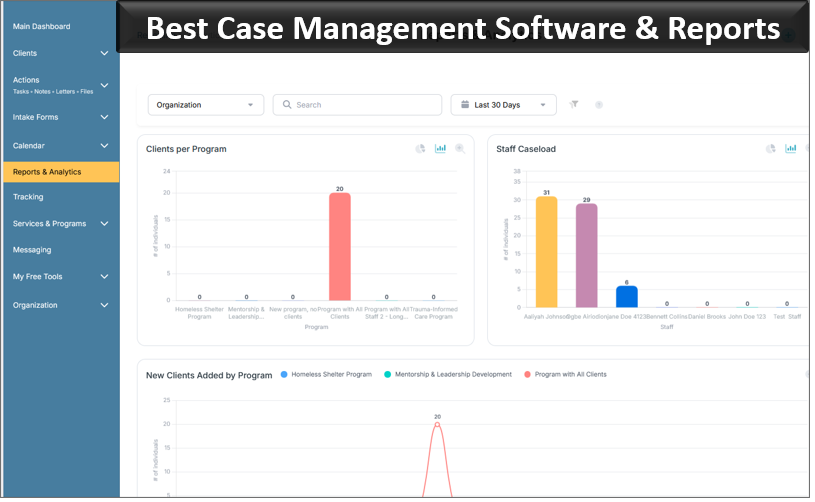
Note: Content on this website (socialworkportal.com) is copyrighted and protected under applicable copyright laws. Unauthorized reproduction, distribution, or use of any content from the website, without explicit written permission, is strictly prohibited. Read: Terms of Use.
Social Work Portal Disclaimer: Social Work Portal is not a social work agency and we do not refer social workers. This web site is provided for educational and informational purposes only and does not constitute providing medical advice or professional social and healthcare services. The information provided should not be used for diagnosing or treating a health problem or disease, and those seeking personal medical advice should consult with ... Read our full disclaimer here: Social Work Portal Disclaimer.