Build Accurate Formulations, Accelerate Diagnostic Intakes, and Protect Client Care
Mental health professionals spend an extraordinary portion of their working hours translating human suffering into standardized documentation. Whether you are an intake coordinator admitting an acute client, a licensed clinical social worker conducting a biopsychosocial assessment, or a psychiatric nurse completing a baseline review, the initial evaluation sets the entire trajectory of care. A missed risk indicator or an incomplete social history can delay effective intervention, disrupt insurance reimbursement, and leave clients feeling unheard.
The administrative burden accompanying clinical practice exacerbates this pressure. According to a study published by the Annals of Internal Medicine, ambulatory clinicians spend approximately two hours on electronic health records and documentation tasks for every one hour of direct face-to-face client care. When initial intakes rely on fragmented paper packets, disconnected PDF checklists, and manual re-typing, clinical burnout accelerates while diagnostic accuracy suffers. Conducting an effective, ethical assessment requires balancing deep diagnostic precision with streamlined, standardized documentation.
Let’s get started
Watch this video:
or
read the guide below.
What You’ll Learn in This Guide
- How to structure the four core phases of a clinical interview and mental status examination
- Key distinctions between a psychological evaluation vs psychiatric assessment
- How to implement an evidence-based mental health risk assessment protocol
- Best practices for adapting assessments for pediatric, adult, and geriatric populations
- Practical comparisons of manual charting versus automated intake workflows
- Strategies to transition from initial diagnostic findings into actionable SOAP and DAP notes
💡All-in-one Case Management Software.
Everything in one place: clients, notes, forms, appointments, reports, and outcomes.
👉 Try it Free - No credit card needed
What Are the Core Components of a Mental Status Examination?
The mental status examination (MSE) provides an objective, point-in-time snapshot of a client’s cognitive, behavioral, and emotional functioning. Rather than assessing historical events, the MSE captures what the clinician directly observes and tests during the session.
A systematic MSE evaluates nine standardized domains:
- Appearance and General Behavior: Grooming, hygiene, nutritional baseline, eye contact, body posture, and cooperativeness.
- Motor Activity: Psychomotor agitation (e.g., pacing, hand-wringing) or psychomotor retardation (e.g., slowed movements, delayed responses).
- Speech: Rate, volume, rhythm, latency, and articulation (e.g., pressured, monotone, slurred).
- Mood and Affect: Mood reflects the client’s internally reported emotional state (“depressed,” “anxious,” “irritable”). Affect reflects the clinician’s objective observation of emotional expression (e.g., flat, blunted, labile, congruent, or incongruent with stated mood).
- Thought Process: The organization and flow of ideas. Clinicians assess for goal-directed thinking versus loose associations, tangentiality, flight of ideas, circumstantiality, or thought blocking.
- Thought Content: The presence of delusions, obsessions, phobias, ideas of reference, or intrusive ideation.
- Perception: Auditory, visual, tactile, or olfactory hallucinations, as well as depersonalization or derealization experiences.
- Cognition and Sensorium: Alertness, orientation to person, place, time, and situation, concentration, and immediate and remote memory.
- Insight and Judgment: The client’s awareness of their illness and their practical decision-making capacity regarding personal safety and treatment adherence.
Standardizing these MSE observations ensures reliable communication across interdisciplinary treatment teams and establishes an objective clinical baseline.
How Do You Structure Clinical Interview Questions for Mental Health Intake?
A clinical interview must balance conversational warmth with rigorous diagnostic inquiry. Using a structured biopsychosocial assessment template social work framework ensures you capture biological vulnerabilities, psychological stressors, and environmental factors without making the interview feel like an interrogation.
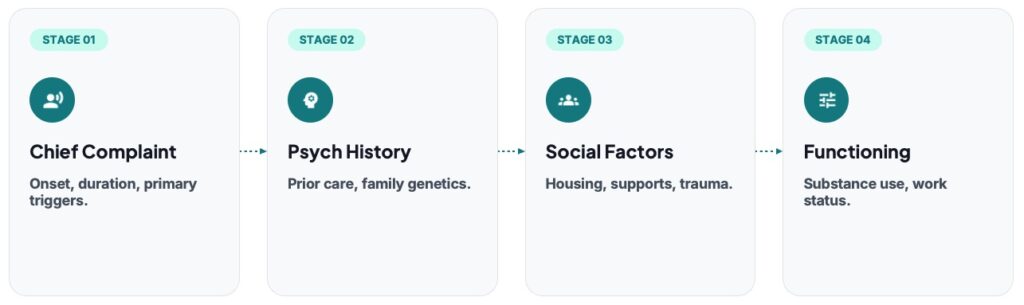
Structuring your interview questions across four systematic stages yields the most thorough outcomes:
- Chief Complaint and Presenting Problem
Begin with open-ended inquiry to identify what brought the client to care now:
- “What specific challenges or symptoms prompted you to seek support at this moment?”
- “When did these difficulties first begin, and how have they shifted over the last two to four weeks?”
- “On a scale from 1 to 10, how severely do these symptoms interfere with your daily routine?”
- Psychiatric and Medical History
Explore physiological and genetic foundations:
- “Have you ever received behavioral health treatment, counseling, or medication management in the past?”
- “Is there a history of depression, anxiety, mood instability, or substance misuse in your biological family?”
- “What active medical conditions, chronic pain issues, or prescription medications are you currently managing?”
- Psychosocial and Developmental History
Map out systemic stressors and protective factors:
- “What does your current living situation look like, and who serves as your primary emotional support?”
- “Are you currently experiencing financial strain, housing instability, or employment challenges?”
- “Have you experienced significant physical, emotional, or environmental trauma during your life?”
- Substance Use and Functional Impact
Quantify external variables:
- “How frequently do you consume alcohol, cannabis, or unprescribed substances?”
- “How are these symptoms impacting your personal relationships, job performance, or academic progress?”
👉 Try it Free - Free Case Management System
What Is the Difference Between a Psychological Evaluation vs Psychiatric Assessment?
Clinicians and intake specialists must distinguish between different diagnostic scopes to route clients to appropriate providers:
- Psychological Evaluation: Typically conducted by clinical psychologists (PhD or PsyD). This evaluation focuses on formal psychometric testing, cognitive screening, projective measures, and comprehensive behavioral rating batteries to clarify complex differential diagnoses, learning disorders, personality structures, or neurodevelopmental profiles.
- Psychiatric Assessment: Conducted by medical professionals, including psychiatrists (MD or DO), psychiatric nurse practitioners (PMHNP), or physician assistants (PA-C). While incorporating psychosocial context, the primary focus is evaluating neurobiological symptoms, ruling out medical etiologies, diagnosing disorders through medical frameworks, and initiating or managing pharmacotherapy.
Both modalities depend on detailed intake histories and clear communication between therapists, case managers, and medical prescribers.
How Should Clinicians Execute a Mental Health Risk Assessment Protocol?
Risk assessments require explicit, systematic inquiry. Clinicians cannot rely on passive assumption or general impressions when evaluating harm to self or others. An effective risk screening protocol must include three operational steps:
- Direct Suicide and Self-Harm Inquiries: Ask direct, unambiguous questions: “Are you having thoughts of wanting to end your life?” “Have you thought about ways or methods you might use?” If ideation is endorsed, assess frequency, intensity, access to means, active intent, and existing deterrents.
- Harm to Others and Protective Well-Being: Evaluate thoughts of violence, homicide, or severe retaliation, particularly when paranoid delusions or acute agitation are present. Screen for domestic safety, child welfare concerns, and dependent adult vulnerabilities.
- Stratification and Action Planning: Categorize risk as low, moderate, or high based on intent, access, and protective factors. High-acuity presentations require immediate crisis stabilization, voluntary or involuntary emergency evaluation, and removal of lethal means. Moderate-acuity presentations demand explicit safety plans, designated emergency contacts, and rapid follow-up scheduling.
Every risk screening must be documented with explicit quotes and rationale to support clinical decisions.
How Do Assessment Frameworks Vary Across Children, Adults, and Older Adults?
A single assessment framework cannot fit every stage of life. Tailoring your approach according to age group preserves clinical accuracy:
- Pediatric Mental Health Intake Interview Guide: Evaluating children and adolescents requires multimodal information gathering. Minors frequently struggle to articulate affective states verbally, showing distress through behavioral changes, somatic complaints, or academic decline. Clinicians must gather objective collateral data from parents, caregivers, and teachers alongside standardized child behavior scales.
- Adult Assessments: Focus primarily on self-reported symptoms, vocational functioning, interpersonal relationship health, and substance use patterns.
- Geriatric Mental Health Assessment Checklist: Evaluating older adults (typically age 65 and above) demands attention to cognitive baselines, early indicators of mild cognitive impairment or dementia, sensory deficits, polypharmacy interactions, and grief related to the loss of physical autonomy or peers.
Do You Have a Team? Our best all-in-one client and top case management software simplifies everything from client intake and assessments to programs, projects, goals tracking, planning, scheduling, documentation, reporting dashboard, and progress tracking.All-in-One Case Management Software
Sign Up Today, Free
No credit card needed!
How Digital Tools Streamline Mental Health Assessment Workflows
Traditional clinical workflows rely heavily on manual documentation: hand-written interview notes, paper intake packets that front-office staff transcribe by hand, and standalone scoring sheets for questionnaires like the PHQ-9 or GAD-7. This manual approach consumes billable time, introduces charting delays, and increases the likelihood of data entry mistakes.
Modern behavioral health EHR with customizable assessment templates and mental health assessment software eliminate this friction across the clinical lifecycle:
- Automated Remote Intakes: Patients receive secure, HIPAA compliant digital intake forms for therapists via an encrypted portal prior to their initial session. Biographic data, medical histories, consent documents, and symptom screeners populate the client record automatically before they enter the consultation room.
- Instant Objective Scoring: Automated mental health screening tools for case management instantly score standardized screening instruments, flagging elevated risk thresholds directly in the clinical chart.
- Structured Clinical Formulation: During the diagnostic interview, clinicians input findings into a cloud based psychiatric evaluation documentation tool with structured drop-downs, standardized MSE prompts, and customizable narrative sections.
- Seamless Transition into Treatment Plans: Assessment data, verified diagnoses, and functional baselines immediately flow into treatment goals. Clinicians can generate ongoing clinical records using electronic health records with DAP note templates or SOAP frameworks without re-entering baseline details.
- Integrated Billing and Compliance: Completed assessments link directly to appropriate CPT evaluation and management codes within an integrated mental health billing and documentation platform, preventing missed billing submissions and ensuring audit-ready records.
Manual Workflows vs. Automated Digital Workflows
| Assessment Phase | Manual / Paper-Based Process | Automated Digital Workflow |
| Intake Collection | 30 to 45 minutes of manual in-office clipboard completion; staff re-types details into charts. | Completed securely at home via digital client portal; auto-populates the master client file. |
| Symptom Screening | Clinician hand-calculates PHQ-9, GAD-7, or AUDIT scores; risks manual scoring errors. | Automated scoring algorithms instantly calculate point totals and highlight clinical severity alerts. |
| MSE & Clinical Charting | Hand-written or unstructured Word docs; prone to missing required compliance categories. | Standardized digital templates with mandatory fields ensure comprehensive MSE and diagnostic capture. |
| Progress Note Setup | Clinicians re-copy assessment baselines, goals, and history manually into session notes. | Automatic data propagation directly into structured SOAP and DAP progress note templates. |
| Billing & Coding | Manual reconciliation of intake service dates with separate billing software or clearinghouses. | One-click synchronization linking completed assessment files with respective CPT diagnostic codes. |

People Also Ask
How long does a comprehensive mental health assessment take?
A standard clinical mental health assessment typically takes between 60 and 90 minutes of direct interview time. Additional time is usually required for formal psychometric scoring, collateral history gathering, and clinical report formulation.
What is the difference between SOAP and DAP notes in mental health?
SOAP notes organize documentation into Subjective, Objective, Assessment, and Plan sections, making them widely favored in multidisciplinary medical and psychiatric settings. DAP notes condense documentation into Data, Assessment, and Plan, which many outpatient therapists and case managers prefer for behavioral progress tracking.
Can mental health assessments be conducted via telehealth?
Yes, mental health assessments can be conducted remotely using HIPAA-compliant video platforms. Clinicians must verify the client’s physical location for safety management and ensure adequate video resolution to observe affect, psychomotor behaviors, and cognitive engagement.
Who is legally qualified to conduct a mental health assessment?
Licensed mental health professionals, including clinical psychologists, licensed clinical social workers, licensed professional counselors, marriage and family therapists, psychiatrists, and advanced practice psychiatric nurses, are credentialed to conduct assessments within their defined scope of practice.
What happens if a client refuses to answer intake questions?
Clinicians should validate the client’s hesitancy, explain confidentiality boundaries, and clarify how the requested information informs their treatment. If resistance continues, note the guarded presentation in the Mental Status Examination and address non-sensitive topics first to build therapeutic rapport.
What standardized tools are most commonly used during mental health screening?
The Patient Health Questionnaire (PHQ-9) for depression, the Generalized Anxiety Disorder 7-item scale (GAD-7), the Columbia-Suicide Severity Rating Scale (C-SSRS), and the Alcohol Use Disorders Identification Test (AUDIT) are among the most validated, widely implemented screening tools in behavioral healthcare.
Modernize Your Clinical Workflow with Case Management Hub
Documenting complex clinical assessments should not keep you buried in paperwork after clinic hours. Case Management Hub is an all-in-one, HIPAA-compliant platform built specifically for clinical social workers, counselors, therapists, and case management teams who require clinical depth without administrative friction.
With Case Management Hub, you can eliminate fragmented paper forms and outdated software tools:
- Deploy secure, customizable digital intake forms that clients complete from any smartphone or computer
- Utilize pre-built, customizable biopsychosocial assessment templates and automated screening instruments
- Transition diagnostic findings directly into integrated treatment plans, goal trackers, and structured DAP or SOAP clinical note templates
- Coordinate comprehensive case management client tracking software features, secure client messaging, appointment scheduling, and streamlined billing in a single encrypted environment

Experience how an integrated documentation platform can protect your clinical focus and lighten your administrative load.
Start your 21-day free trial of Case Management Hub today (no credit card required).
Frequently Asked Questions (FAQs)
How do I write an initial behavioral health evaluation report efficiently without cutting clinical corners?
Adopt structured digital templates that use point-and-click selection for objective MSE domains while reserving open text fields for formulation and treatment recommendations. Completing administrative details and objective observations during or immediately following the session prevents documentation backlogs and preserves descriptive accuracy.
What are the key HIPAA compliance requirements for digital intake forms?
Digital intake platforms must feature end-to-end encryption for data both in transit and at rest, unique user authentication credentials, automated session timeouts, and comprehensive audit logs detailing file access. Covered entities must also execute a formal Business Associate Agreement (BAA) with the software vendor before transmitting protected health information.
How do I adapt an assessment when a client presents in acute crisis?
In high-acuity crisis scenarios, abbreviate the comprehensive psychosocial history and immediately prioritize the mental health risk assessment protocol and mental status examination. Focus on current safety, access to lethal means, organic drivers, and the immediate level of care required to secure stability before scheduling a comprehensive intake at a later date.
What is the most effective way to document lack of insight in the MSE?
Avoid vague labels such as poor insight. Instead, document descriptive behavioral evidence: The client acknowledges experiencing daily panic symptoms but attributes them exclusively to room temperature, declining to discuss emotional, work-related, or physiological contributors.
How can case managers coordinate care with psychiatric prescribers using assessment data?
Case managers can export structured biopsychosocial summaries that highlight functional baselines, objective screener scores, reported medical comorbidities, and current medication lists. Providing organized, objective documentation accelerates psychiatric consults and supports precise medication management.
How frequently should an initial mental health evaluation be formally updated?
Accreditation bodies and third-party payers generally require comprehensive diagnostic reassessments annually. However, clinicians should update diagnostic formulations whenever significant clinical transitions occur, such as a major psychiatric hospitalization, the emergence of new high-risk symptoms, or an absence of progress toward treatment plan goals.
👉 Try it free today - No credit card needed
Note: Content on this website (socialworkportal.com) is copyrighted and protected under applicable copyright laws. Unauthorized reproduction, distribution, or use of any content from the website, without explicit written permission, is strictly prohibited. Read: Terms of Use.
Social Work Portal Disclaimer: Social Work Portal is not a social work agency and we do not refer social workers. This web site is provided for educational and informational purposes only and does not constitute providing medical advice or professional social and healthcare services. The information provided should not be used for diagnosing or treating a health problem or disease, and those seeking personal medical advice should consult with ... Read our full disclaimer here: Social Work Portal Disclaimer.