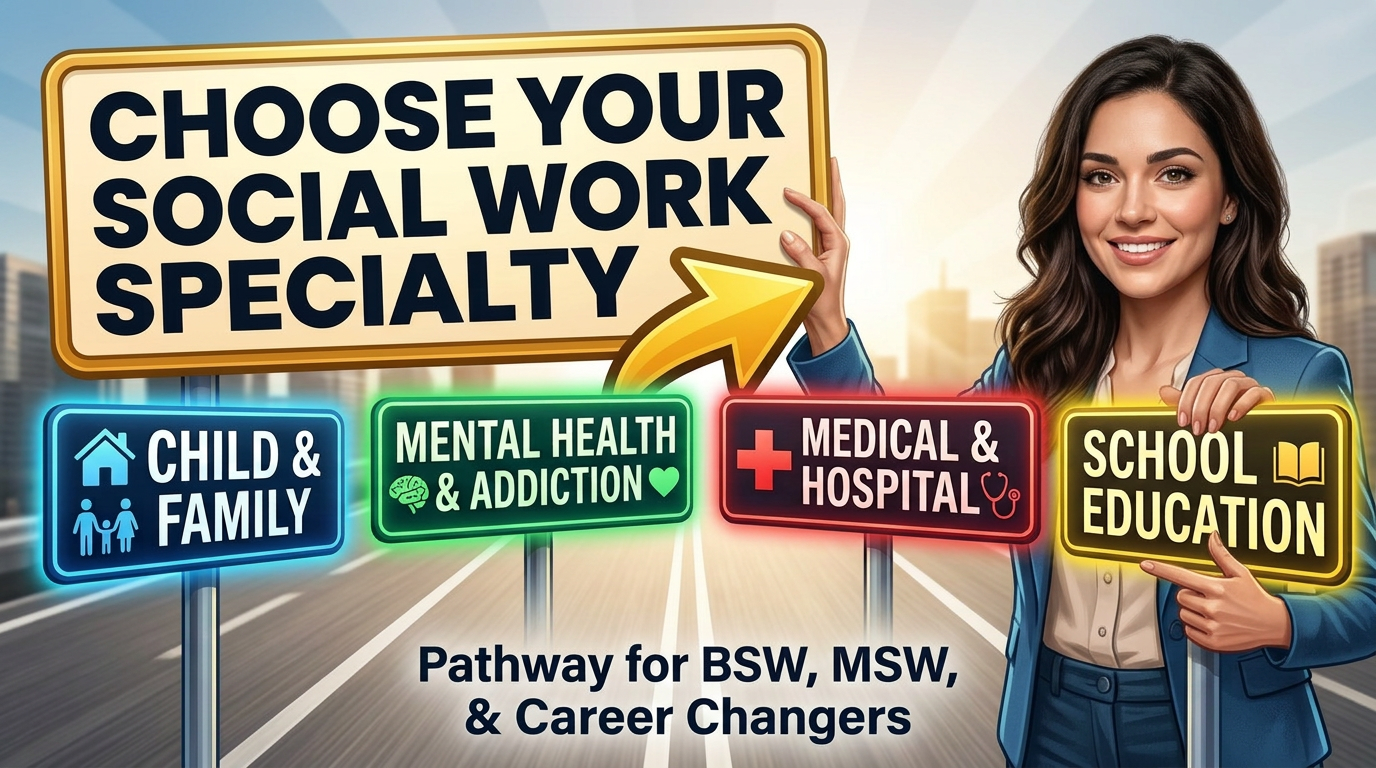
A Step-by-Step Pathway for Navigating Specialization Options
Finding your place in the human services sector can feel both exciting and overwhelming. Social work is a vast field spanning direct individual counseling to large-scale policy reform. Because the scope of practice is broad, knowing how to align your natural talents, values, and lifestyle preferences with a specific practice area is essential for long-term fulfillment and preventing burnout.
Whether you are completing a Bachelor of Social Work (BSW), finishing a Master of Social Work (MSW), preparing for licensure supervision and goal tracking, or planning a mid-career pivot, choosing a focus area requires clear self-assessment and practical market knowledge.
Let’s get started
Watch this video:
or
read the guide below.
What You Will Learn in This Guide
- Core Differences: The structural distinctions between direct clinical practice and macro systemic work.
- Specialty Alignment: How to map personal strengths directly to settings like health systems, schools, or court systems.
- Licensure Pathways: Essential licensing considerations for specialized practice and long-term career growth.
- Practice Logistics: The role of case management tools, scheduling software, and documentation in day-to-day workflow.
- Career Transitions: Strategic pathways for transitioning from case manager to clinical social worker or pivoting between specialties.
- Decision Frameworks: Key financial, structural, and lifestyle factors to evaluate before selecting a pathway.
💡All-in-one Case Management Software.
Everything in one place: clients, notes, forms, appointments, reports, and outcomes.
👉 Try it Free - No credit card needed
What Is the Difference Between Clinical vs Macro Social Work Career Goals?
Understanding the divide between direct client care and large-scale systemic advocacy is the foundational step in mapping your trajectory. Social work career paths and specialties generally sit along a spectrum anchored by clinical practice at one end and macro social work at the other.
| Practice Spectrum Tier | Core Focus | Primary Target Audience / Scope |
| Micro / Clinical Practice | Direct Individual Care | Individuals, couples, families, and small support groups |
| Mezzo Practice | Group & Community Intervention | Schools, local neighborhoods, small agencies, and regional groups |
| Macro Practice | Systemic Policy & Advocacy | Legislation, government policy, large organizations, and public systems |
Direct micro and clinical practice focuses on individuals, couples, families, and small groups. In these roles, professionals perform clinical assessments, diagnose mental health conditions, provide psychotherapy, and coordinate direct interventions. If you thrive on one-on-one relationships, deep interpersonal problem-solving, and active listening, clinical settings offer direct, tangible feedback.
Macro social work shifts focus from individual treatment to community organization, administration, policy analysis, and program evaluation. Corporate social work and macro social work roles address systemic inequalities by reforming public policy, managing non-profit organizations, or leading community advocacy initiatives.
If your strengths lie in project management, research, grant writing, and organizational leadership, macro practice allows you to impact entire populations rather than single caseloads at a time.
| Feature | Micro / Clinical Social Work | Macro Social Work |
| Primary Focus | Individuals, families, small groups | Communities, systems, organizations |
| Daily Core Activities | Psychotherapy, crisis intervention, clinical intake, case management | Grant writing, policy evaluation, community organizing, administration |
| Common Credentials | MSW, LMSW, LCSW / LICSW | BSW, MSW (Macro concentration), PhD |
| Key Skills Needed | Empathy, clinical assessment, active listening, documentation | Program design, data analysis, public speaking, project management |
| Key Documentation Requirements | Progress notes, treatment plans, mental health diagnoses | Annual reports, grant proposals, policy briefs, community needs audits |
👉 Try it Free - Free Case Management System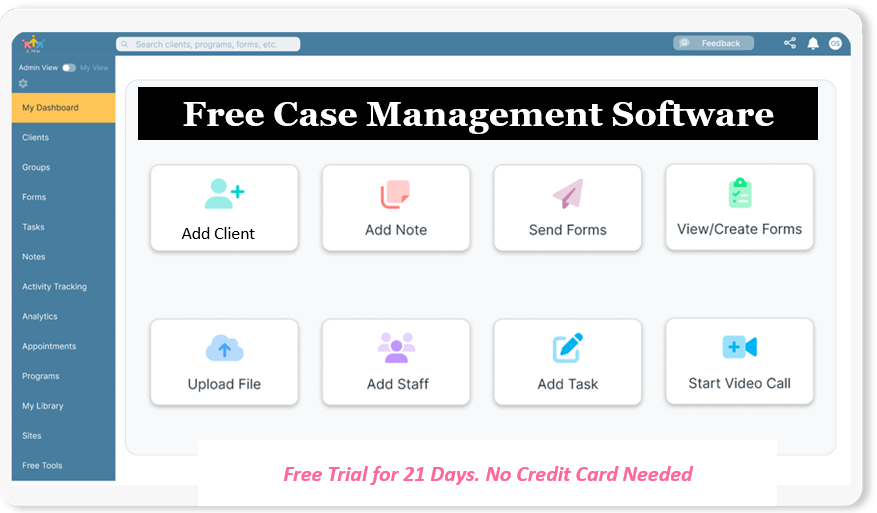
How Do You Match Your Personal Skills to Specific Social Work Practice Settings?
Identifying the best social work specialties for skills assessment means looking honestly at your natural strengths, work style, and emotional boundary limits. Different environments demand distinctly different day-to-day skill sets.
| Work Environment | Core Personal Strengths Required | Target Specialty Area |
| Crisis & Fast-Paced | Rapid assessment, emotional agility, team collaboration | Healthcare & Medical Social Work |
| Structured Educational | Patience, multi-tiered behavioral support, multi-generation communication | School Social Work |
| Therapeutic & Agency | Diagnostic expertise, therapeutic techniques, boundary-setting | Mental Health Social Work |
| Legal & Systems-Based | Risk assessment, legal system comprehension, resilience | Forensic & Child / Family Social Work |
Healthcare and Hospital Settings
Navigating medical social work job requirements and skills calls for high emotional agility, rapid assessment abilities, and comfort within interdisciplinary medical teams. Healthcare social workers assist patients navigating complex diagnoses, discharge planning, organ transplantation, or end-of-life decisions.
According to data from the U.S. Bureau of Labor Statistics, employment of healthcare social workers is projected to grow by 8 percent over the coming decade, driven by an aging population and complex healthcare systems. Fast-paced settings like emergency departments or oncology units require crisp communication, sharp crisis management, and strict documentation hygiene.
Educational and School Environments
Understanding school social worker skills and licensure steps reveals a unique intersection of clinical intervention, family advocacy, and child development. School social workers support students dealing with behavioral challenges, learning disabilities, family trauma, or socio-economic distress. Success here relies on patience, intergenerational communication, multi-tiered behavioral support strategies, and collaboration with teachers, school psychologists, and parents.
Mental Health and Community Agencies
Reviewing mental health social worker daily responsibilities highlights the demand for diagnostic expertise, individual therapy techniques, and structured treatment planning. Whether serving in community mental health centers, outpatient clinics, or private practices, practitioners in this space build sustained therapeutic relationships. Key skills include boundary-setting, cognitive-behavioral techniques, trauma-informed care, and structured clinical documentation.
Specialized Fields: Child, Family, and Forensic Roles
The child and family social work career trajectory offers pathways across protective services, adoption agencies, and family preservation programs. These positions require deep risk-assessment skills, family dynamics knowledge, and resilience.
Meanwhile, forensic social work skills and career outlook center on the legal and justice systems. Practitioners work in public defender offices, correctional facilities, court diversion programs, or victim advocacy organizations, applying human services frameworks to legal procedures, expert witness testimonies, and reentry planning.
How Does Licensure and Career Stage Impact Your Specialty Options?
Your current educational milestone directly dictates your immediate career scope, supervision requirements, and salary potential.
| Career Milestone | Credentials Earned | Primary Career Scope | Typical Work Settings |
| BSW Graduate | BSW | Entry-level care coordination, intake, client advocacy | Child welfare agencies, shelters, eldercare facilities |
| MSW Graduate | MSW / LMSW | Clinical assessment, program coordination, supervised practice | Hospitals, outpatient clinics, schools, community agencies |
| Licensed Clinical Worker | LCSW / LICSW | Independent clinical practice, therapy, supervision | Private practice, mental health centers, clinical administration |
BSW Graduates and Entry-Level Roles
For human services career changer social work guide seekers or BSW graduates, entry-level positions provide foundational practice exposure. BSW professionals excel in care coordination, intake coordination, client advocacy, and resource navigation. Roles in child welfare agencies, homeless shelters, and eldercare facilities build essential field exposure.
MSW Students and Recent Graduates
Earning an MSW expands clinical, supervisory, and specialized opportunities. MSW graduates can pursue state licensure as Licensed Master Social Workers (LMSW) or equivalent state designations. This credential opens doors to clinical diagnostic roles, hospital case management, program coordination, and school social work positions.
Licensed Clinical Practice and Mid-Career Pivots
Achieving full clinical licensure (LCSW or LICSW) requires completing mandatory post-MSW supervised clinical hours. This tier unlocks independent clinical practice, insurance billing capabilities, and specialized private practice management options.
For experienced professionals transitioning from case manager to clinical social worker, full licensure provides autonomy, higher earning potential, and the ability to supervise early-career practitioners.
What Practical Tools Do Social Workers Need Across Different Specialties?
Regardless of setting, accurate documentation, schedule management, client tracking, and privacy compliance form the backbone of sustainable professional practice.
| Practice Tool Requirement | Direct Clinical & Private Practice | Non-Profit & Case Management |
| Client Administration | Online intakes, digital consent forms | Broad demographics, referral workflows |
| Scheduling & Calendar | Client appointment booking, reminders | Multi-provider calendars, group visits |
| Clinical / Narrative Notes | Progress notes (SOAP/DAP), diagnoses | Case notes, service tracking logs |
| Compliance & Data Security | HIPAA-compliant storage & messaging | Grant reporting, funder compliance |
| Financial Operations | Insurance billing, claim tracking | Cost tracking, budget allocation |
Modern practice environments rely on specialized administrative workflows to reduce administrative burden and maintain ethical compliance:
- Clinical Documentation: Managing progress notes (such as SOAP or DAP structures) using standardized, HIPAA-compliant social work EHR and note templates.
- Client Management: Maintaining secure intake forms, client records, and social work client progress tracking and reporting metrics.
- Scheduling and Billing: Streamlining client scheduling, appointment reminders, and claim generation via private practice social work scheduling and billing systems.
- Care Coordination: Utilizing integrated social work case management and documentation tools to track interventions, manage goals, and measure client outcomes across team settings.
Utilizing an all-in-one platform for social workers and case managers helps agencies and solo practitioners handle appointment scheduling, client communication, secure file storage, and financial tracking in a unified workspace, preserving time for direct client care.
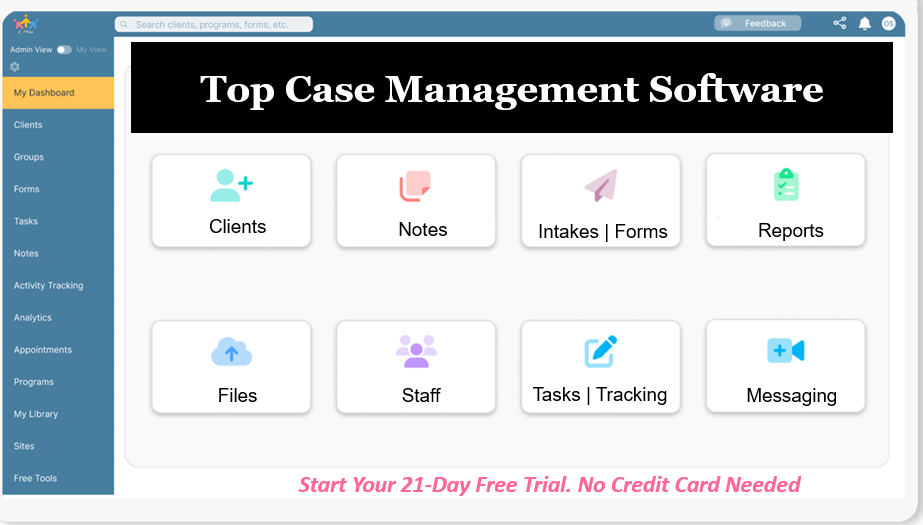
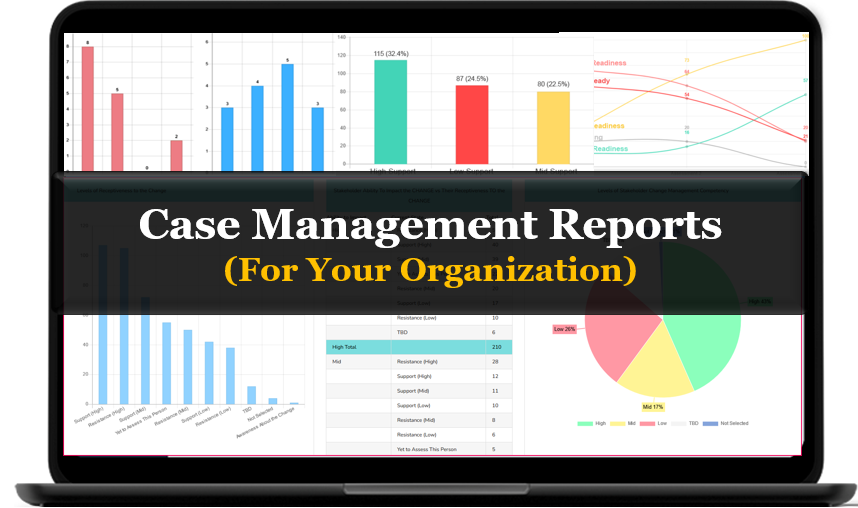
Do You Have a Team? Our best all-in-one client and top case management software simplifies everything from client intake and assessments to programs, projects, goals tracking, planning, scheduling, documentation, reporting dashboard, and progress tracking.All-in-One Case Management Software
Sign Up Today, Free
No credit card needed!
What Key Factors Should Guide Your Final Specialty Decision?
Choosing a specialization requires balancing financial expectations with personal values and daily work environments.
| Evaluation Pillar | Decision Factors to Consider |
| 1. Compensation & Growth | Salary benchmarks, credential-based earning jumps (LMSW vs LCSW) |
| 2. Work Environment | Daily pace preference (fast hospital units vs structured private practice hours) |
| 3. Client Population | Alignment with personal empathy reserves, boundaries, and clinical interests |
| 4. Licensure Supervision | Availability of qualified clinical supervisors and goal tracking in the workspace |
- Compensation and Growth Potential: Review salary trends using official resources such as the Bureau of Labor Statistics or state-level licensure reports. Evaluate credential-based earning jumps between LMSW and LCSW tiers.
- Work Environment and Daily Pace: Decide whether you perform best in fast-paced medical environments, structured school calendars, agency office hours, or independent private practice.
- Target Client Population: Reflect on which community groups align best with your clinical interests, empathy reserves, and personal boundaries.
- Licensure Supervision Requirements: Ensure your target employment environment provides access to qualified clinical supervisors and structured goal tracking toward independent licensure.

People Also Ask
What is the most in-demand social work specialty?
Healthcare social work and mental health/substance abuse social work consistently rank among the highest-growth specialties. Increasing demand for outpatient mental health care, integrated healthcare settings, and eldercare management drives rapid job expansion across these sectors.
Can you change your social work specialty mid-career?
Yes. Social work degrees offer flexible transferability across settings. A clinical social worker can transition into healthcare, administrative macro roles, or corporate advocacy without re-earning a degree. Specific settings may simply require supplementary certifications or continuing education units (CEUs).
What is the salary difference between a BSW and an MSW?
MSW graduates generally earn higher starting salaries and access advanced supervisory, diagnostic, and clinical roles closed to BSW holders. Achieving full LCSW status further unlocks higher earnings through private practice, federal agency positions, and clinical administration.
Is macro social work better than clinical social work?
Neither path is objectively better; they address different scales of problem-solving. Clinical social work focuses on direct client therapy and family intervention, whereas macro social work targets legislative policy, community organizing, non-profit management, and program oversight.
What credentials do I need for private practice social work?
To practice independently in private practice, you typically need a Master of Social Work (MSW) degree, the required hours of post-graduate supervised clinical experience, and a full clinical license (such as an LCSW or LICSW, depending on your state).
How do case management tools help early-career social workers?
Case management software simplifies administrative tasks like clinical note-taking, appointment scheduling, billing, and progress tracking. Automated intake and documentation tools reduce administrative stress, lower burnout risk, and support ethical compliance.
Streamlining Your Practice Management
Managing paperwork, documentation, scheduling, and progress tracking shouldn’t take away from client care. Case Management Hub provides an integrated case management workspace tailored for social workers, clinicians, and human services agencies. Features include intake form management, secure messaging, client goal tracking, and HIPAA-compliant note templates.
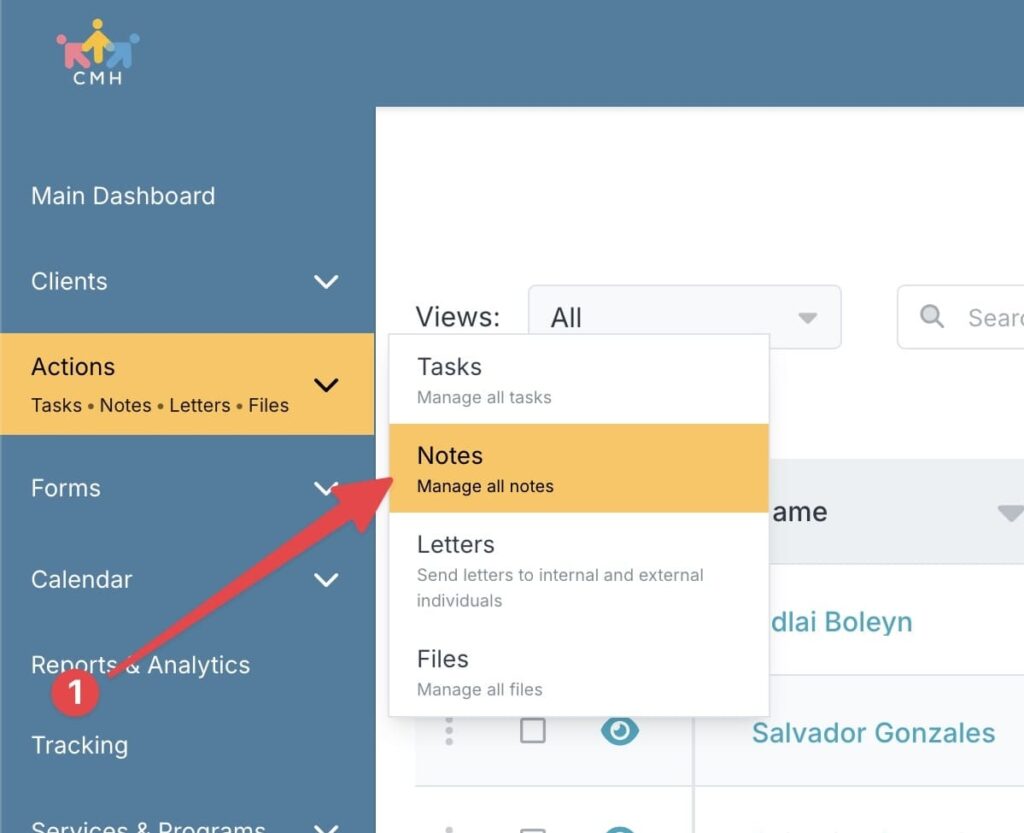
To create a SOAP note in Case Management Hub:
Step 1:
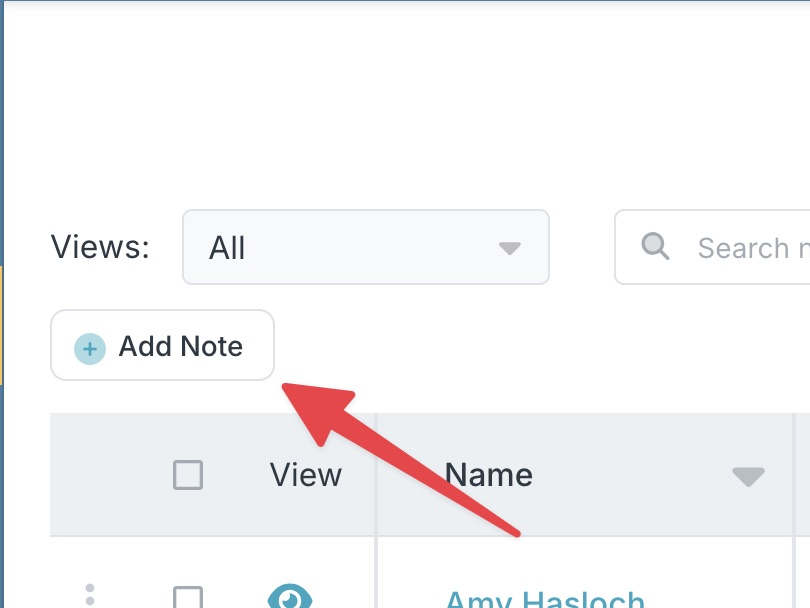
Navigate to the Notes module from the sidebar and click Add Note
Step 2:
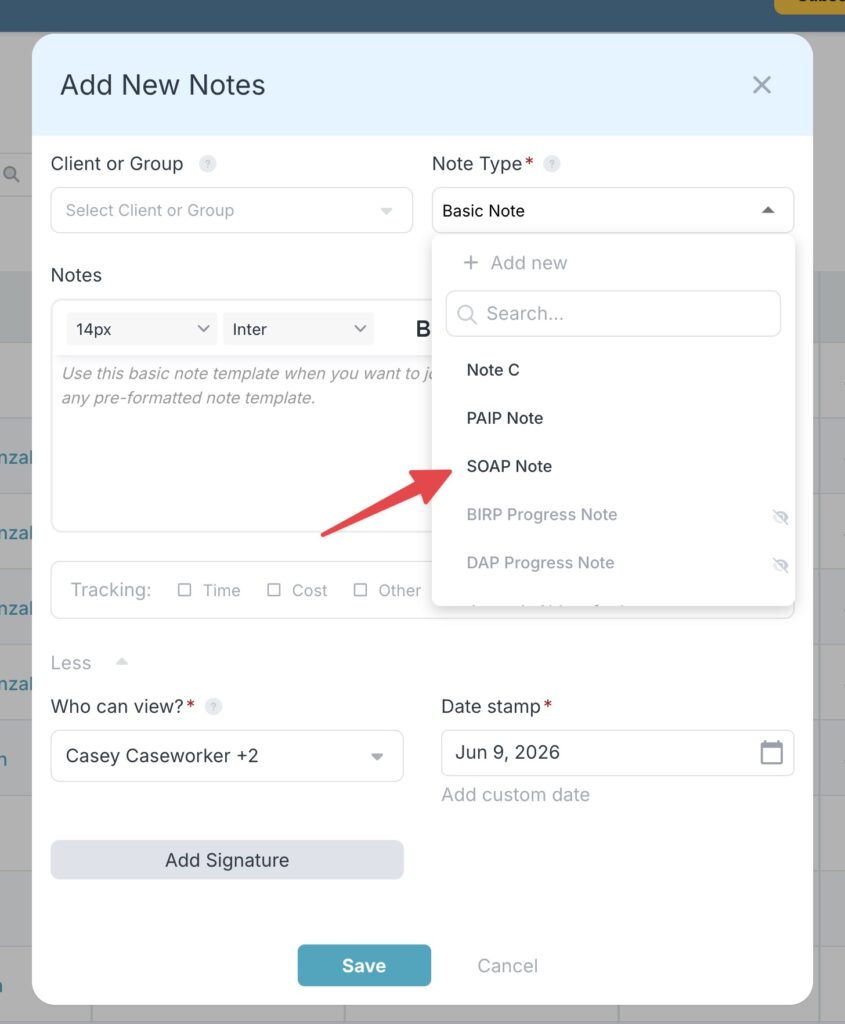
From the note type dropdown select the SOAP note template
Step 3:
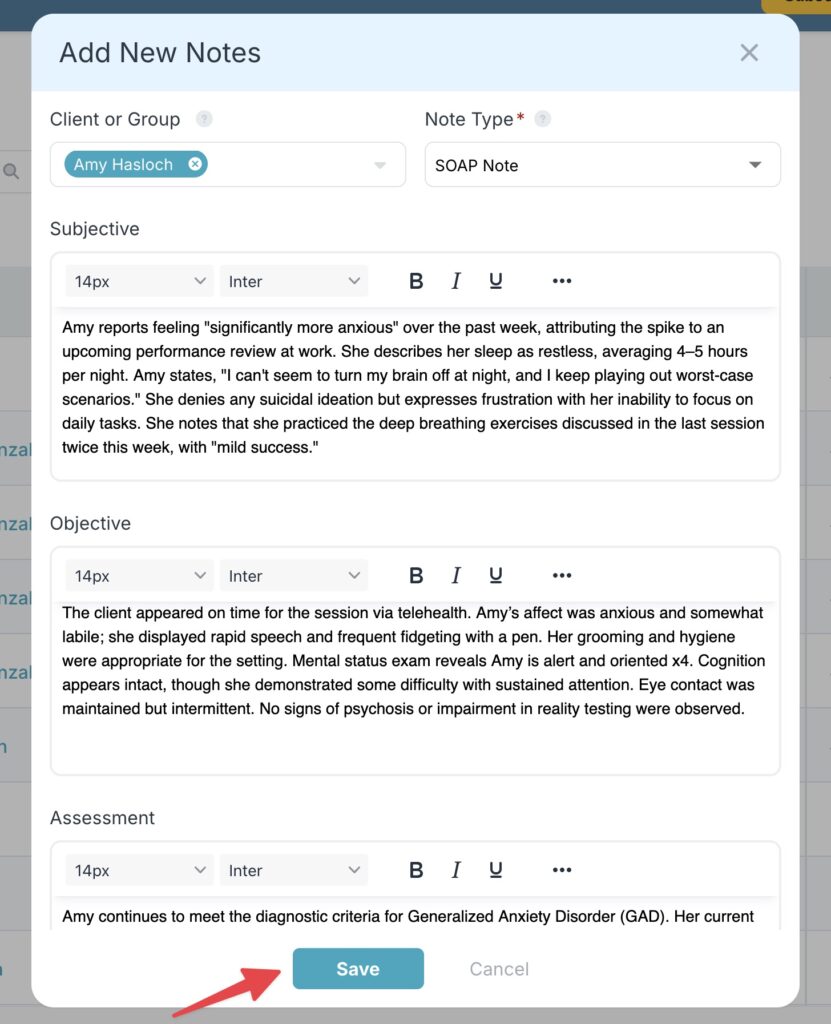
Add your note details to the four sections of the SOAP note, select the client, and then click save.
Step 4:
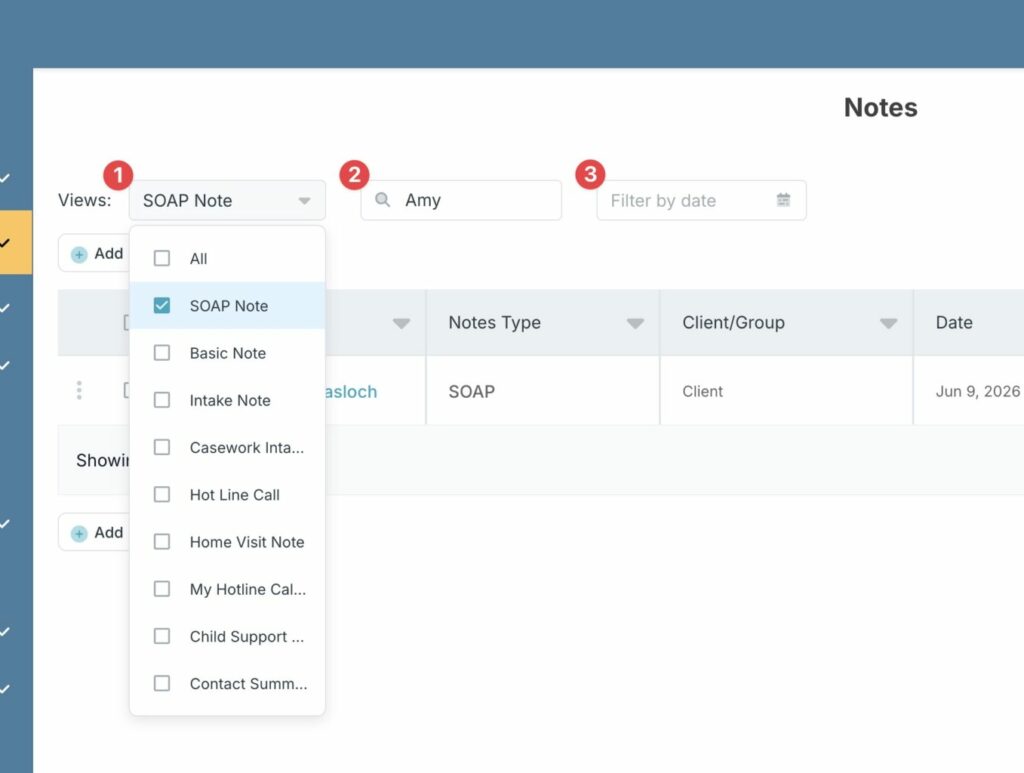
View, search and filter all of your client notes, including the SOAP notes in one place.
Step 5:
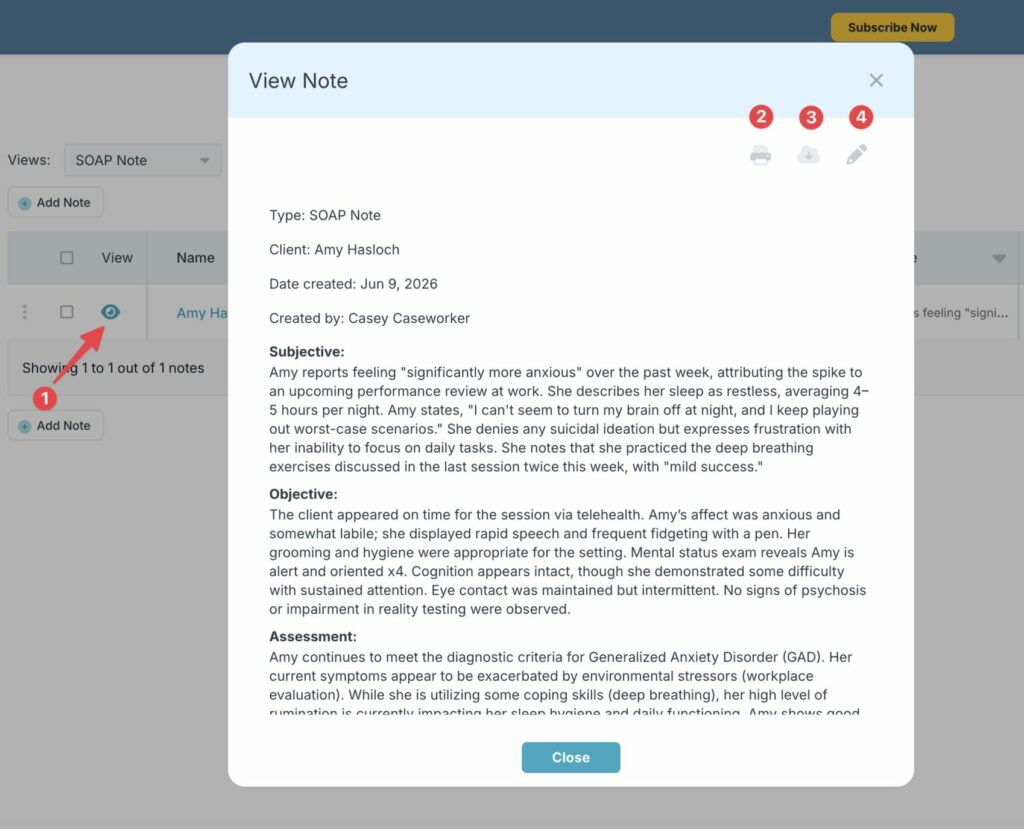
Click the eye icon to view or edit the details of the note
Start your free 21-day trial with Case Management Hub today (no credit card required) to simplify administrative workflows and spend more time focusing on client outcomes.
Frequently Asked Questions
How do I know if clinical social work is right for me?
Clinical social work suits individuals who enjoy direct one-on-one relationships, clinical assessment, active counseling, and therapeutic problem-solving. It requires strong interpersonal boundaries and comfort managing crisis situations.
What roles can I pursue with a BSW degree?
BSW graduates work in case management, child welfare advocacy, community outreach, residential care management, intake coordination, and career navigation within human services agencies.
How long does it take to become a Licensed Clinical Social Worker (LCSW)?
After completing a two-year MSW program, achieving LCSW status typically requires 2,000 to 4,000 hours of supervised clinical practice over two to four years, followed by passing the ASWB Clinical Licensing Examination.
What software skills do modern social workers need?
Modern practice requires familiarity with secure Electronic Health Record (EHR) platforms, HIPAA-compliant messaging systems, digital assessment tools, client portal navigation, and practice management billing software.
What is corporate social work?
Corporate social work involves applying human services principles inside business organizations. Responsibilities include managing Employee Assistance Programs (EAPs), leading corporate diversity initiatives, advising on occupational wellness, and designing corporate social responsibility programs.
Why is clinical documentation compliance so critical?
Accurate documentation protects client safety, supports continuity of care, ensures billing compliance for insurance reimbursement, and satisfies legal and ethical standard requirements across practice settings.
👉 Try it free today - No credit card needed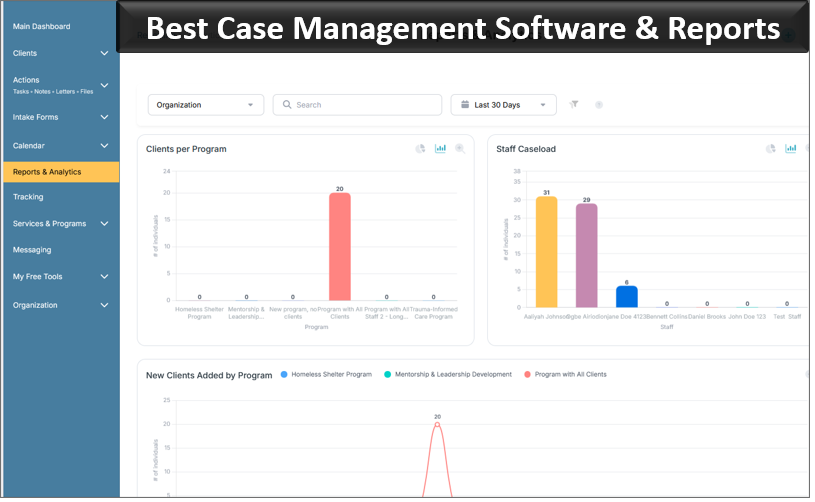
Note: Content on this website (socialworkportal.com) is copyrighted and protected under applicable copyright laws. Unauthorized reproduction, distribution, or use of any content from the website, without explicit written permission, is strictly prohibited. Read: Terms of Use.
Social Work Portal Disclaimer: Social Work Portal is not a social work agency and we do not refer social workers. This web site is provided for educational and informational purposes only and does not constitute providing medical advice or professional social and healthcare services. The information provided should not be used for diagnosing or treating a health problem or disease, and those seeking personal medical advice should consult with ... Read our full disclaimer here: Social Work Portal Disclaimer.