The Field Guide to the Department of Defense Family Advocacy Program
Entering military human services is one of the most impactful career decisions a social worker, clinician, or victim advocate can make. At the same time, transitioning from civilian practice into an installation environment brings immediate operational challenges. Civilian practitioners encounter unfamiliar federal pay scales, unique legal reporting boundaries, strict chain of command structures, and rigorous background clearance protocols. Clinicians must balance intense trauma response with multidisciplinary case coordination alongside military commanders, law enforcement, and civilian child welfare agencies.
According to Department of Defense reports on domestic abuse and child maltreatment, military family advocacy professionals process tens of thousands of incident referrals annually across global installations. A Government Accountability Office review (GAO-20-110) examining military family advocacy operations highlighted that administrative burdens, multi-agency documentation coordination, and staffing churn present continuous operational hurdles for installation clinics.
Without a practical operational guide, navigating USAJOBS announcements, understanding clinical credentials, and adapting to federal documentation standards can feel overwhelming. This comprehensive guide outlines the exact credentials, daily field realities, and case management competencies needed to build a long-term career inside the Department of Defense (DoD) Family Advocacy Program (FAP).
Let’s get started
Watch this video:
or
read the guide below.
What You’ll Learn in This Guide
- Core educational and licensure prerequisites across civilian and military family advocacy roles.
- Key differences between federal GS pay grades, non-clinical victim advocacy, and clinical social work positions.
- Legal and operational mechanics of military restricted vs unrestricted reporting protocol under DoD Directive 6400.01.
- How to navigate multidisciplinary case conferences, command briefings, and Incident Determination Committees (IDCs).
- How modern digital tools eliminate documentation backlogs, automate clinical rating scales, and enforce strict record privacy.
- Answers to common field questions regarding security clearances, license portability, and federal hiring preferences.
💡All-in-one Case Management Software.
Everything in one place: clients, notes, forms, appointments, reports, and outcomes.
👉 Try it Free - No credit card needed
What Is the DoD Family Advocacy Program (FAP)?
The DoD Family Advocacy Program is a specialized, Congressionally mandated program designed to prevent, identify, assess, and treat child maltreatment and intimate partner violence across all service branches. FAP operations exist across the Army, Navy, Air Force, Marine Corps, and Space Force, operating under the statutory framework of DoD Directive 6400.01.
FAP services operate across two main operational divisions:
- Prevention and Education Services: Non-clinical community initiatives that provide new parent support, stress-management workshops, life skills seminars, relationship education, and targeted family crisis prevention.
- Clinical Assessment and Treatment Services: Specialized crisis intervention, comprehensive clinical risk assessments, evidence-based trauma psychotherapy, ongoing safety planning, and formal case presentation before installation review committees.
Whether situated inside a Military Treatment Facility (MTF) or a community-focused installation support agency, such as Army Community Service (ACS) or Fleet and Family Support Centers (FFSC), FAP workers serve as the vital operational bridge connecting at-risk service members, their families, military leadership, and local civilian protection agencies.
What Are the Core Educational Prerequisites and Career Pathways?
Entering military family advocacy depends on your current educational attainment, your clinical licensing status, and whether your career trajectory centers on community advocacy or specialized behavioral healthcare.
1. Non-Clinical Victim Advocacy
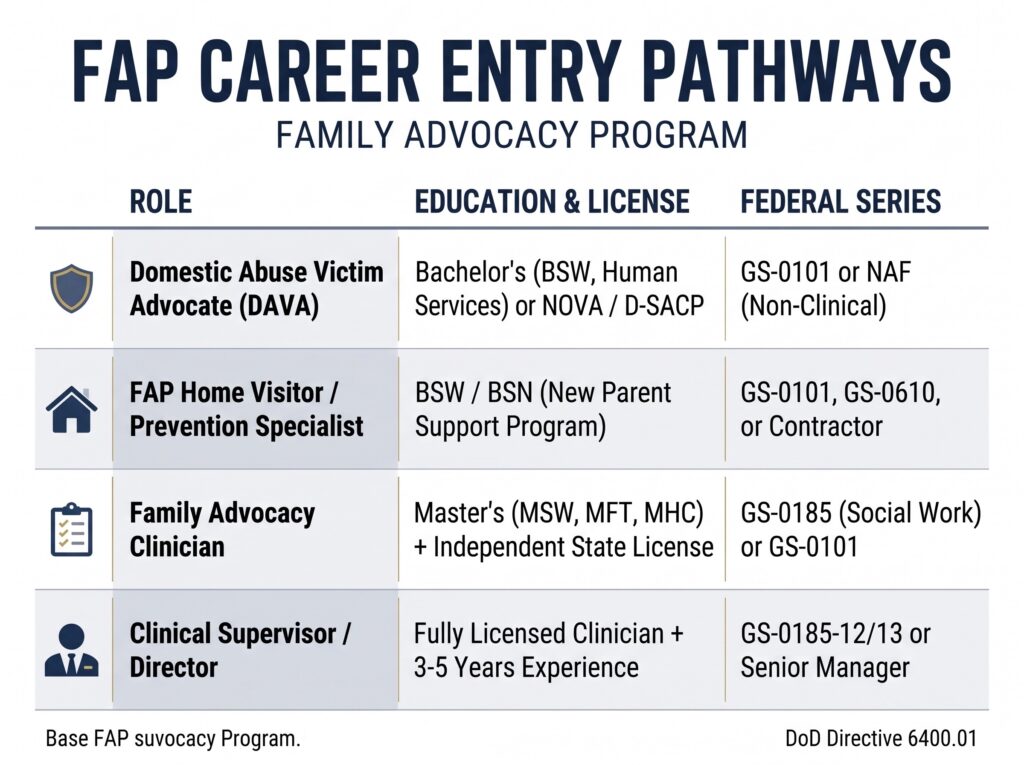
Non-clinical roles, such as a Domestic Abuse Victim Advocate (DAVA), focus on direct emotional support, emergency safety planning, civilian court accompaniment, command liaison work, and resource connection. DAVAs do not provide formal psychotherapy or make diagnostic determinations.
- Target Credentials: A bachelor’s degree in social work, psychology, criminal justice, or human services is standard. Candidates possessing credentials like the National Organization for Victim Assistance (NOVA) or DoD Sexual Assault Advocate Certification Program (D-SAACP) carry strong hiring advantages.
2. Clinical Family Advocacy Social Worker Requirements (DoD)
To conduct formal clinical assessments, open therapeutic cases, and deliver specialized trauma treatment, the federal civil service standard requires independent clinical capability:
- Education: A Master of Social Work (MSW) from an institution accredited by the Council on Social Work Education (CSWE), or a qualifying master’s degree in marriage and family therapy or clinical psychology.
- Licensure: Candidates must hold a valid, unrestricted state license that permits independent clinical practice (such as an LCSW, LICSW, LMFT, or LPC).
- State Portability Advantage: Federal civil service positions operating under the GS-0185 social work series accept a current, unrestricted license from any U.S. state, commonwealth, or territory, regardless of the physical base installation location.
How Does Federal Civilian Hiring Work for FAP Positions?
Securing a civilian position within the military healthcare system involves distinct administrative processes. Most career civil servants apply through USAJOBS for roles within the Department of the Army, Department of the Navy, or Department of the Air Force.
Key hiring considerations include:
- General Schedule (GS) Levels: Entry-level clinical social workers typically begin at GS-11, advancing to GS-12 for full performance independent caseloads. Clinical supervisors, team leads, and program managers generally hold GS-12 or GS-13 ratings.
- Security Clearance Standards: Every FAP professional must pass a comprehensive background check. Because workers manage child protection cases and sensitive domestic abuse disclosures, candidates must pass a Child Care Tier 1 or Tier 3 investigation (Tier 3 secret clearance equivalent). Disqualifiers include recent serious financial defaults, unadjudicated felony charges, or any domestic violence convictions under the Lautenberg Amendment.
- Hiring Preferences: Candidates who leverage non-competitive pathways gain a significant advantage. Military Spouse Preference (MSP) and Priority Placement Program (PPP-S) afford qualified military spouses priority referral on open certificates. Separating service members and disabled veterans can also utilize Veterans’ Preference categories (VEOA, VRA, or 30 Percent or More Disabled Veteran).
What Is the Military Restricted vs Unrestricted Reporting Protocol?
A critical operational competency required of every military family advocacy worker is navigating reporting boundaries under DoD Directive 6400.01. Confusing restricted and unrestricted reporting protocols compromises victim safety, damages professional trust, and violates federal policy.
1. Restricted Reporting
Restricted reporting gives adult victims of intimate partner violence the ability to confidentially disclose abuse to designated personnel without automatically notifying military law enforcement or the service member’s command.
- Eligible Personnel: Only DAVAs, FAP clinical staff, and designated healthcare providers can accept a restricted report.
- Services Provided: The victim receives medical care, emergency safety planning, forensic medical exams, clinical counseling, and continuous advocacy support.
- Mandatory Exceptions: Confidentiality cannot be maintained if there is an imminent risk of serious bodily injury or death, or if child abuse or child neglect is present.
2. Unrestricted Reporting
Unrestricted reporting triggers an immediate, formal official investigation and direct command notification.
- Initiation: Reports made through the service member’s chain of command, military law enforcement (such as Army CID, NCIS, or Air Force OSI), or base security are automatically unrestricted. A victim can also intentionally choose unrestricted reporting to pursue military protective orders (MPOs) and command accountability.
- Interagency Coordination: FAP clinicians in unrestricted cases interface with unit commanders, law enforcement investigators, and the installation staff judge advocate.
3. Child Abuse Reporting Realities
Restricted reporting is strictly limited to adult intimate partner violence. Under federal and military law, there is no restricted reporting option for child maltreatment. Every suspicion, disclosure, or incident involving minor children requires immediate, mandatory reporting to military law enforcement, the installation FAP office, and state Child Protective Services (CPS).
How Do Multi-Disciplinary Case Conferences and Field Investigations Operate?
Civilian caseworkers frequently operate inside decentralized systems where court-appointed personnel rarely interact directly with an individual’s employer. In contrast, military family advocacy functions in close proximity to the installation command structure.
Consider an authentic installation scenario: A clinical social worker at an overseas air base receives a walk-in crisis intake from a military spouse. The spouse discloses recurring physical violence by their active-duty partner. During the comprehensive clinical intake, drawing directly from the holistic framework of what is a biopsychosocial assessment, the spouse mentions that their seven-year-old child stepped between them during an altercation and was pushed to the floor.
At that exact moment, the clinician must pivot: while the intimate partner abuse began under a restricted disclosure, the presence of child maltreatment mandates immediate reporting. The clinician must calmly explain the statutory child protection obligations, initiate an immediate safety plan, notify installation law enforcement and family advocacy leadership, and initiate coordination with civilian child welfare authorities.
When an incident enters the formal system, FAP professionals guide the case through structured stages:
- Intake and Triage: Immediate verification of safety, physical triage, medical referrals, screening for acute danger, and applying core standards on how to assess safety and risk in case management to complete structured lethality evaluations before determining case disposition.
- Clinical Assessment: Thorough biopsychosocial intake, historical trauma review, and evaluation of lethality factors (including weapons access, strangulation history, and substance dependency).
- The Incident Determination Committee (IDC): FAP clinical case managers present objective clinical findings to a formal multi-disciplinary committee. This body typically includes military law enforcement investigators, medical officers, legal counsel (Staff Judge Advocate), and the subject’s unit commanding officer. The IDC reviews evidence to determine whether the incident meets DoD clinical criteria for child maltreatment or domestic abuse.
- Treatment and Command Communication: Following committee determination, the clinician designs an intervention plan focusing on family stabilization, individual trauma therapy, and parenting education, while regularly reporting compliance milestones back to unit commanders.
How Do Digital Tools Streamline Military Family Advocacy Workflows?
Military family advocates carry heavy administrative responsibilities. Caseworkers must complete comprehensive risk evaluations, log continuous client contacts, maintain absolute confidentiality, and prepare formal documentation for multidisciplinary review boards. When programs rely on disparate paper folders, fragmented spreadsheets, and unlinked forms, administrative delays can easily impact direct client care.
Modern practice requires purpose-built case management software to reduce manual paperwork, enforce strict data boundaries, and maintain audit readiness.
1. Unified Intake Automation and Client Profiles
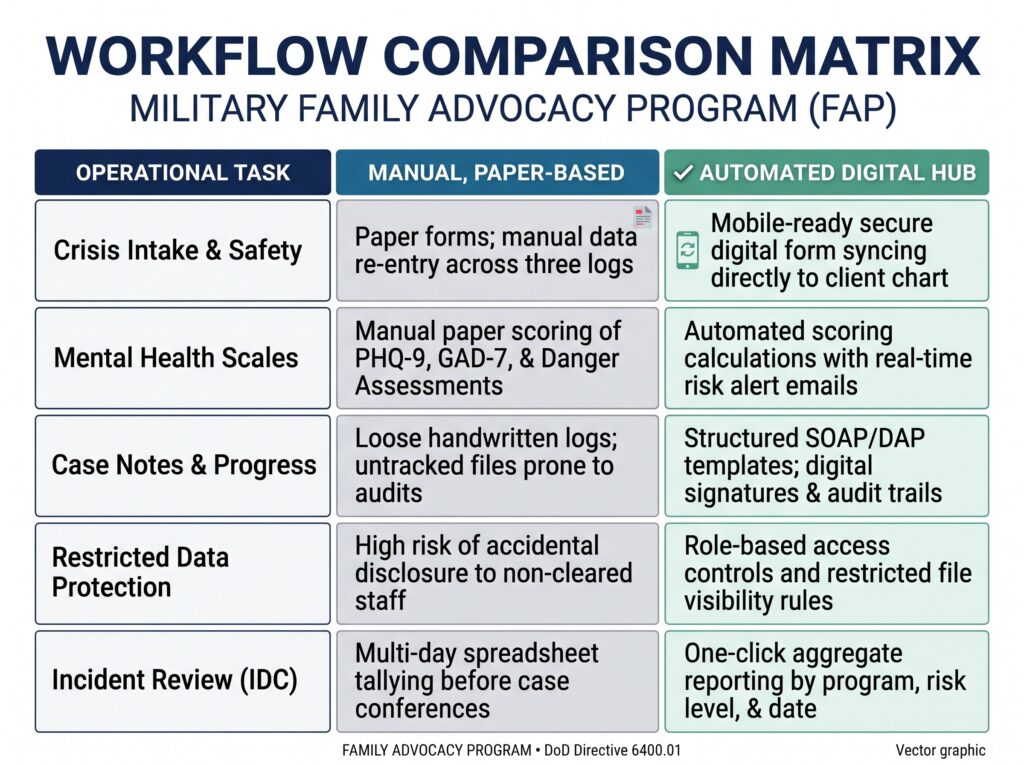
Instead of handing clients physical packets or manually copying contact details into multiple systems, advocates deploy digital intake forms. When a client or intake worker completes an online form, the platform instantly creates a centralized profile, links demographic details, logs safety contacts, and assigns the case to an active caseworker. If the individual cannot access an account, caseworkers publish standalone secure form links tied to unique phone or email identifiers, preventing duplicate entries. When working with standardized military forms that cannot be altered, advocates utilize uploaded PDF templates equipped with digital signature blocks, allowing clients to complete and upload documents through a secure client account.
2. Standardized Mental Health Rating Scales and Risk Alerts
Field assessments require clinical precision. Using integrated digital rating fields, clinicians can administer standardized screeners like the PHQ-9, GAD-7, or intimate partner lethality screens. Understanding how to match GAD-7 scores to clinical intervention tiers allows clinicians to immediately interpret severity levels when assessments are completed. The platform automatically tabulates numerical scores, interprets severity bands, and triggers instant automated email alerts to clinical supervisors when scores cross moderate or severe thresholds. Clinicians can track rating trend reports over weeks or months to objectively document clinical progress and evaluate intervention effectiveness.
3. Structured Clinical Documentation and Audit Trails
Every consultation, victim safety touchpoint, and command check-in requires defensible documentation. Modern platforms provide dedicated SOAP and DAP note templates equipped with customizable tracking fields, activity logs, time tracking, and digital signatures. Clinicians adapting civilian charting standards to military committee requirements can reference established clinical guides on how to write a SOAP note to ensure their subjective, objective, assessment, and plan sections remain objective and audit-ready. Notes feature individual permission controls allowing clinicians to designate exactly who can view sensitive entries. Furthermore, every action taken on a record (profile updates, file views, and document modifications) is logged inside an immutable audit log capturing user IDs, timestamps, and IP addresses to maintain total audit readiness.
4. Protecting Restricted Records with Role-Based Access Controls
Confidentiality failures in domestic advocacy can have severe legal consequences. With granular role-based permissions, installation directors can establish dedicated roles (such as Account Owner, Admin, Employee, Support, or custom Victim Advocate permissions). Staff members only see cases specifically assigned to them, ensuring sensitive restricted reporting records and victim safety logs remain invisible to non-cleared agency personnel.
5. Multi-Agency Referral Tracking and Automated Reporting
Coordinating between installation resources and civilian community partners requires seamless referral management. Modern platforms allow case managers to catalog incoming and outgoing referrals, assign referral partners, and share view-only records with external civilian agencies through secure guest accounts. When compiling data for command briefings or program reviews, directors generate automated custom reports based on single-select fields, program outcomes, and service dates, eliminating manual spreadsheet consolidation.
People Also Ask
What degree do I need to work for the DoD Family Advocacy Program?
Non-clinical victim advocacy roles generally require a bachelor’s degree in social work, psychology, or a related behavioral science. Clinical caseworkers and therapists need a master’s degree (such as an MSW) from an accredited institution along with an active, unrestricted state license for independent practice.
Can an LCSW work on any military base with an out-of-state license?
Yes. Federal civil service positions operating under the GS-0185 social work series accept a current, unrestricted clinical license from any U.S. state, commonwealth, or territory. You do not need to re-license in the specific state where the military installation is located.
How much do military family advocacy workers get paid?
Salaries depend on position type, federal pay grade, and local cost-of-living adjustments. Under federal General Schedule pay tables, GS-11 social work roles generally start between $65,000 and $85,000 annually, while experienced GS-12 and GS-13 clinicians and supervisors often earn between $85,000 and $125,000 or more.
What is the Lautenberg Amendment in military hiring?
The Lautenberg Amendment to the Gun Control Act makes it a felony for anyone convicted of a misdemeanor crime of domestic violence to possess firearms or ammunition. Because military family advocacy workers handle firearms restrictions and domestic violence assessments, applicants with domestic violence convictions are legally disqualified from these roles.
What is the difference between a DAVA and a FAP social worker?
A Domestic Abuse Victim Advocate (DAVA) provides non-clinical crisis support, safety planning, and resource navigation, and does not conduct clinical therapy. A FAP social worker is a licensed clinician who conducts formal biopsychosocial assessments, delivers evidence-based trauma psychotherapy, and presents case findings to the Incident Determination Committee.
Can military spouses get priority hiring for FAP jobs?
Yes. Spouses of active-duty service members can utilize Military Spouse Preference (MSP) and Priority Placement Program mechanisms through USAJOBS. This provides priority referral ahead of general civilian applicants for competitive federal positions when qualified.
How Does Case Management Hub Solve Military Family Advocacy Operational Challenges?
Managing complex caseloads, victim safety plans, and multi-agency reporting requirements demands software designed around the realities of professional human services. Case Management Hub provides a unified, HIPAA-compliant platform that centralizes your entire case workflow from initial intake to program discharge.
- Effortless Intake and Assessment Builder: Deploy drag-and-drop digital forms that synchronize automatically with client charts, capture digital signatures, and eliminate manual data entry.
- Built-in Standardized Rating Scales: Run PHQ-9, GAD-7, and custom risk matrices with automatic score calculation, severity tiering, and instant supervisory risk alerts.
- Structured SOAP and DAP Notes: Standardize case notes with custom activity tags, integrated time tracking, and staff signature blocks.
- Granular Role-Based Security: Protect restricted disclosures, client safety files, and victim contact logs with user-level access controls and detailed system audit logs.
- One-Click Aggregate Reporting: Instantly generate cross-program statistics, demographic summaries, and case status counts for leadership briefings and audits.
Take back your time, eliminate manual documentation bottlenecks, and keep your client records audit-ready every single day.
Start your 21-day free trial of Case Management Hub today (no credit card required).
Frequently Asked Questions (FAQs)
What is the typical daily caseload for a full-time FAP clinical social worker?
Caseload volume varies by installation size, deployment cycles, and branch. Full-time clinical case managers typically handle between 15 and 25 active clinical cases at any given time, supplemented by crisis drop-ins, ongoing lethality assessments, and interagency collaboration meetings.
What is the role of the Incident Determination Committee (IDC)?
The Incident Determination Committee is an interdisciplinary installation board that evaluates reported cases of domestic abuse and child maltreatment. The IDC does not determine criminal guilt. Instead, it determines whether reported incidents meet DoD clinical and administrative criteria to substantiate abuse and mandate rehabilitative support.
How are client records maintained between civilian CPS and military installations?
FAP maintains a distinct administrative record within military medical and community services. When incidents involve dependent children, federal regulations require concurrent coordination with local county or state child protective services. While civilian and military systems run separate investigations, workers coordinate on safety planning, joint home assessments, and ongoing service delivery.
What background checks are required to handle child abuse cases in the DoD?
Applicants must successfully clear a Tier 1 or Tier 3 Child Care Background Investigation. This includes local police checks, FBI fingerprinting, an installation records check, and state child abuse central registry clearances for every location where the candidate lived or worked over the preceding five years.
How do modern electronic systems handle confidential victim contact information?
Modern secure platforms allow caseworkers to customize client profiles and notes with strict visibility controls. Caseworkers can hide specific contact fields, restrict document permissions to assigned staff, and run encrypted client communications without exposing sensitive physical locations or emergency numbers.
Can non-military civilians apply for FAP jobs on overseas installations?
Yes. DoD installations in Europe, Asia, and other overseas regions frequently post GS-0185 social work and advocacy vacancies on USAJOBS. Civilian candidates hired from the United States typically receive living quarters allowances (LQA) and relocation support under federal civil service transfer guidelines.
👉 Try it free today - No credit card needed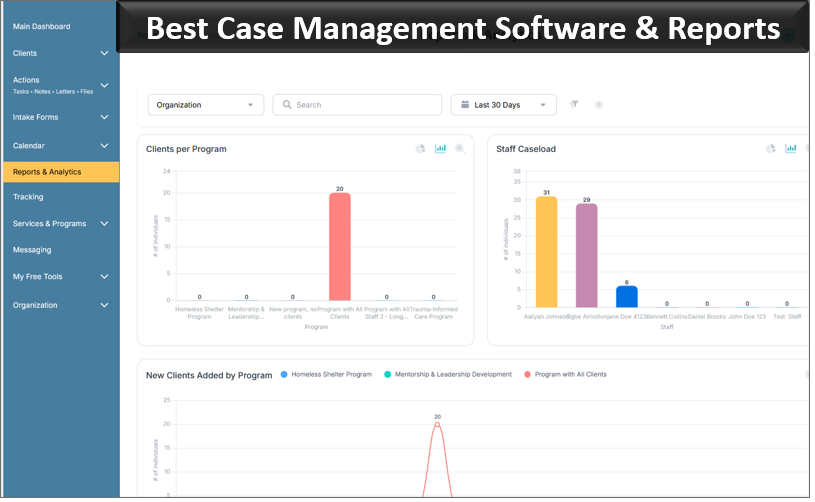
Note: Content on this website (socialworkportal.com) is copyrighted and protected under applicable copyright laws. Unauthorized reproduction, distribution, or use of any content from the website, without explicit written permission, is strictly prohibited. Read: Terms of Use.
Social Work Portal Disclaimer: Social Work Portal is not a social work agency and we do not refer social workers. This web site is provided for educational and informational purposes only and does not constitute providing medical advice or professional social and healthcare services. The information provided should not be used for diagnosing or treating a health problem or disease, and those seeking personal medical advice should consult with ... Read our full disclaimer here: Social Work Portal Disclaimer.