Moving Clients from Crisis to Long-Term Independence
It is 9:15 AM on a Tuesday. You have three voicemails from clients whose emergency utility assistance lapsed, two court reports due by noon, an unscheduled intake pacing in the lobby, and thirty open tabs on your browser.
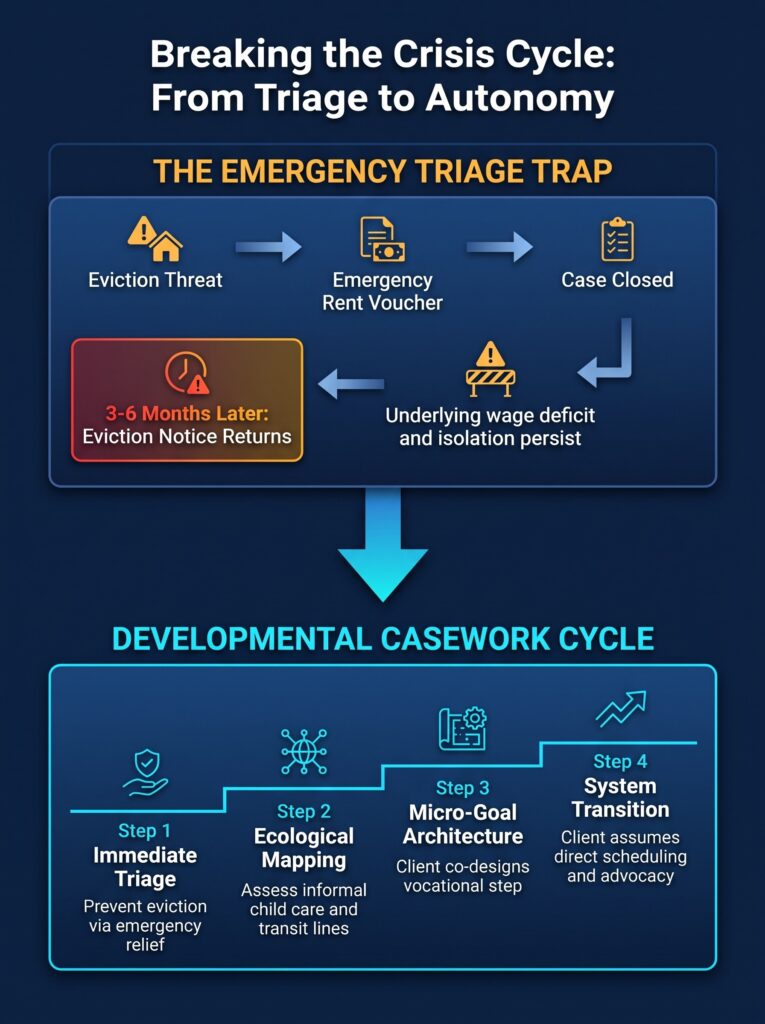
In this environment, reading about “macro-level empowerment” or “capacity building” can feel completely detached from reality. When funding depends on clearing waiting lists and your immediate metric is preventing an eviction before 5:00 PM, survival mode becomes your default practice model. You patch the hole, file the emergency voucher, close the ticket, and move to the next fire.
Three months later, that same client is back in your lobby facing the exact same eviction notice.
Emergency relief keeps people alive, but triage alone does not break generational dependency. Developmental social work bridges this gap. It does not ask you to ignore immediate crises or hand a philosophy worksheet to someone facing homelessness. Instead, it provides a tactical framework to weave long-term capacity building directly into your crisis interventions, intake assessments, and routine progress notes.
Let’s get started
Watch this video:
or
read the guide below.
What You’ll Learn in This Guide
- How to balance emergency triage with long-term human development during high-stress encounters.
- Concrete conversational scripts to pivot assessments from deficit checklists to capacity mapping.
- Exact, side-by-side SOAP and DAP documentation examples showing traditional deficit notes versus developmental progress notes.
- Step-by-step methods to eliminate documentation drag and reclaim direct client contact hours.
- Practical strategies for measuring client self-efficacy and community reintegration for grant renewals.
- How to configure electronic client records to maintain strict HIPAA compliance while scaling collaborative goals.
💡All-in-one Case Management Software.
Everything in one place: clients, notes, forms, appointments, reports, and outcomes.
👉 Try it Free - No credit card needed
Why Does Reactive Crisis Management Keep Social Workers and Clients Stuck?
The human services sector runs on a contradiction. Agencies write mission statements promising holistic transformation, yet billing structures, state contracts, and daily emergencies force staff into reactive triage.
When you treat an isolated crisis without addressing the surrounding ecosystem, the relief is almost always temporary. Handing a food voucher to an underemployed parent solves hunger for four days. It does not solve the lack of dependable child care that caused them to lose their last job, nor does it address the social isolation that leaves them with no backup when a toddler gets sick.
Developmental social work insists that human development and economic self-sufficiency must advance simultaneously. Rather than viewing the client as an isolated bundle of pathology and unmet needs, it positions the person as an active economic and social participant. This aligns directly with the core ethical mandates outlined in the National Association of Social Workers (NASW) Code of Ethics, which charges practitioners with challenging social injustice and honoring the inherent dignity and self-determination of every individual.
When workers shift from solving problems for clients to building problem-solving capacity with clients, caseload velocity changes. Recidivism drops because the individual develops the relational networks, institutional knowledge, and personal agency needed to handle the next obstacle independently.
What Does Strengths-Based Developmental Assessment Sound Like in the Field?
Intake assessments often look like interrogations. Standard agency forms ask clients to list every failure, trauma, financial deficit, and behavioral infraction in detail. When agencies fail to ground intake in a proven strength-based approach in social work, the clinical relationship is framed around what is broken before the first conversation even begins.
A developmental assessment does not ignore risk factors or pretend hardship does not exist. It changes the operational angle. You identify existing problem-solving strategies, assess informal support networks, and catalog survival skills that can be repurposed into long-term assets.
Here is how to adjust your phrasing during intake and reassessments:
Triage Inquiry vs. Developmental Inquiry
- Traditional Deficit Script: “Why have you struggled to hold a job over the last six months?”
- Developmental Script: “When you look back at past jobs, what environments allowed you to perform at your best, and what specific obstacles interrupted that momentum?”
- Traditional Deficit Script: “Do you have any reliable family members, or are you completely on your own?”
- Developmental Script: “When an emergency came up in the past and an agency wasn’t open, who in your circle answered the phone or helped you work through it?”
- Traditional Deficit Script: “You missed two medical appointments this month. Why are you having trouble complying with your treatment plan?”
- Developmental Script: “What broke down with your transportation or schedule on those appointment days, and what would it take to build a routine that actually fits your daily reality?”
These questions are grounded in ecological systems theory. You assess the client not as an isolated problem, but as someone navigating complex neighborhood, family, and institutional systems. Visualizing these external dynamics through a digital ecomap makes it significantly easier to identify hidden community assets alongside acute barriers during the initial assessment phase.
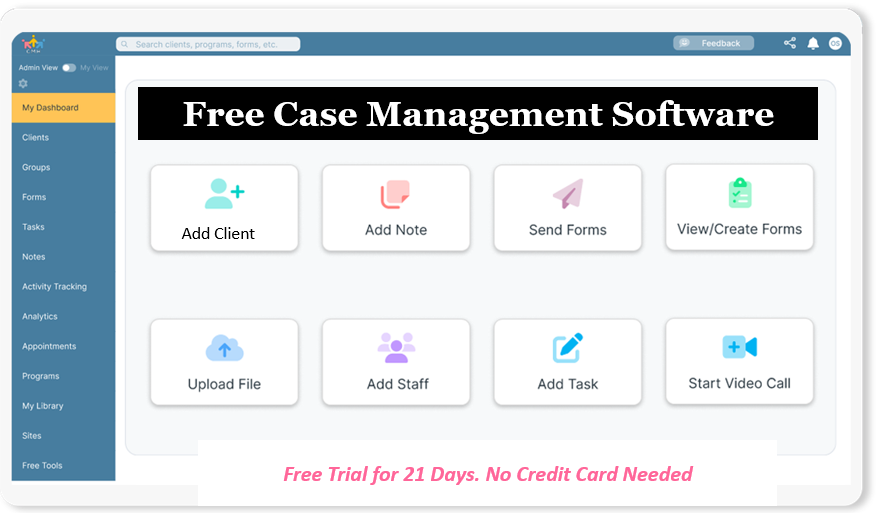
👉 Try it Free - Free Case Management System
How Do You Document Developmental Progress in Real-World Clinical Notes?
Your documentation is an intervention. If your progress notes only track compliance, missed appointments, and deficit symptoms, your clinical plans will reflect those same limitations.
Writing notes from a developmental perspective requires documenting client agency, decision-making rationales, and progress toward self-reliance milestones. If your team is brushing up on core clinical formats, mastering the baseline mechanics of how to write a SOAP note is the essential first step before shifting your narrative toward client autonomy.
Example 1: SOAP Note Comparison (Housing Casework)
The Traditional Deficit-Oriented SOAP Note
- S (Subjective): Client reports high anxiety regarding impending eviction notice. States she has no money for rent and lacks support.
- O (Objective): Case manager provided $450 emergency rental voucher. Client arrived 15 minutes late. Affect flat.
- A (Assessment): Client remains chronically unstable and dependent on emergency community funds. Demonstrates poor financial management and executive dysfunction.
- P (Plan): Case manager to follow up with landlord next Monday. Case manager will submit additional utility subsidy paperwork on client’s behalf.
The Developmental SOAP Note
- S (Subjective): Client presented with an 8-day notice to quit, stating, “I need help stopping this eviction so my kids don’t lose their school district.” Client identified that irregular child care directly caused lost hourly shifts last month.
- O (Objective): Reviewed household balance sheet collaboratively. Client calculated an immediate $450 gap. Client identified a neighbor willing to exchange child care two days per week. Emergency rent assistance voucher processed.
- A (Assessment): Client demonstrates clear proactive concern for family educational stability. While facing acute cash-flow insolvency from child care disruptions, client actively generated a realistic peer-support plan to stabilize work hours.
- P (Plan): Client will contact landlord by Thursday to confirm voucher receipt and propose a written repayment schedule for the remainder. Case manager will send digital child care resource link through portal. Re-evaluate child care barter progress at next session.
Example 2: DAP Note Comparison (Reentry & Workforce Support)
The Traditional Deficit-Oriented DAP Note
- D (Data): Client attended mandatory weekly check-in. Client has not yet secured full-time employment. Client admits to struggling with motivation and low energy.
- A (Assessment): Client is non-compliant with job search goals. High risk for program disengagement and recidivism due to poor initiative.
- P (Plan): Worker ordered client to submit 5 job application receipts by next Friday. Worker will call parole officer if compliance does not improve.
The Developmental DAP Note
- D (Data): Client attended scheduled session. Completed two entry-level logistics applications independently since last week. Client noted significant anxiety during online personality questionnaires, stating, “I freeze up because I don’t know how to explain my gap years without getting rejected.”
- A (Assessment): Client exhibits persistence by applying for positions despite severe interview-related trauma and institutional anxiety. The barrier is not a lack of motivation, but a technical roadblock regarding justice-impacted resume disclosures.
- P (Plan): Client and worker practiced scripted responses for interview work histories. Client selected two local employers from a fair-chance hiring list and committed to submitting both applications through the agency portal before next Tuesday.
All-in-One Case Management Software
Sign Up Today, Free
No credit card needed!
Do You Have a Team? | ||
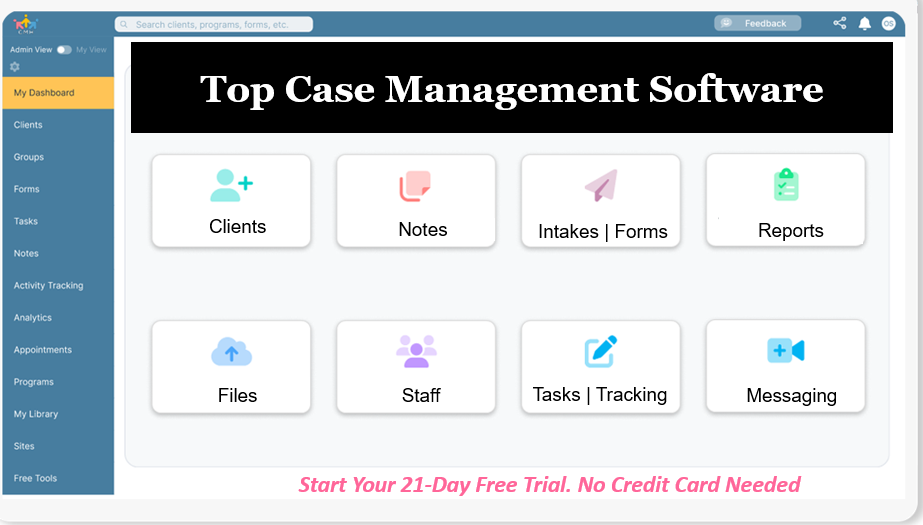
Our best all-in-one client and top case management software simplifies everything from client intake and assessments to programs, projects, goals tracking, planning, scheduling, documentation, reporting dashboard, and progress tracking.
How Digital Tools Streamline Developmental Social Work
Operationalizing this model requires rigorous longitudinal tracking. When you commit to developmental casework, you must track multi-step goals over months, document incremental client decisions, manage referrals across multiple community providers, and capture clear progress indicators.
The problem is administrative drag.
A comprehensive workforce study published in the British Association of Social Workers (BASW) Resource Archive revealed that caseworkers spend up to 60% of their working hours buried in administrative paperwork and computer screens rather than engaging in direct, face-to-face client support. When case managers spend three hours typing duplicate entries across multiple paper forms, state registries, and unlinked spreadsheets, they have zero cognitive bandwidth left for collaborative goal coaching.
Modern case management technology eliminates this operational logjam. By applying targeted strategies for how to automate case management tasks, agencies reclaim lost documentation hours across five foundational workflows:
- Self-Guided Digital Intake Forms: Converting the most common social worker intake forms into self-guided web questionnaires allows clients to complete demographic histories, social determinants screeners, and self-assessments on a smartphone or tablet prior to entering your office. Data flows directly into their master electronic file, sparing workers from repetitive manual transcription.
- Dynamic Clinical Templates: Custom case note templates for social services allow supervisors to embed developmental prompts directly into SOAP and DAP interfaces. Workers check off operational items and focus their narrative writing on client capacity and systemic barriers, maintaining clinical depth while adhering to strict HIPAA compliant case notes templates SOAP DAP.
- Collaborative Milestone Portals: Dedicated client goal tracking software for human services replaces the traditional agency black box. Clients log into their own secure portal, track their progress toward vocational and housing targets, and upload their own confirmation documents, reinforcing autonomy.
- Automated Reminders and Task Routines: Instead of staff losing an entire morning making confirmation calls, automated appointment scheduling for case managers handles SMS and email confirmations, reducing no-show rates and keeping development plans on track.
- Secure Mobile Client Records: Using cloud-accessible electronic case files for community health workers, field staff can securely pull up case histories, log notes, and verify resources on-site during home visits without hauling vulnerable paper files around town.
Manual Administration vs. Modern Digital Infrastructure
| Casework Milestone | Fragmented / Paper-Based Operations | Integrated Case Management Architecture |
| Client Intake & Registration | 20 pages of paper clipboards; manual re-entry into billing and client systems; high rate of missing signatures. | Web-based digital intake forms for social workers; auto-populates master electronic records; digital e-signatures. |
| Progress Documentation | Free-text narrative notes in physical binders or Word files; irregular auditing; non-standardized clinical quality. | Standardized, HIPAA-compliant digital templates; clear dropdowns for goal progression; rapid audit readiness. |
| Longitudinal Goal Tracking | Scattered across paper action plans, sticky notes, and caseworker memory; lost when staff turnover occurs. | Centralized client goal tracking software for human services; visual progress dashboards visible across teams. |
| Client Engagement & Tasks | Insecure text messaging on personal cell phones or phone tag; clients wait days for resource lists. | A secure client portal for social work agencies providing compliant messaging and shared task lists. |
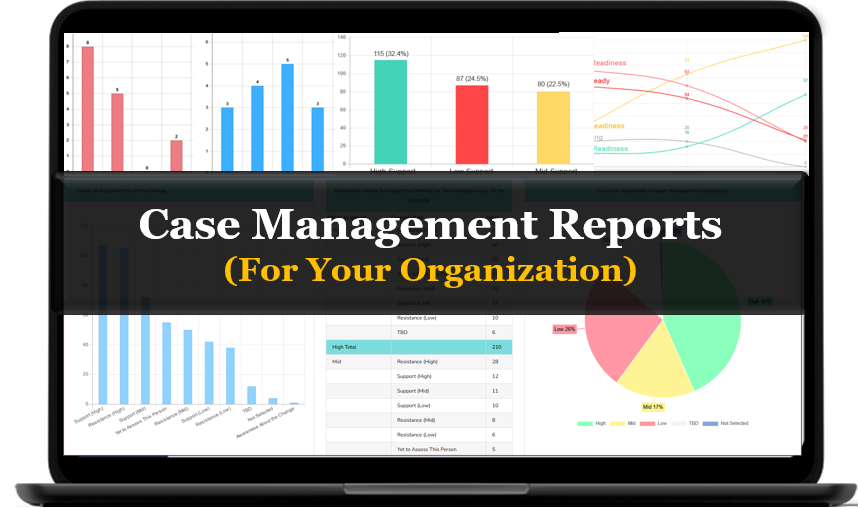
| Grant & Outcome Reporting | Days of manual spreadsheet calculation; missing fields; high stress during state and foundation audits. | Instant social service outcome reporting software; aggregate demographic and progress metrics exported to Excel in seconds. |
How Can Practitioners Measure Client Self-Efficacy and Community Integration?
Developmental social work demands concrete accountability. Knowing how to implement an effective case plan that tracks incremental milestones over time is essential, especially when boards of directors, private foundations, and state contract monitors want verifiable proof that your agency’s interventions lead to durable outcomes rather than short-term relief.
To prove program impact, measure indicators of growing autonomy alongside standard output metrics:
- Validated Self-Efficacy Scoring: Implement brief, validated tools such as the General Self-Efficacy Scale (GSE) at intake, 90 days, and case closure. This tracks whether the client’s internal confidence in navigating unexpected hurdles has measurably increased.
- Agency Transfer Ratios: Track who performs key administrative tasks over time. In month one, does the caseworker place the call to the housing authority? By month three, does the client place the call while the worker observes? By month six, does the client handle the call and summarize the outcome? This progression provides quantitative proof of growing operational independence.
- Ecosystem Resilience Mapping: Measure the client’s reliance on professional services versus informal community networks. Success looks like an expanding circle of neighborhood child care exchanges, peer support groups, faith-based networks, and community sports leagues, alongside a declining dependence on crisis vouchers.
- Long-Term Case Durability: Audit closed cases at 6 and 12 months. Track housing retention, employment continuity, and the absence of re-opened emergency files.

People Also Ask
What is the primary difference between remedial and developmental social work?
Remedial social work focuses on resolving immediate deficits, managing crises, and treating symptoms after an acute disruption occurs. Developmental social work integrates immediate relief with long-term human, economic, and community capacity-building to prevent the crisis from repeating.
How do you introduce long-term goal setting to a client experiencing acute trauma?
First, stabilize the immediate safety or material crisis completely so the client’s nervous system can regulate. Once physical safety is secure, frame long-term planning as a practical strategy to protect their current relief, asking questions like, “What is one small step we can put in place this week so you don’t have to face this kind of stress again?”
Why do traditional social work case notes often fail to capture client strengths?
Most agency templates are built around compliance checklists and clinical billing requirements that mandate documenting pathology, medical necessity, and deficits. Without structured developmental prompts, overworked caseworkers default to recording the client’s problems rather than their problem-solving capacities and progress.
What are the risks of using consumer messaging apps to communicate with clients?
Using standard SMS or unencrypted commercial messaging apps violates HIPAA regulations and exposes protected health information (PHI) to data breaches. It also blurs professional boundaries and makes it nearly impossible to maintain an audit-ready, centralized record of client communications.
How does ecological systems theory apply to day-to-day casework?
Ecological systems theory directs caseworkers to look past individual behavior and analyze how family dynamics, neighborhood safety, employment policies, and systemic discrimination interact. Interventions then target points of leverage across all these systems rather than placing the entire burden of change on the individual.
Can developmental social work methods work in mandatory or court-ordered settings?
Yes. Even within court mandates, practitioners create opportunities for genuine choice and control by allowing clients to determine the sequence of their goals, select the community resources they prefer, and co-design the benchmarks used to report compliance to the court.
Modernize Your Agency’s Practice with Case Management Hub
You cannot lead clients toward self-sufficiency when your staff is trapped under manual paperwork and administrative chaos. When caseworkers spend their afternoons hunting through physical filing cabinets, re-entering intake forms, and piecing together disparate spreadsheets, they lose the time and mental energy required for transformative, strengths-based casework.
Case Management Hub provides an all-in-one case management platform for nonprofits and human services organizations, designed specifically around real-world clinical and social services workflows. Built from the ground up to guarantee strict HIPAA compliance, Case Management Hub centralizes your operations into one unified, intuitive system:
- Configurable Digital Intakes: Gather client background, social determinants, and consent forms through secure web links that automatically build clean electronic case files.
- Strengths-Based Documentation Engine: Deploy ready-to-use SOAP and DAP templates or configure custom agency formats that prompt staff to record client growth, strengths, and ecological goals.
- Interactive Client Goal Tracking: Establish collaborative action plans with visual progress indicators that show clients and supervisors exact progress toward independent living milestones.
- Direct Client Portal: Securely exchange sensitive documents, collect digital signatures, and communicate through an encrypted portal without compromising worker privacy or compliance.
- Comprehensive Grant & Outcome Reporting: Track client progress across cohorts, measure program efficacy, and export clean data directly into Excel or audit-ready PDF reports for funding partners.
Give your clinical and casework teams the modern digital tools they need to break the crisis cycle and build lasting community empowerment.
See how Case Management Hub transforms your day-to-day workflows. Begin your 21-day free trial today with complete feature access and no credit card required.
Frequently Asked Questions (FAQs)
How can a caseworker practice developmental social work when agency productivity quotas require high billable hours?
Developmental casework is not an extra task added to your day; it is a shift in how you execute your existing billable hours. Documenting collaborative planning, teaching clients how to self-advocate with landlords, and conducting ecological assessments all fall within standard billable service definitions. Using structured digital templates cuts documentation time in half, opening up billable minutes for this high-impact work.
How does Case Management Hub protect sensitive client health data under HIPAA standards?
Case Management Hub protects all data both in transit and at rest using bank-grade AES 256-bit encryption. The platform maintains detailed access audit logs, enforces role-based user permissions, and is hosted on dedicated, secure cloud infrastructure built strictly to comply with federal HIPAA and HITECH privacy standards.
How do we convince staff who are used to paper records to adopt digital case management?
Staff resist software when it is overly complex or designed for hospital billing rather than human services. Case Management Hub is designed around the daily reality of casework, featuring a clean, uncluttered interface that requires minimal training. When caseworkers realize they no longer have to spend two hours a day hunting for physical folders or hand-writing progress notes, user adoption happens quickly.
Can our agency customize the SOAP and DAP templates to meet our state contract requirements?
Yes. Case Management Hub includes a fully flexible template builder. You can tailor your progress notes, intake screeners, and assessment questionnaires to match state contracts, county requirements, and private accreditation bodies while keeping strengths-based prompts central to every entry.
How does collaborative goal tracking improve client retention and attendance?
When clients are simply handed a list of agency demands, engagement drops and no-show rates climb. When clients access a secure portal where they can see their goals broken down into manageable milestones, check off completed tasks, and watch their own progress bars move forward, they feel ownership over their care and remain actively engaged.
What kind of outcome data can we export for our board of directors and grant makers?
You can pull automated reports on program enrollment trends, average length of stay, demographic breakdowns, milestone completion rates, and longitudinal stability metrics. These aggregated summaries can be reviewed directly on your dashboard or exported instantly into Excel for board presentations and foundation grant reporting.
👉 Try it free today - No credit card needed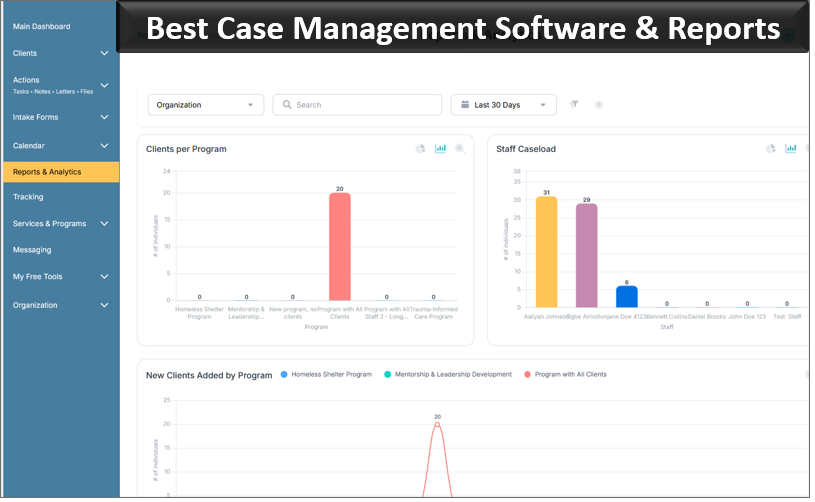
Note: Content on this website (socialworkportal.com) is copyrighted and protected under applicable copyright laws. Unauthorized reproduction, distribution, or use of any content from the website, without explicit written permission, is strictly prohibited. Read: Terms of Use.
Social Work Portal Disclaimer: Social Work Portal is not a social work agency and we do not refer social workers. This web site is provided for educational and informational purposes only and does not constitute providing medical advice or professional social and healthcare services. The information provided should not be used for diagnosing or treating a health problem or disease, and those seeking personal medical advice should consult with ... Read our full disclaimer here: Social Work Portal Disclaimer.